Diner Theology

coffee-cup-2830904_960_720

I love eating in diners. You how to tell if you are in a good diner? Your coffee cup is never empty. There is always a waitress coming by to fill it. You get to half a cup and this friendly voice says, “Hon, you want more coffee?” And your cup is full again.

I recently preached a funeral for one of the street people who was a part of our church. I knew a lot of his friends from the streets would attend, as well as members of our church, who are run of the mill Presbyterians. I had chosen to preach on the Luke passage where Jesus reads from Isaiah:

“The Spirit of the Lord is upon me,
because he has anointed me
to bring good news to the poor.
He has sent me to proclaim release to the captives
and recovery of sight to the blind,
to let the oppressed go free,
to proclaim the year of the Lord’s favor.”

I knew how to aim this at the street people who were at the service. I wanted them to know that Jesus was on their side. But how would the church members take it? “Didn’t Jesus come for all us” I could imagine hearing. “Are you saying these people are somehow special? Didn’t Jesus come to help me too?” How was I going to thread this needle? Yes, Jesus did come for all people. But there are these pesky parts of the Bible where he indicated he came especially for the needy.

Then I stumbled onto diner theology.

In a diner, the waitress comes to fill empty cups. If your cup is full, she does not need to serve you. But if it is early in the morning, and you are not used to being out that early, and you are pretty sleepy, not yet awake, and your coffee cup is empty, a good waitress will come fill your cup.

So, in the diner of life, it’s not a coffee cup, it’s your heart. And instead of coffee, it’s love. We go through life and our hearts get wounded or broken–it can happen in a thousand different ways–and up comes Jesus, saying, “Let me fill that heart for you. Looks like your heart is running low. Looks like you are about out of love. Let me fill that heart for you.” My friend Jesus goes to the broken hearts, and he tries to fill them with love. And because I’m one of Jesus’ friends, he says to me, “You know, there are a lot of broken hearts out there. Why don’t you help me try to fill them. I need your help on this.” And because Jesus is such a great friend, I try to help him. The church tries to help him.

When you are trying to fill hearts with love, you run into two problems. The first is that people put their hands over their cups and say, “No thanks. Don’t need it.” If the waitress was determined to fill the cup, and poured coffee on their hand, she would actually burn the person with hot coffee. That’s not a good idea. It is hard to pour love on someone who does not want it, or worse yet, has no cup to hold it. We don’t ignore that person. We still try to help them. But it is harder.

When someone says they don’t to be loved, there is nothing you can do about. There is nothing my friend Jesus can do, except wait until they are ready to be loved.

But there is a second problem, a much bigger problem. Imagine a diner where the waitress comes to the table, and one cup is almost empty and the other is full. And imagine the person with the full cup is well dressed, looks like they have some money, and the person with the empty cup looks kind of shabby, like maybe they have been sleeping on the streets. And the waitress goes to the guy whose cup is already full, and pours in more coffee, and ignores the guy whose cup is empty.

When Jesus says he came to preach Good News to the poor, release to the captives, help the blind see, and free the oppressed, he is saying that he came to fill the empty cup. Its not that he doesn’t care about the person with the full cup. But the empty cup needs to be filled. As Jesus said, in Mark 2:17, “Those who are well have no need of a physician, but those who are sick; I have come to call not the righteous but sinners.”

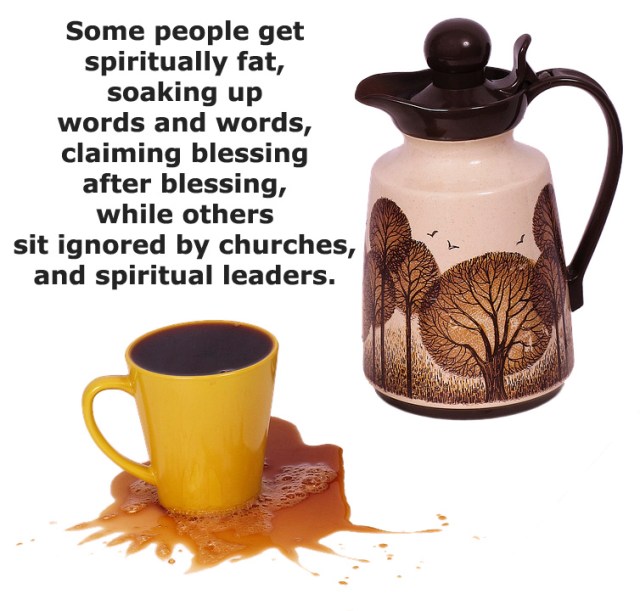
Jesus goes to the empty cup. And that is what he calls us, his friends, to do. But too often the friends of Jesus spend more time filling cups that are already full, and not enough time filling empty cups. Coffee runs all over the table, spilling around empty cups, which remain empty and ignored.

Some people get spiritually fat, soaking up words and words, claiming blessing after blessing, while others sit ignored by churches, and spiritual leaders. This is not the way of Jesus. Nor should it be the way of the friends of Jesus.

Perhaps it is understandable. We see the empty cups and we think, “I don’t have enough love to share. I barely have enough for myself.” The thing is, love is one of the few things that, the more you give it away, the more you have. Because our friend Jesus is always coming around to us, saying, “Your cup looks empty. Let me fill it for you, so you can fill the cups of others.”

In a good diner, the cup is never empty. The major difference between a diner and a church, is that Jesus tells us that we are both waitress and customer. Jesus serves us, but then calls us to serve others. After he washes his disciples’ feet, he says, “So if I, your Lord and Teacher (i.e. waitress), have washed your feet (poured you a cup of hot coffee), you also ought to wash one another’s feet (fill each others’ cups).  For I have set you an example, that you also should do as I have done to you.” 

Too often we think of the Church as a posh social club for Christians. Better to think of the Church as a diner, where we all serve one another.
 

Posted in Church, Compassion, Jesus, ministry, Mission, Musings, Poor, Social Justice, Social Ministry, Spiritual Growth, spirituality, Wealth | Tagged , , , , , , , , , , | Leave a comment

A Holy Yielding


yieldThis is a piece I wrote in 2008, after doing a workshop for the Quaker national gathering. At the time I was worshiping at a Quaker meeting, and considered myself to me more Quaker than anything else. I spent three good years as part of a Quaker community before I felt the calling of the Presbyterian Church, the church of my youth, the church I had serve in as pastor. 

Last April, I was asked to lead a workshop for the Gathering this past summer. I had not planned on attending, and certainly had not planned on taking on a leadership role. But the person who asked me said the organizers wanted several options for workshops on the Bible, and they only had one. Since I teach a Bible survey class at University of Alaska, I was asked if I would design and lead a workshop that was somehow related to the Bible.

It was an opportunity—a divine opportunity. I didn’t really give it a lot of thought, but decided I would yield to the opportunity and started making plans. Living in Alaska, attending the Gathering was a pretty expensive proposition for me, but for some reason it seemed I should make the effort.

I was given a lot of leeway as to what kind of workshop to offer. “Something on the Bible” was my only guideline, and so I decided to do it on something I had never taught before, but that interested me greatly—how to use the Bible as a tool for spiritual growth. I called it “A User’s Guide to the Bible,” and I was really interested to see where this topic would take me. Since I had never led a workshop at Gathering before and really didn’t know what to do, I tried my best to be prepared for whatever situation arose. I planned each day’s activities, and I made handouts for a variety of exercises we could do during the week.

At our first meeting on Sunday, I found that about half the group was composed of lifelong Quakers and the other half were spouses of Quakers, who identified themselves as being primarily Presbyterian, Methodist, or Anglican. Some were clearly theists, and some were clearly not. Some knew a lot about the Bible (a few knew more than I did), while others were beginners at reading it.

It looked like a daunting group to lead, and I was feeling pretty spooked about how the rest of the week would go. But I ran into three different people from my meeting who all gave me the same basic affirmation: do what you do best, and use your gifts. I took this to mean that the challenges I saw were just another divine opportunity to use my gifts and talents for spiritual growth—my own growth, and the growth of others.

The class did not go as I expected—it went better. Not surprisingly, I suppose, I found that half the lesson plans I made were useless given the situation “on the ground” (that is, in the classroom), as were half of the handouts I made. Each night I took some time revising my plans, and revisions occurred even as I was facilitating the workshop. For example, I had a series of opening exercises, which I figured would take about 30 minutes, but almost all of them ended up taking an hour and a half. It was a very good hour and a half, but an unexpected amount of time that entailed more yielding on my part.

Instead of forcing my agenda on the group, I realized that using my gifts meant being flexible and accepting of the needs of the people who were there. My choice was to do what I had planned to do, in the amount of time I had planned for it, or to yield to the Spirit and see where that took us.

As I yielded, the result was a thing of beauty. On the second to last day, after doing one of the opening exercises, one group member shared that she had gotten exactly what she had come for. She didn’t elaborate, but it was clear that something was working.

Earlier on in the week, on the second day of the Gathering, while I was in the cafeteria—a situation that could best be described as “combat eating,” where around 800 people swarmed into a building designed for 500—a woman I had never seen before walked up to me and said, “You are a healer, right?” I was taken aback, but nodded, and said, “Yes, I am a hospital chaplain.” She then invited me to the organizing meeting of the Gathering Healing Center that afternoon.

Here was another spiritual opportunity, and again I yielded to it. I went to the organizing meeting, and discovered that the person who originally asked me to come—the one who had pointed to me as a healer—had actually mistaken me for someone else. Of all the people she could have called a healer, she happened upon me! It was an accidental encounter that led to a divine appointment and a spiritual opportunity.

So again I yielded, and again the fruits were delicious. For the few people I saw, I happened to have just what they needed. One encounter particularly stands out because the fact that I am an Alaskan and work in the healthcare field was crucial background for the interaction I had with that person. And as often happens, the more I gave the more I received in the process. While healing others, I found real healing for my own soul.

The last days of my trip east were also defined by yielding, but of a different sort. After the Gathering, I took my nine‐year‐old son to Washington, D.C., for a few days. I had things I wanted to do, which mostly involved visiting various art museums. My son had an entirely different agenda. I did manage to drag him to one art museum, which held his interest for all of three minutes, and the rest of the time I yielded to his desires. He wanted to see the monuments, especially the Washington Monument, the Museum of Natural History, and the Air and Space Museum. He wanted to go the Mall and watch people play baseball. He wanted to eat at a hot dog stand, ride the Metro, and play in fountains. All this we did. At the end of our time in the city, I asked him what his favorite part of the trip was, and he replied, “Spending time with you.” The fruit hardly gets more delicious than that.

While I was at the Gathering, I picked up Thomas Kelly’s A Testament of Devotion, which I read while in D.C. The second chapter is called “Holy Obedience,” which I tried to plow through as quickly as possible both because I didn’t feel I needed to read about obedience and because I don’t like the idea of holy obedience one whit. After all, one of the reasons I am a Quaker is because I don’t like people telling me what to do. But I kept getting stuck in that chapter. Apparently the Spirit had something to say to me through Kelly. Instead of plowing onto the next chapters, I read and reread the pages on Holy Obedience, wondering what lesson it had for me.

The lesson became clear as I was sitting in meeting the week after I returned. I was thinking about my experiences at Gathering and with my son, and realized that all this yielding was indeed a form of divine obedience. I always thought of obedience as something that is by nature dreary, dull, and painful. But this was a happy yielding, and the fruits were delicious. Every time I yielded to the divine opportunities, I found blessings upon blessings, and it was surprisingly easy! Kelly writes that when we yield to God we hear ourselves being called Home to feed upon green pastures and walk beside still waters. “It is life beyond the fevered strain” (his emphasis).

I wonder how many spiritual opportunities I have missed over the years because I was too busy or self‐absorbed to notice they were being offered up to me. This year the Gathering was, for me, a time to respond to those opportunities, which led to a many‐coursed spiritual banquet.

As I awoke to return to work on my first morning back, I could not help but think, “What spiritual opportunities will come my way this day? And will I yield to them?” There are days we learn to see the world through new lenses, and my new spectacles are the lenses of holy yielding to divine opportunities.


Posted in Compassion, Courage, Healing, Mission, Musings, Spiritual Growth, spirituality | Tagged , , , , , , , , | Leave a comment

That One Thing…

very-rich-ryruler


I was 17 when I had a faith encounter that changed my life. The story of the encounter was not so dramatic, but what happened immediately after was. At the time I was working in a professional summer stock theatre group at Tanglewood Park, outside of Winston-Salem, North Carolina. I helped build sets mostly, but I also acted in a play, with professional actors, and did lights and sound for some of the productions.

At the time I wanted to go into theater as a profession. I wanted to be an actor, but ultimately I wanted to direct plays. I had been doing community and high school theater for years, and now that I was working with the big boys, I saw that I could hold my own with the pros, and and I wanted to turn pro.

But then I had a life-changing encounter with Jesus Christ, and all that changed. I still loved theater, but I knew that if I were follow that path, my faith was likely to be compromised. The promise I made to myself when I had the faith encounter was I was either going to be all in, or all out. There were too many things I loved that were not helpful for a life of faith, and if I was not all in, I knew these things could put me all out. I was doing the sound and lights for the second to last play of the season, and we were covered for the last play. I decided I would finish my commitment to the current production, and leave after.

The last night of the play I knew I had to tell the theater director that I was leaving. Before the show started he told me he wanted to see me after the play. I dreaded telling him, because there was no way to say what I wanted to say without sounding like a religious kook. “Sorry, I am leaving, but Jesus is calling me to a different path.”

I had no idea what I was going to say. I ran the lights, and the production ended, the cast took their final curtain call, and as I was dimming the stage lights, and bringing up the house lights, I saw the theater director in the wings waiting for me. I really didn’t want to have this conversation, but I knew I had to. There was something deep inside of, perhaps the Holy Spirit, that convinced me I was doing the right thing by leaving this thing I loved so much.

The director took me aside, and said, “I’ve got good news for you. We are going to get an equity card.” If you don’t know what that is, it’s an actor’s union card. You have to have one if you want to work professional theater, and they are really hard to get. And he was offering me one, the very night I was going to walk away from it all!

I thanked him, but in the end I did tell him that I was going to pursue other things. I didn’t say anything about my faith, because I didn’t really know how to, but I did walk away.

I did perform in plays later, but as a hobby. I knew that my life was heading in another direction.

The night I walked away, it was as if I heard Jesus say, I love and I accept you, but there is one thing you lack. Give away your commitment to theater, and come and follow me. And I did just that. And I never really looked back.

#

The young man in this morning’s Gospel lesson was faced with a similar situation.

I have to tell you, he does not come across well in this story, for a variety of reasons.

It all starts with his question to Jesus–What must I do to inherit eternal life?

Being two thousand years removed from the text, we don’t think that question is too strange. Christianity is, at a basic level, about eternal life. When people talk about getting saved, they mean they are saved for eternal life, hopefully an eternal paradise.

However in that context, this is a strange question. Most of the people that come to Jesus with requests have very specific, and very earthly needs. They want to be healed, or they want Jesus to intervene in a family dispute about money, or they want to know when Jesus is going to do his political revolution. Life was hard back then, and not a lot of people had the leisure to sit back and think about eternal life. They were just trying to get through this life!

But not this young man. Apparently he has all he needs for this life. While everyone else is wondering how they are going to feed their families through the winter months, or even how they are going to feed their family tomorrow, he comes asking about eternal life. Who’s got time for that? Well, this man does.

“Good teacher, what must I do to inherit eternal life?”

Jesus’ answer is probably not he expected. First of all, Jesus is not affected by the flattery. No one else in all of scripture calls Jesus “Good Teacher.” They call him teacher, rabbi, but not Good teacher. That has kind of a smarmy effect.

Jesus calls him on that. “Why do you call me good?” He knew the guy was just trying to butter him up. “No is good but God.” Now being the Son of God, Jesus surely has claim to being called good. But there was something about the way this guy did it. It is kind of like when you get a phone call from someone you don’t know, and they start by buttering you up. I don’t know about you, but when I hear that on the phone, I know someone is trying to sell me something.  But Jesus will play his game. He answers the question. “You know the commandments,” he said. “Don’t kill people. Don’t commit adultery, don’t steal.” Jesus rattles off the commandments.

The young man smiles. This is the answer he was expecting. He’s got this down. “Teacher,” he says, omitting the “good” this time, “I have been doing this since I was a youth.” It’s a lock. He has everything he needs in this life, and now he has just heard that he is set up for eternity! He’s about to walk away, but Jesus isn’t finished with him yet. He looks at him. You’ll notice that I have been a little contemptuous of this man.  Not Jesus. Mark tells us, he loved this young man. One thing you lack, he says, with love. One thing. The man listened, sure it would be some small act of kindness he could perform, and maybe, he assumed, Jesus was going to ask him to support him in his ministry. One thing you lack said Jesus. “Get rid of your money. Give it away. You don’t need it. If you are really interested in eternal life, let go of the things that are keeping you nailed down in this life.”

Everyone standing around watching this exchange was shocked. This was the last thing the man had expected to hear. This was the last thing anyone expected Jesus to say.


#

In Fiddler on the Roof, Tevye sings, If I were a rich man…. In the song he dreams of all the things he could do if he were rich. He would build a great house, he would have a yard full of chickens, he would hire many servants for his wife, he would be respected by everyone in the town. But best of all, he sings:


If I were rich, I’d have the time that I lack

To sit in the synagogue and pray,

And maybe have a seat by the Eastern wall,

And I’d discuss the holy books with the learned men

Seven hours every day

That would be the sweetest thing of all

For Tevye, the only way to really grow close to God was to have the time to leisurely read the holy books, instead of having to scratch for a living day by grueling day. This man that comes up to Jesus, has all the time and leisure he needs to pursue the godly life. If anyone can be saved, it is this man. So really, when he came up to Jesus to ask him how he can come into glory in the afterlife, he thought he knew the answer. He was pretty sure that if anyone was going to inherit eternal life, he would. He had inherited everything else he needed in this life–so why not the afterlife as well?

On thing you lack, said Jesus.

#

One thing you lack, said Jesus.

And it was exactly the one thing the young man was not willing to part with.

One thing you lack.

This man did not lack anything. At least not in a material sense. He had probably never heard those words before. “One thing you lack.” He had everything. And ironically, what he had was exactly what he lacked. He thought all his wealth would somehow assure his place in heaven. Imagine how surprised he was to learn it was the one thing keeping him from heaven! Surprised and sad, because the one thing we had to give up was the one thing he could not give up.

If Jesus were to say to you, “You are doing really well in life, but one thing you lack,” what might that one thing be? For some people, God is calling them to give drugs or alcohol, or gambling, or some other kind of addiction. For others, it might be a something else they cling to, something else they think will give them security, and perhaps it does give earthly security, but not heavenly security. We might cling to our dignity, to our possessions, to our ability to get our own way. We might cling to things that seem strange to cling to, like our insecurities, our fears, our anxieties. We might even cling to our notion of what religion is supposed to be, unwilling to let it go even in the face of Jesus’ call to let it go.

We cling to things because we think they will get us through this life. We think they will save us. Letting go of some thing is like letting go of hope.

#

When Jesus told the disciples that the rich would actually have a harder time getting into heaven than the poor, the people were astonished. “If the rich, who have the leisure to do all the things God requires cannot be saved, then who can be?” Everyone knew that the Rich had a much better chance of getting into heaven than anyone else. But now Jesus is telling them different, and if they rich cannot be saved, then who can?

With God, all things are possible, said Jesus. It is not about how much you have. It is not about all the things we do. It is not about being the best person or the most holy person or about the being the person who is in church the most. With God, all things are possible. It is God who saves us, it is God who assures our place in eternity, it is God who acts to save us.

We cooperate with what God is doing. We keep ourselves open to the work of God in our lives. That was what Jesus was doing with the rich young ruler. He was trying to help him be more open to the work of God in his life. But he was ready to do that. Not yet.


#

Sometimes I wonder what my life would have been like if I had ignored that voice in me that said, “One thing you lack–walk away from the theater.” I would certainly not be here today. I would not be a pastor. I would not be doing what I love. I’m pretty sure that my faith would not have survived a life in theater, even if I was able to succeed in it.

In short, had I not walked away, I would have been a poorer person. I did walk away because I wanted to be a pastor. I had no idea what I wanted to be, but I was pretty sure that I did NOT want to be a pastor. I walked away from theater with no idea what I was walking toward. Well, that’s exactly true. I knew I was walking toward Jesus. And they say if you take one step toward Jesus, Jesus takes three steps toward you. That has been my experience in the 43 years since that night.

Sometimes I have wondered what my life would have been like if I had ignore that voice, but I have never regretted what I did that night. If the young man in the story had heeded Jesus’ voice, I think he would have found himself a richer man. There are times when God calls us to some hard things. But in the end, those hard things lead to an easier life of faith.

Amen.

Posted in Jesus, Preaching, Salvation, Spiritual Growth, spirituality, Wealth | Tagged , , , , , , | Leave a comment

wrestling with the Word


It has been a little quiet here the last few weeks. I have been busy doing the editing on a book of sermons, and it has just come out! It is published by Parson’s Porch Press, and is available on-line at Amazon or Barnes and Noble. You are also order directly from Parson’s Porch (https://www.parsonsporch.com/presbyterian-books/wrestling-with-the-word-thomas-murray-richmond-iii).

They did a wonderful job with the printing. It has taken up the bulk of my spare time these last few weeks. I’m sorry for the drop off in posts on here.

It was an interesting experience. You might think a book of sermons would be pretty easy, but I had to choose which ones I wanted to include, and then edit them for book form. The editing took the better part of four weeks!

Thanks to the Redhead, my wonderful wife, for supporting me in all this, and to Jaye Wheeler, who helped me edit.

If you want a signed version of the book, you can message me here on at my author page The Still Point (https://www.facebook.com/thestillpoint3/) and I will be glad to send you an autographed copy. The cost is $18.95, and you can paypal me the money.

Thanks for reading. More posts to come!

Posted in Uncategorized | Leave a comment

A Global Faith

2015

This sermon was preached on World Communion Sunday. 

In the early 1970s the government of Peru did an extensive survey of their population, to find out how they could best serve their population. Some of the results were really puzzling, especially from the rural regions. One question in particular had a confused set of answers: “What are the major problems with Peru?” They did a follow up survey to see if they could find out what the problems were, which contained the question, “What is Peru?” To their surprise they learned that many of the people in the rural Andes had no idea what Peru was! They knew they were Quichua, the Incan tribe that populate the mountain regions, but they had no idea they were Peruvian.

Borders are a relatively new innovation. In the ancient world most borders were geographical features–rivers, mountains, or islands that naturally defined a region. Occasionally the Romans would put up walls, which acted as de facto borders, but that was more to keep invaders out than to define a nation state. Tribes would inhabit regions, but those regions had few if any borders. The Hausa and Fulani nations in Africa were spread throughout central Africa, and you might have a Fulani settlement right next to a Hausa village. Often the only border between peoples was their language. In medieval Germany for example, there were regions that were defined by which German dialect they spoke. You can find this even today. The people in Bonn spoke a German called Bunch, and it Kolne they spoke a dialect called Kolsche. Princes and kings had territories, which were defined loosely by who owned the serfs who worked there.

Italy became a nation state in 1861, and Germany did not follow suit until 1871. Almost all the borders in the Middle East came into being after World War I, almost arbitrarily drawn by the League of Nations. Iraq, for example, was established, with almost no thought to the Kurdish regions, or the fact that the country had interspersed in it both Sunni and Shi’ite regions. It was cobbled together like a mule, and then recobbled after the first set of borders did not work, and then recobbled again after WWII. African borders were mostly drawn by the people who came in to colonize the continent. They wanted to establish their territories, but they had almost no regard for the different tribal groups who lived there.

#

When we think about the Kingdom of God, a central theme in Jesus’ preaching and teaching, we may default to thinking of it as a modern kingdom, the kind with boundaries, and border guards and all the things that come with being a modern nation state. But in fact we best understand it when think of the Kingdom of God as a place with no boundaries, no borders, no lines saying, “Here it is, but not here.”

The Kingdom of God has no boundaries, and no borders. It is not defined by geography, or people groups, or language groups, or race. It is defined by only one thing–anywhere where any person gives their heart to Christ, there we find the Kingdom. Wherever there is a follower of Jesus, there you will find the Kingdom of God. The constitution of the Kingdom is the teaching of Jesus, and the founding moment was on Pentecost when the Holy Spirit came upon people of all nations, and was extended when the Spirit came upon Gentiles. When that happened, it became abundantly clear that the Gospel of Jesus Christ was intended for all people in all places.

Christianity is truly a global faith. It knows no boundaries. As we sang this morning, Jesus shall reign where e’er the Sun, does its successive journeys run.

The only boundaries of Christianity are the ones we put on it.

#

Being a global faith, Christianity takes on many expressions around the world. I was worshiping in a church in Guatemala back in the 1978. The congregation was building a new sanctuary across the street from the hut where we were worshiping, and I noticed that during the service people would come in, tap someone on the shoulders. The person tapped would get up and walk out, the person who did the tapping would take their place. I found out where they were going when someone tapped me on the shoulder. I walked out and some guys across the street were waving me over. They were working on the new building. So I went over, and they had me hauling bricks from a truck parked out front into the building site. After I had worked about twenty moments, someone told me I was done, and go get someone else to take my place. Working on the sanctuary was seen as a form of worship for them. Oh, and by the way, the worship service lasted three hours.

I was worshiping in Haiti, and during the offering, when the plate went around, several people took the offering plate to the aisle, and stood on it. I asked someone later about that, and was told that if someone did not have money to give, they would give an offering of themselves. When they stood on the plate, they were saying that they were offering themselves to God.

There are as many ways to worship God around the world as there are churches. In Russian, it is customary to have a fence around your church. In Ghana they use banana chips for communion. In German churches they take up the offering as people leave church. Ushers stand in the exits with velvet lined bags, and people put money in them as they depart. But Germany also has the Kirchen Steuern–Church taxes. You pay your tithe when you pay your taxes. And no, you do not get to choose how much you pay.

In most countries they serve wine at communion, and they don’t understand why we use grape juice. I was with a group of Russian priests once in Alaska, and we visited the local Orthodox church in Fairbanks. At the time they did not have a local priest, and the Russian priests found out about it, they immediately wanted to hold a service there on Sunday, which was the next day. I explained to them that we expected them to be in our churches, and had planned around that, and then I said, “Besides, today is Saturday. We can’t get word out so that people will be here.” One of the priests looked at me in amazement, as if I had said the stupidest thing a minister could say, and he said, “You think we need a crowd? You think we do the service for people? We do them for God.”

They were also amazed that I did not wear a clerical collar when I was running them around Fairbanks, or even in worship. “Are you ashamed of being a minister?” they asked. “Why do you not want people to know?”

In short there a multitude of ways that Christians worship Jesus around the world, and sometimes it seems the only thing that holds them all together is the Name of Jesus.

But that is enough.

#

So what does all this mean for us?

First, that Christianity is a lot larger than our conception of it. We have a particular view of the faith here in this country. Other places have a different view of Christianity, with different practices. We do it one way here; other people around the world do it differently. What we do here is not the end all and be all of the faith. It’s just what we do here. There are some things all Christian churches all around the world have in common–celebration of communion, baptism and worship. And there are a lot of places where we are different, where the mores and ethos of the country we are in mold our faith. Few other countries, for example have a song like God Bless America. In some countries faith takes a large back seat in the public life, much more so than in America, and in some places the faith is essentially a national faith. In yet other places, people fight over which faith, or which form of faith will be the majority religion.

It is tempting to think that we are the center of universe, but when it comes to global Christianity, we are not.

The largest Presbyterian church in the world is Myungsung Presbyterian Church in Seoul, South Korea. It has over 100,000 members. The largest church in the world is also in Seoul, the Yoido Full Gospel Church, with 253,000 members. The largest Methodist church in the world is the Yotabeche Methodist Church, in Santiago, Chile with 150,000 members. There are more Anglicans, (Church of England and Episcopalians) in Nigeria than in Great Britain and the United States combined. In fact Nigeria, Uganda, and Kenya each, individually, have more Anglicans than Great Britain and the United States combined. African and Latin American churches are now sending missionaries to the United States and Europe, just as we sent them to their countries 100 years ago.

People who study statistical trends in Christianity all agree–the focus of Christianity is shifting from Europe and the United States to third world countries. The percentage of Christians in Asia, Latin America, and Africa is growing, while the percentage of Christians in Europe and North America is shrinking.

Secondly, what we do here is our expression of the faith. We may have a defined, American way to celebrate our faith, but other cultures have a defined way as well. In Russia, Christianity looks very Russian. In Peru, it looks very Peruvian. In Kenya, it looks Kenyan, in Iraq it looks like an Iraqi faith. Some expressions are much stricter than ours, some are much more tolerant. But what we do here is what we do. The point is not to fight about who practices Christianity the best, but to be as faithful in our practice as we can.

And thirdly, we can learn from the other nations around the world. A fish does not know it is wet. We are often very unaware of how American our particular version of Christianity is. When we see how other people in other countries do it, we can learn from them, and we can teach them. When missionaries first starting going to foreign countries to share the Gospel, they thought they were going to teach, but the longer they were in other cultures, the more they realized they could learn from the people they were supposedly going to convert. What started as a movement to bring a Western Faith to people in Africa, Latin America and Asia, turned into a way Christians in the West could learn from Christians around the world.

And that brings us here today–world communion Sunday.

#

If you look up communion in the dictionary, one definition is, “the sharing or exchanging of intimate thoughts and feelings, especially when the exchange is on a mental or spiritual level.”

That is really what we are doing here today–sharing our intimate thoughts and feelings about faith to all the people around the world. That is why we are coming to this table. It is not a Presbyterian table. It is not a Pacific Northwest Table. It is not an American table. It is the table of the Kingdom of God. Today we celebrate that this table extends, spiritually speaking, across time and space, and into every human heart. Today we celebrate the transnational nature of this table. Today we also celebrate that everything that happens at this table transcends national boundaries, transcends language groups, transcends all borders.

And you are invited here to partake of this international feast.

Amen.

Posted in Church Growth, Communion, Global Christianity, ministry, Mission, Preaching, Sermons, World Communion Sunday, Worship | Tagged , , , , , , , | Leave a comment

The Quality of Mercy

homeless+ministry


Back in the early ’90s I was in the market for a new car, and decided, with a family of four, maybe we needed a mini-van. (It was the ’90s!) I saw a used one for sale, a model I was totally unfamiliar with–and Oldsmobile Silhouette. It was very different from all the other minivans, most of which looked like boxes. The Silhouette had a steeply sloped nose, and looked more like a futuristic space pod, something you would see on Star Trek, than a minivan. I test drove it, and told the guy selling it I needed a day or two to make up my mind on buying it.

The next day I had to drive to Charlotte, NC from Durham, a trip of about 150 miles. I probably saw twenty Silhouettes on that trip. They were all over the place! Up to that day, I don’t ever remember seeing one.

That is a common phenomena. Clearly, I had been seeing them before that day, they just did not register on my radar. You have probably had similar experiences. There is actually a name for it–the Baader-Meinhof Phenomenon. Basically what is says is that we have selection attention spans. We pay heed to the things that are important to us, and we filter out the stuff that is not. But when a new thing comes to our attention, like, say, an Oldsmobile Silhouette, then we start to notice it. We bring that into our attention span, and we don’t filter it out.

We all do that. When I was in Germany, I would learn a new vocabulary word, and then suddenly I has hearing that word everywhere. Before I knew the word, I filtered it out. Once it got into my sphere of attention, then I was noticing it.

I had another significant experience like this, but this one happened when I was in college. I was a member of our campus Christian Fellowship, I read the Bible and did frequent Bible studies, I read tons of books about the Bible, but then, in 1978, I did two things that changed my whole outlook on the life of faith. First, I read a book called Rich Christians in an Age of Hunger by Ron Sider. The book so changed my life, that after I graduated from college, I went to work with Ron for a short while. In the book, Ron goes through many of the biblical passages that call us to care for the poor and needy. The second thing I did was go to Guatemala for a summer mission trip. There I saw the poor and needy up close.

After reading Rich Christians, I could no longer read the Bible and not see all the references to the poor–the widow, the orphan, the immigrant in the land. Nor could I miss how God felt about people who turned a blind eye to the needs of others. It was everywhere I looked. After going to Guatemala, and later Haiti, I could not see the world without also seeing the people who have been traditionally overlooked by people like me.

The words we heard from the first reading this morning, the words of James, are not an anomaly in the Bible. They don’t stand out because they are so unusual. In fact they blend in with the whole biblical message.


All Through the Bible

The message to take care of the poor is a prevalent message that spans throughout the Bible. The word “poor” shows up around 210 times in the Bible, and around 60 percent of those times, it is in the context of taking care of the poor, the widow, and orphan, the traveler in your land. It is about taking care of people who fell through the cracks of the safety net of that day.

For example, in Psalm 72, we find a prayer for the king.

Give the king your justice, O God,

    and your righteousness to a king’s son.

Then it goes on to say what makes a godly king in the eyes of God.

May he judge your people with righteousness,

    and your poor with justice.

3 May the mountains yield prosperity for the people,

    and the hills, in righteousness.

4 May he defend the cause of the poor of the people,

    give deliverance to the needy,

    and crush the oppressor.

Then it enumerates blessings for the king.

8 May he have dominion from sea to sea,

    and from the River to the ends of the earth.

9 May his foes bow down before him,

    and his enemies lick the dust….

11 May all kings fall down before him,

    all nations give him service.

And why does the King have all these blessings?

12 For [because] he delivers the needy when they call,

    the poor and those who have no helper.

13 He has pity on the weak and the needy,

    and saves the lives of the needy.

14 From oppression and violence he redeems their life;

    and precious is their blood in his sight.

That is not exactly how we judge our leaders today. In Israel, the king was first and foremost to the keeper of God’s law. He was to act according to God’s standards. We have a secular government today, so perhaps it is unfair to judge a city councilman, or a Representative or Senator, or even the President by what God demands of the king of Israel. But we can see here what is important to God. And, for our purposes here in the Church, which is the representative of the Kingdom of God here on earth, we see what God is calling us to do, what will make us great in the eyes of God. And what displeases God.

In the book of Genesis, we read the story of the destruction of Sodom and Gomorrah. What was their sin? Why did God destroy them? The answer may not be what you think. In the book of Ezekiel, the prophet tells why God destroyed those cities:

49 This was the guilt of your sister Sodom: she and her daughters (Gomorrah] had pride, excess of food, and prosperous ease, but did not aid the poor and needy. 50 They were haughty, and did abominable things before me; therefore I removed them when I saw it.

James has some sharper words in his letter. In Chapter Five we read:

Come now, you rich people, weep and wail for the miseries that are coming to you. 2 Your riches have rotted, and your clothes are moth-eaten. 3 Your gold and silver have rusted, and their rust will be evidence against you, and it will eat your flesh like fire. You have laid up treasure for the last days. 4 Listen! The wages of the laborers who mowed your fields, which you kept back by fraud, cry out, and the cries of the harvesters have reached the ears of the Lord of hosts.

By the way, Upton Sinclair read that passage to a convention of pastors and attributed it to Emma Goldman, an infamous anarchist of the time. The pastors voted that whoever wrote this should be expelled from the United States.

“The Poor will always be with you” 

What about Jesus’ word, “… you always have the poor with you?” Let’s look at that. Jesus says this a few days before he is going to be arrested and crucified.  His time with the disciples is coming to an end, and while he is with them, a woman comes up to him and pours a very expensive anointment on his head. (That was considered an honor back then, not a form of harassment!) The disciples talk about how that is a waste of money, and the money it costs for the anointment could be given to the poor. It is at this point that Jesus says,  “… you always have the poor with you.”

Some people take this to mean that Jesus is saying, “It is useless to help the poor. There will always be poor people, and you really cannot do anything about it.” But let’s look at the quote. “For you always have the poor with you, and you can show kindness to them whenever you wish; but you will not always have me.”

Jesus is not making a fatalistic statement about the poor. He is not saying, “There’s poor people everywhere, there will always be poor people, and there is nothing you can do about it.” He is saying, “There is always an opportunity for you to help poor people. And you are right to do so. But I’m going to be gone in a few days, to take advantage of having me around as long as you can.”

Now it is also possible that Jesus here is quoting a verse from Deuteronomy (15:11): There will always be poor people in the land. Therefore I command you to be openhanded toward your fellow Israelites who are poor and needy in your land.  Both Jesus and the writer of Deuteronomy see poverty as a chance for people to do good. We may always have poor people among us, and that just means we have that many chances to care for them.


Two Extremes

There are two dangers whenever anyone talks about the biblical mandate to care for the poor. The first is to ignore it. It’s one thing to lay aside something in the Bible that you don’t understand. It is quite another to deliberately ignore something that is very important to God.

But I don’t want to dwell on that, and I will tell why a little later.

The second danger is to overemphasize the biblical mandate to help the poor, and make it the standard by which everything is judged. “How can you have such a nice, big sanctuary when there are hungry people in the world. How can you have such an expensive organ, when there are people sleeping on the streets of Medford?” In other words, “How can you enjoy yourself when there are people who are suffering?”

The answer to that is simple–having a ministry to the poor is not the only thing we are called to do. When the woman poured the ointment on Jesus, he accepted it. When we gather here to worship Jesus, when we sing to the beautiful sounds of this organ, when we meet together in fellowship, we are also doing the work of God. If you look carefully at the passage in James, it is clear there are rich and poor in the church. His problem is not that there are rich people there–it is how the rich people treat the poor. In the passage I read earlier about how the rich will have their wealth rot on them, the reason is not because they have wealth; it is because the use their wealth to oppress the poor.

There are a host of thing the Bible calls us to do: worship, fellowship with one another, prayer, study, evangelism, stewardship, taking care of each other, and taking care of the poor and needy. All of these things are important.


A Pat on the Back

I want to end on a very personal note. As I said, these issues have been important to me since my college days. I have struggled with them since the 19070s, and I have worked to help others understand them since I was ordained, almost thirty years ago.

In all that time, I have never been a member of, or been a pastor in a church that took the issue to help the poor and needy as much as this church does. I have never served a church that did as good a job as this church in feeding the hungry, and opening our doors to the needy. When the James passage was read this morning, I hope you thought as I did; THAT IS NOT US! I have seen you welcome all people to this place since I have been here. And you do so with grace and dignity.

In this community we are known for a couple of things; our music program, especially the organ, choir and our Jazz vespers. That is good. But we are also known as a church that helps people.

If I were preaching this sermon in another church, odds are very good that at the end I would say, “And we need to do this here! We need to be more open, and more engaged with the poor in our community.”

But not here. No. Here I am saying, “You are phenomenal! James tells us not to discriminate against the poor, and you take that seriously!

We live here at ground zero when it comes to issues involving the poor, the homeless, people who suffer from food insecurity. It is a challenge, one that you have met “energy, intelligence, imagination and love.” We house the largest food bank in Jackson county. We give away around 300 free bag lunches a week. Our Wednesday Night Live program serves children who may not fit into traditional youth groups. During the week our doors are open to those in need. We walk with people who need someone to walk with them.

We care. Not just about the people who can benefit us. We care for all.

I know this is hard. It is easy to say, “God wants us to care for the poor,” but the poor are individual people, many of whom come with a host of problems. Not everybody appreciates what we do here, and that includes some of the people we help. It is a hard task, but you handle it with grace and love.

In a parable, Jesus says that at the end of all things, people will be sorted out. On one side, he says, are those who fed him when he was hungry, who gave him something to drink when he was thirsty, who visited him when he was lonely.  Jesus welcomed those people into paradise. There was another group in the parable, a group that did not fare so well, but I don’t need to talk about them, because you are not those people.

I want to close with this, words from Jesus that I want to say, on His behalf, to you today.

“Well done, good and faithful servants.”

Amen.

Posted in Compassion, Micah 6:8, ministry, Mission, Musings, Poor, Preaching, Social Justice, Social Ministry, spirituality | Tagged , , , , , , | Leave a comment

There’s No Place Like….Where’s Toto?

WizardBallon


We are almost at the end of our journey on the Yellow Brick Road. Today we will learn how Toto, the mythic Trickster, helps Dorothy see what life is all about.


 Romans 8:28-30

28We know that all things work together for good[a] for those who love God, who are called according to his purpose. 29For those whom he foreknew he also predestined to be conformed to the image of his Son, in order that he might be the firstborn within a large family.[b] 30And those whom he predestined he also called; and those whom he called he also justified; and those whom he justified he also glorified.

Luke 17:20-21

20Once Jesus was asked by the Pharisees when the kingdom of God was coming, and he answered, “The kingdom of God is not coming with things that can be observed; 21nor will they say, ‘Look, here it is!’ or ‘There it is!’ For, in fact, the kingdom of God is among you.”


Alfred Hitchcock was asked in an interview why one of his characters in the movie The Birds, walks upstairs into a dangerous situation, instead of fleeing a house that had clearly been ravaged by the killer birds. The motivation was simple, said Hitchcock. I wanted to make an interesting movie. If she had just fled the house, that would have been boring. By making her walk up the stairs, I was able to build tension, which made The Birds a better movie. Really good movies have to have some kind of creative tension. In a romantic comedy, the couple has to have something that keeps them apart before they can finally get together. A movie about a couple who meet, fall in love, get married and live happily ever after is a pretty boring movie. But a movie about a woman who saves the man of her dreams on a subway platform, and who is mistakenly identified as his fiance while he is in a coma, only fall in love with the man’s brother while he is in the coma–that is an interesting movie.

If the flying Eagles had been able to carry Frodo to Mount Doom to destroy the One Ring of Power, without him having to make the arduous journey through enemy infested lands, the Lord of the Rings would have been a short, boring book, and an even more boring movie.

If Luke Skywalker had a tearful, father/son reunion with Darth Vader at their first meeting, Star Wars would have been an unsuccessful, one movie run, instead of a blockbuster multi-movie franchise. If Jennie had realized early on that Forrest Gump was the kindest man she would ever meet, and married him in college, none of us would ever had heard the name Forrest Gump. If Tom Hanks could have helicoptered to where Private Ryan was, Saving Private Ryan would be ultimately forgettable.

Or, if the Good Witch Glinda had told Dorothy when she first met her that all she had to do to get home was to click her heels, the Wizard of Oz would have been much shorter, and I never would have based a sermon series on it!

It is often the tension, the conflict, the setbacks, the obstacles and the challenges that make a movie, a book, or even a piece of music interesting. There is a reason an album of lullabies is not going to sell as well as a recording of Beethoven’s Ninth symphony.

While not to the same extent, this is true in our lives as well.

#

Last week I talked about the Flying Monkeys–the bad things that happen to us. Natural disasters, like earthquakes or hurricanes, illnesses, such as cancer or mental illness, or life events, just as losing your job are examples of flying monkeys. Anything bad that happens to you is a flying monkey. The presence of the flying monkeys were bad for the Scarecrow, the Tin Man and the Lion, and the presence of things like natural disasters, illnesses or life crises are flying monkeys for us. But I said last week that not all bad things that happen to us are flying monkeys. Some of them are the work of Toto.

Toto, I believe, is the trickster hero of the Wizard of Oz. A Trickster is the character in a story who upends the conventional order. The trickster is the one who makes the story interesting. Whether it is Loki in Norse myths, Anansi in the Caribbean, the Raven in Native Alaska stories, the Coyote in Native American stories, especially of the tribes around the Pacific Northwest and the plains, or Brer Rabbit, in African American stories, the trickster thwarts authority, turns things around, and is often seen as a creative and creator force. Raven is responsible for bringing light into the world in Tlingit stories. Coyote steals water from the Frog people, so the rest of the world can enjoy it.

In the Bible, Jacob is a trickster. His name literally means, “pulls your leg.” He tricks Esau out of his birthright, and Laban out of his sheep. Because of the incident with Laban, he has to get the heck out of dodge, and because of that, ends up wrestling with an angel, or God, and receives the name Israel. It is the children of Jacob who become the twelve tribes of Israel–the twelve children of Jacob, now known as Israel.

There is a sense where even Jesus is a trickster. Time and time again he upends the authority of the Pharisees, and after he is finally killed, he pulls the ultimate trick, rising from the dead. In one story, the Gospel of John, the Pharisees and religious establishment is trying to discredit Jesus, who goes and heals a blind man. The blind man is running around saying “Jesus healed me,” while the Establishment is saying, “This man is up to no good.” At one point they even try to get the man to say he wasn’t blind, or that the man who healed was a very bad man, to which the formerly blind man says, “I don’t know anything about that. All I know is that I used to be blind, but he healed me, and now I can see,” leaving the establishment with the proverbial egg on their faces.

Without tricksters a lot of stories would be a lot less interesting. But the problem is, tricksters cause problems for other people in the process of making the story interesting.

And this is where Toto comes in. How does Dorothy end up in Oz? Why isn’t she down in the storm cellar with Auntie Em and Uncle Henry? Because Toto bit Miss Gulch. He then escapes from her (a perfect trickster action), goes back to Dorothy, who runs away to keep Miss Gulch from coming back and getting him. Were it not for Toto, there would be no story.

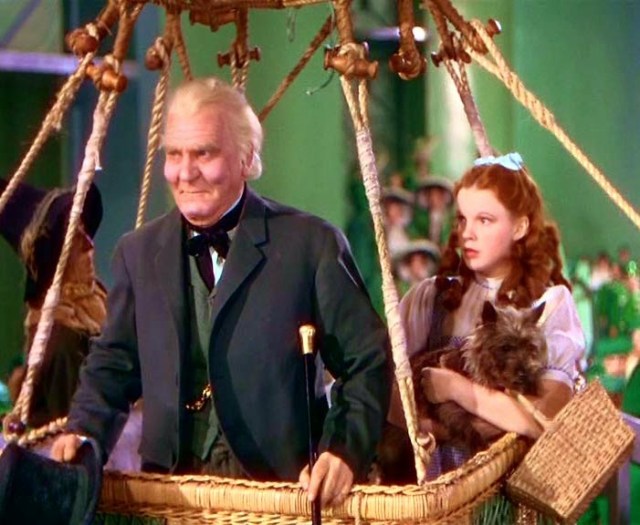
And how does Dorothy learn that “There’s no place like home?” How does she learn that home is in her heart? She is in the balloon with the Wizard, ready to travel back to Kansas, and Toto sees a cat, jumps out of the balloon, and Dorothy jumps out to get him, just as they are releasing the balloon for its journey. She could have taken the balloon, but then she would have learned the true lesson that Oz was teaching her.

#

Toto does two things that look really bad. It is because of him that Dorothy is blown away from Kansas, and it because of him, that she missed her ride back. That may look like the work of flying monkeys. But it’s not. Its’ the work of Toto, the Trickster.

There are things that look like flying monkeys, but they are really Toto events. Take losing a job. The psychologist Karl Jung used to say, when a client informed him that they had lost their jobs, Jung would say, “That’s great!” Why? Because he knew that if someone was stuck in life, often the only thing that can get them unstuck is a radical shift in the situation. It may look bad at first, and it may actually be bad at first. When Dorothy landed in Oz, one of the first things she learns is that there is now a wicked witch who wants to kill her. That’s bad. The trip down the Yellow Brick Road was not all fun and games. But it changed her life, and changed it for the better.

Losing a job can change your life, and there is perils in that. But the possibility exists that it will change your life for the better.

I had a parishioner who lost his job. He had screwed up at work, and they fired him. This was in October, 2008, and he told that every morning he woke up and heard the latest unemployment statistics on the news, and that scared him to death. He was afraid he would lose everything. He had to make drastic cuts in his lifestyle. His kids had almost no Christmas that year. He had to sell a car to make his mortgage.

But he did find a new job. And it was his dream job. He never would have quit his previous job, which he told me he really hated, especially in that economy. Had he not been fired, he would still be doing that job today. But he was fired, and he had to make a change. And in the end, it was a change for the better. Losing his job looked like a flying monkey at first, but in the end it became a Toto event.

I have heard it said many times that an alcoholic, or and addict has to hit bottom before they change. Hitting bottom can be a flying monkey. Hitting bottom may mean you lost your car, your house, your family, your dignity, your self-esteem, but often hitting bottom is the only thing that can get someone to change destructive behaviors.

Divorce can look like a flying monkey. Someone who used to love you walks out on you. But more than once I have a divorced person eventually bounce back, find someone they really love, someone who really loves them, and now they are happy. Or better yet, they learn to love themselves, and can be happy with who they are. Sure, there are countless nights of loneliness along the way. Toto events can look catastrophic. At first. But sometimes they are the only thing that can change us. They are the only things that can get us unstuck.

This is not to say that all flying monkeys can turn into Toto events. Sometimes it starts and remains a flying monkey. Sometimes the disaster can undo us. But the Biblical witness points us to resurrection. In the Romans passage we heard this morning, it says, “We know that all things work together for good for those who love God, who are called according to his purpose.” Now the “all things” in that passage really means all things. It means good and bad things. This passages does not say that all things are good. It says all things can work together for good.

Paul also says, in his second letter to the Corinthian church, “We are afflicted in every way, but not crushed; perplexed, but not driven to despair; persecuted, but not forsaken; struck down, but not destroyed.” Afflicted. Perplexed. Persecuted. Struck down. Those things happen. But in spite of them, we are not crushed, we are not driven to despair, we are not forsaken, we are not destroyed. When someone is grieving I often say, “You may never get over this; but you will get through this.

Part of what can turn a flying monkey into a Toto event is our attitude toward it. Part of it is the support we receive from family, friends, and our church. Those things cannot always turn a flying monkey around, but they are important if we are to turn it around. This is not work we can do on our own. Dorothy needed Toto to get to Oz, but she also needed the friendship of the Scarecrow, the Tin Man and the Lion–and especially the Good Witch of the North, to see this the situation for what it really was–an opportunity for growth.

#

If there is one overall message from the Wizard of Oz, after seven weeks of preaching about it, it is this–we have within and around us what we need to make our way through this life. It is obvious from the get-go that the Scarecrow is the brainiest of the bunch, and the Tin Man has a deep heart for others. It is less obvious with the Lion, but even he had within him the courage to do what needed to be done when the time came.

Jesus said, “The kingdom of God is not coming with things that can be observed; nor will they say, ‘Look, here it is!’ or ‘There it is!’ For, in fact, the kingdom of God is among you.” It is within you. The Greek word ἐντὸς is often translated as “In your midst,” or “Among you.” The word only appears twice in the New Testament–once in this passage, and once in Matthew where Jesus says that you have to clean the inside of a cup to make it clean. The word he used for inside the cup is the same word he uses for where the kingdom of God is–it is inside of you. It is inside of us. We don’t need to go looking for it, although often we will. But it is here. Now. In us.

The thing is, sometimes we have to go a long way to find what is already in our own back yard. In his letter to the Philippian church, Paul writes (Phil. 2:12-13): …work out your own salvation with fear and trembling; 13 for it is God who is at work in you, enabling you both to will and to work for his good pleasure. We have to work things out while God is at work in us. That is the whole idea behind a spiritual journey, which is what this whole sermon series has been about. On the one hand, we move from one place to another. It’s a journey. That is us working out our salvation. On the other hand, God, whom we seek in this journey, is with us the whole way.

If Dorothy had woken up one morning and said, “You know, I think there is no place like home,” that would not only make for a bad movie, it would also be unrealistic. The fact is, we have to struggle for some things. There are things that should not come easy. When I have done counseling with people, there are times when I can see clearly what their problem is. But if I tell them, “You clearly have some issues regarding intimacy,” or, “You are still working out the problems you had with you older brother,” or whatever, it can short circuit the process. I might say that, the person would say, “Ah, I see what you mean,” but they really don’t. It’s not real to them. It is just an idea.

I first learned about God’s love and God’s grace when I was a young child. It was repeated to me over the years. When I committed my life to Christ, at the age of 17, I knew about God’s love and grace. But to be honest, I did not know God’s love and grace. It was all theoretical to me. But later in life, down the road in my spiritual journey, a few things happened to me that made me see, with fresh eyes, what God’s love and grace was all about. I saw it. I felt it. I experienced it. I knew it as a reality, not as an idea.

That is the aim of our spiritual journeys—to put into our hearts and will the things that live in our heads. To make our thoughts a reality. It can take some time to do that. It can take a journey down the Yellow Brick Road. I promised you, at the beginning of this, it was worth the trip. They only way to prove that, is to make the trip yourself.

Go with God.

Posted in Church, Follow the Yellow Brick Road, Musings, Preaching, Sermons, Spiritual Growth, spirituality, Wizard of Oz | Tagged , , , , | Leave a comment

Of Witches, Flying Monkeys, and Munchkins

Munchkins+Wizard+of+Oz


When I mentioned I was doing a series on the Wizard of Oz, I got a very common reaction from people—that movie scared me to death. Whether it was the Wizard, who really scared me, or the Wicked Witch of the West, or the Flying Monkeys, this movie has apparently scared generations of watchers. It has been, in all likelihood, the first scary movie most people ever see.

What makes it scary? That is a hard question to answer. Today scary movies are full of gore. But not so with the Wizard of Oz. Not a drop of blood is spilled in the movie. Ok, so the Scarecrow has his innards tossed all around by the Flying Monkey, but that is straw. No, I think what makes it scary, especially for young people, is that a likable young girl comes face to face with evil. As children we like to think our lives are safe and secure. In an ideal world our parents can protect us from the hazards of the world—witches and flying monkeys and monsters under the bed. When we are scared we run to our parents beds and snuggle up with them, and we are safe from all the beasties and boogeymen of the world.

Of course we know what is not true for all children. Some encounter abuse, some from their parents. Some end up homeless. Some are torn from the parents arms, by social workers or border agents. Some don’t get enough food. In some countries kids are snatched away by roving paramilitary soldiers, who train them to kill at an early age.

Most of us have this idea of a safe and secure world, and if that is upended, we feel our wholes lives are upended.

There were a few scenes that were deleted from the Wizard of Oz, most notably a scene with Dorothy in the Witch’s castle. She has been threatened with death, and is left alone by the witch to wait for her impending doom. That part was in the movie, but they shoot a scene where Dorothy once again sings “Somewhere Over the Rainbow,” but this time is scared, small, quivering voice. I have not seen that particular scene, but I heard the song, and it was heart wrenching. They cut it from the movie because test audiences found it far too disturbing. It was too powerful, too emotional, too sorrowful.

I think it reminded people too much of how cruel and wicked the world can be, nobody wanted to go to movie to see that. The Wizard of Oz was released in 1939. Our country was still in the Great Depression, where hundreds of thousands of people lost their homes or farms. The unemployment rate peaked at 25%. In Europe, Germany was on the march, and in Asia, Japan had invaded China and Korea.

Nobody wanted to go to a movie to be reminded of how dangerous the world could be. And no wonder. Evil is a topic we are quick to avoid.


But, you don’t get two pages in the Bible before you run into a snake in the garden—Evil.

Why does the serpent tempt Eve? There is nothing in it for him, except perhaps the perverse joy of seeing someone else fall. Unlike Satan in Job, this slimy creature does not have a side bet with God about the general condition of humanity. He does not profit from his actions; no time off for good behavior. In fact it leads to a curse upon him. As far as the story goes, he does it for fun, for spits and giggles.

And that is evil.

If I were to steal bread to feed my family I am not an evil person. I am just desperate. But if steal for the fun of stealing, that is evil. Evil serves no constructive purpose. We like to think there is always a good reason for something, even something that appears irrational, even for behavior we call evil. “He did that bad thing because…” But a large part of what makes evil evil is that it serves no overarching purpose. We want to find deep psychological reasons for evil behavior, but often there is none.

On Sunday night, October 1, 2017 a man stood at his window on the 32nd floor of his hotel, and opened fire on concert goers who were attending the Route 91 Harvest music festival on the Las Vegas Strip. He killed 58 people and injured 851. To date investigators have yet to determine a motive. He was not mentally ill, this was not a hate crime, and as far as anyone knows, he was not out to seek notoriety.  (I am not writing his name because I don’t want him to have the notoriety.)

This was a truly evil act. It is especially disturbing because he seemed to have no motive. Maybe he just wanted to see people die, or maybe he was bored. A school shooter in San Diego, when asked why she opened fire on elementary school children, killing two and injuring eight, simply said, “I don’t like Mondays. This livens up the day.” Later, when asked again, she said, “There was no reason for it, and it was just a lot of fun. It was just like shooting ducks in a pond.”

But sometimes evil occurs when we desire the wrong things in the wrong ways. The Witch desired the ruby slippers and she was willing to kill for them. We never find out exactly what kind of power they had, only that they must have been mighty powerful, otherwise the Wicked Witch would not have wanted them so badly. Power is a great corrupter of peoples. Most of our are familiar with Lord Acton’s statement, “Power tends to corrupt, and absolute power corrupts absolutely.”

In the Gospel lesson, Herod, fearing he might lose power, had all the boys two and younger killed in Bethlehem, to make sure a king would not arise there. That is not an unusual historical event.

There is evil in the world, O people. We don’t want to admit it, for if we do, that makes this a scary world, but there is evil in this world. Only the evil here does not have green skin, and does not dress in black and ride a broom. They do not always look like snakes. Evil people do not wear t-shirts advertising their depravity.  Some wear business suits. Some wear uniforms. Some wear Khakis and Docksiders. Some even wear the robes of a minister or priest.

Last week a grand jury document named 300 Catholic priests who had abused more than a thousand children. The Mail Tribune reported on the trial of youth minister who secretly taped young girls taking showers and dressing—while he was leading youth retreats with them!

Evil can reside in bureaucracies, that systemically wear people down, and keep them away from the very services they promise. Evil can reside in good things, like love of country, or love for another person. It is a good thing to love your country, but not if you kill those who do not fit into your definition of a good citizen—not if you want to kill the Jews in your land, or the Hutus, or any other citizen group. Not if you want a false notion of purity. Not if you want to oppress people because of their race, religion or nationality.

Evil is not always apparent. But anytime people are systemically oppressed, anytime the natural way of doing things creates winners and losers, anytime people are ground down and denied the basics of life—that is an evil system. And an evil system can make good people do evil things.

The Nestle company sells many things, including infant formula. Nothing wrong with that—except they market their formula to mothers in third world countries, places where there is no safe drinking water. When I was in Haiti, I saw those advertisements, and the formula in a village that had no safe water to drink. The mothers who feed the formula to their kids, in the hope of giving them something really healthy, are actually giving their babies dysentery. The National Bureau of Economic Research, a pro-business think tank, has determined that in 1981 66,000 babies died from dysentery due to infant formula.

And this year, our country is lobbying to make it easier for these companies to sell infant formula.

That, in a word, is evil.

We can pretend evil does not exist, that there is just good and bad, winners and losers, that good people would not allow these things, but that is evil’s greatest weapon—getting us to believe that evil does not exist.


Not all bad things are evil however.

A serial killer is evil. A hurricane is not. Genocide is evil. Earthquakes are not. Racism is evil. Cancer is not. My daughter used to complain that mosquitoes were evil, but I had to explain to her they were just a part of nature. “They are a bad part,” she said, and she was right, from her perspective.

There is a difference between humans acting badly and nature acting up. A hurricane is a convergence of weather patterns that create a huge storm. An earthquake is the result of tectonic plates sliding against one another. Cancer is abnormal growth of cells in the body. There is no intention behind a hurricane, an earthquake, cancer or any number of medical or natural disasters. From our perspective these are bad things, but only because they mess up our lives. From a moral standpoint they are not evil. A hurricane is not the act of the Wicked Witch of the West. It is just nature doing what nature does.

This is where the flying monkeys come in. They are bad, but not evil. They are monkeys. There are times in our lives when we encounter flying monkeys. They set on the scarecrow, Tin Man and Lion, and tear the scarecrow into pieces. When the Tin Man finds the Scarecrow, the scarecrow says, “My arm are over there, my chest is over there, and my legs are over there,” to which the Tin Man says, ‘Well, that’s just you all over.” (That’s my favorite line in the movie.)

We encounter flying monkeys on a regular basis. Most are minor—the automated phone system that sends you into an endless loop of “Choose number one if,” and what you need is not listed. (OK, maybe that one is evil!) Your refrigerator breaks down just when you finished paying off the car repair bill. The rain storm that hits just when you were planning a picnic.Your cable goes out, just before the big game. The smoke that has descended on our city the last few months.

Some are major—cancer. Getting laid off at work. Losing your home. Death of a loved one.

These things try us. When we encounter them, we learn more of what kind of people we are. We learn what we are made of. And we learn to rely on God.

I wish I could say that life was no more complicated or scary than a children’s book, or entertaining movie. But reality proves me wrong, again and again.

The flying monkeys of life are a part of the terrain. When we encounter them, we can do several things.

We can fold. We can give in. We can quit. That’s not the option I recommend.

We can draw on our inner resources to get through them. That’s great, if you still have the strength. However sometimes the monkeys gang up on us. It’s not one thing, it is a hundred, and we might be able to deal with one, but what we face is overwhelming.

We can draw on the good gift we have in each other. We value self-reliance. We look up to people who overcame difficulties, by sheer inner strength. But sometimes we need help. There are times when we cannot, and should not, go it alone. That is why we have each other. That is why we need each other.

And we can come before God.(Oh no, is it that bad that we have to drag God into this?) Yes, we do. That is where we should start. Next week we will learn that not all flying monkeys are really flying monkeys. Some of them are different. But they are only different to the extent we give our lives to God, and let ourselves be strengthened, molded and guided by God.


Finally that brings us to the Munchkins. I have focused on the bad things that happen to us. I want to end on a different note.

When I was in college, I was in a fraternity—Baseball Kappa. It started as a joke, but got bigger and bigger. We did all sorts of funny things around campus. There was a huge bell tower in the quad, and one year we raffled it off. The winner got a certified deed, and a t-shirt that said, “I own the Belk Tower.” They were doing a lot of building on the campus, and they had to drain the small pond near one of the buildings, so we formed a Dixie Cup brigade to fill the lake. We had fifty people, stretched out from the dorms to the pond, passing water in Dixie Cups.

A friend of mine told me that morning she was walking to class to take a test she had not studied for. She felt really down, but saw the Brigade. “It made my day,” she said. “I still flunked the test, but I felt a lot better about it.”

When I was in high school I took a friend of mine to a formal birthday dinner—at McDonalds. I wore a suit, she wore a prom dress, and a friend of mine play maitre d  and waiter. He went in, set the table with china, silver, and crystal we had borrowed from his mother, and a linen table clothe. He stood by the door waiting until we came in, led us to our table, took our orders, and when it was ready, opened the burgers, placed them on our plates, and poured our drinks into the crystal glasses. He asked if there was anything else we wanted, and I said, “Ahh, Ferguson (his name was not Ferguson, but sounded good), it is the young lady’s birthday. Could you please sing to her?” And he did. The whole restaurant gathered around to watch. Two guys were sure we were all on candid camera, and were pointing to where they thought the cameras were hidden. I am sure they talked about that night for years afterward.

When Dorothy lands in Oz, she meets some interesting and entertaining people—the munchkins. They are adorable! Imagine if you are having a bad day, and suddenly you are surrounded by little people singing about the Lullaby League, der Lollipop Guild,  and declaring the witch was not merely dead, but most sincerely dead. It is the most delightful part of the movie. If only we had munchkins in our life!

But we do.

Sure, there are flying monkeys. There is all manner of ways things can go wrong. But there is also the miracle of random acts of kindness and delight. In story we heard from Ruth, Ruth and her mother in law were essentially refugees—and instead of being met with hostility, Boaz takes pity on them, and offers them kindness. They were vulnerable women, and he protected them, he fed them, and he eventually married Ruth. That little act of kindness changed Israel’s history. For Ruth had a son, Obed; he became the father of Jesse, the father of David. From one act of kindness arose a king.

We probably will not be king-makers with our acts of kindness, but who knows. In any case, we can be kind. We can bring delight to people. We can smile at the downtrodden person taking our order at the restaurant. We can be pleasant to the person on the phone who only hears complaints.

In a world full of evil witches, and flying monkeys, it’s still not that hard to be kind.

Amen.

Posted in Evil, Follow the Yellow Brick Road, Musings, Preaching, Sermons, Spiritual Growth, spirituality, Wizard of Oz | Tagged , , , , , , , , | Leave a comment

A Very Bad Wizard


Wizard_of_Oz

One of my favorite movies is Bruce Almighty.  In one scene Bruce encounters God, who encourages Bruce to pray. Bruce prays. “Lord, feed the hungry, and bring peace to all of mankind.:” he turns to God and asks, “How’s that?” to which God says, “Great…if you wanna be Miss America.”

Chastised, Bruce then prays a real prayer. He tells God what is actually on his heart. He is open with God, honest with God. When he’s finished, God says, “Now that’s a prayer.”

The state motto of North Carolina, my home state is, Esse quam videri, which means, “To be rather than to seem.” I think that should be the motto for every Christian who takes their spiritual journey seriously.  What we are is more important than what we look like.

I heard a story of a pastor who when to visit a woman, someone who had not been to church in a long while, and she was saying that while she was not a faithful church attender, she was a faithful person, and turned to her son and said, “Bring Mommy that book that we all love to read from so much,” and the boy returned, not with the Bible, but with a TV Guide.

One of the hardest lessons to learn in the spiritual life is that God loves us for who are, and not for who we pretend to be. To put another way, the way to a successful spiritual life is desiring to be more spiritual than you appear to be. The way to hypocrisy is desiring to appear more spiritual than you actually are.

To be rather than to seem.

If I were to ask, “What is the most important conversion you can have in a day?” you might answer, “The conversation we have with God.”

To which I say, “No. It’s the conversation you have with yourself BEFORE you speak to God, because in that conversation with yourself, you decide whether you are going to be honest and authentic with God, or whether you are going to meet God with a false face, a mask, an act, a pretense.”

Above all things, God desires our honesty. God desires a relationship with us, not with who are pretending to be. And that takes us to the Wizard of Oz.


When I watched the Wizard of Oz as a small child, I was not as frightened by the Flying Monkeys, or even the Wicked Witch of the West as I was by the Wizard. The huge head, floating over the throne, with flames and smoke surrounding him scared me to death. If I had been there I would have run and jumped out the window with the Lion.

Of course later in the movie we find out that the Wizard is not all that scary after all. He is just the guy behind the curtain. And when the quartet realizes that he is not THE GREAT AND POWERFUL OZ, but just a humbug from Kansas, Dorothy says, “You’re a very bad man,” to which the Wizard replies, “Oh no, my dear. I’m a very good man. I’m just a very bad wizard.”

Maybe he was a very good man, but as far as anyone in Oz knew, he was the Great and Powerful OZ. Except that is not who he really was at all.

In the last few sermons, I have tried to portray who we can and should be as Christians on our spiritual journey. We should all exhibit, to a greater or lesser degree, the brains of the Scarecrow, the heart of the Tin Man, and the courage of the Lion. Now we are moving into different territory. For the next few weeks I am going to be talking about spiritual dysfunctions, about the places we go wrong in our spiritual journey. The first and most common is that we become like the wizard—we appear to be something we are not.

It is one thing to aim at spiritual growth. That is the greatest thing you can ever desire. It is quite another to hope you look more spiritual than you really are. It is bad when we do that with each other; it is even worse when we do that with God.

Over the years I have done a fair amount of counseling and one thing I have noticed is that it can take a long time for people to finally get around to what their real problem is. Now I understand that. We often don’t want to admit to ourselves what our real problems are, much less to anyone else. Much less to God.

Often we feel we have to put our best foot forward for the Almighty. When we feel God is watching us, we want to be on our best behavior. Of course we have be kind of funny about when we feel God is watching us. I was at a parishioner’s house watching the Superbowl one year, and he went to the fridge and got a beer. One of the other people he invited over said, “You’re not going to drink that in front of the pastor, are you?” He said, “I’m going to drink it in front of God; I might as well drink it in front of the pastor too.” We can’t hide anything from God, so why on earth would we think we can fool our Omniscient Creator by trying to be better than we are?

Now there is another way we can be like the Wizard. How many of you remember Leave It to Beaver? Remember Eddy Haskell? He was the kid who was always so polite when he was around parents, and a total brat when he was with his friends. That’s hypocrisy. He wore a mask of politeness when he was talking to the Cleavers, but in private he was a totally different person.

There is a sense where we all do that some extent or another. We have a public persona we wear when we are with other people. Now to a certain extent we have to do that. We don’t have to let everyone know exactly what we are thinking and feeling all the time. And I am not necessarily talking about that.

But I am talking about being ourselves when it counts. And our spiritual life, and our life together here is one of the places where it really does count.


Jesus tells a story about two sons. Both were asked to work in the vineyard. One was honest before his father. “Heck no, I ain’t working in any vineyard today.” The other puts on a good face. “Of course I will work in the vineyard, dear father of mine.”

In that culture, the second son is praiseworthy. He put on the good face, and in that culture, you never disrespect your elders. You always put on your best face when dealing with your father.

But who actually went to the vineyard, and did the work? The first son, and Jesus says he is the one who did his father’s will.

Now Jesus is not interested in saving face. He does not put honor above actions. He is more interested in saving lives and saving souls than in saving face. God wants us to BE rather than to SEEM, even if being is not quite what we want to look like before God.

Now here is the great irony of Church. On the one hand, this is the place where we should be most able to be ourselves. On the other hand, often this is the last place where we feel like we can really be ourselves.

But when Jesus said, I came that you might have life, and life abundant,” he did not mean that we are supposed to have somebody else’s life! He wants us to have our life, the life he gave to us, he wants us to be who he created us to be.

Now Jesus says something really interesting after he tells the parable; “Truly I tell you, the tax collectors and the prostitutes are going into the kingdom of God ahead of you.” Now for the average person in Jesus’ day, those were the LAST two people you would expect to see in the Kingdom of God. Yet Jesus says that they have a better chance than the Pharisees. Why?

Because they were not hiding behind a mask. God was able to see them for who they really are. They were who they were, even if the reality of who they were was not all that pretty.  And because they could admit who they were, they were able to become who God made them to be.

There is a difference between holding things back in public, and being a completely different person in public.  The latter is called hypocrisy. A hypocrite is literally an actor who wears a mask. Who they are and who they pretend to be are two very different people. There is little or no connection between the two.

God accepts us for who we are. We don’t have to pretend to be different.

Now here is the big problem with wearing a mask. No one knows who you really are. I have a friend who builds sets in Hollywood. During one the strikes there, he had a hard time getting work, and I said, “You’re a carpenter. You shouldn’t have any problem finding work. You could do construction or fix things.” And he said, “You don’t get it. I build sets. I don’t build houses. I build things that look like houses. What I build, you cannot live in. You can just pretend to live in it.”

We meet someone, we put up a façade; that is normal. But as we get to know the person, we drop the façade, so they get to know who we REALLY are. If we don’t drop the façade, then they never really get to know us. And if they don’t know us, then deep down, if they like us, we know that all they really like is the façade. I have counseled husbands and wives who both held up facades for years, and eventually they realized they were not loved for who they were, they were loved for who they were pretending to be. And who we pretend to be is NOT who we are.

So here’s one piece of Good News. Before God, you can be who you really are—no matter who you really are. God accepts us for who we are. Before God we can take all the masks off, and be real. God loved the Wizard before he started to pretend he was a Wizard.

We can improve who we are. We call that growth. I am not who I was when I was fifteen. Or twenty-five. Or thirty-five. I am not who I was when I was forty-five. I hope I have gotten better over the years. I hope I have grown. I hope that, in spite of my age, I am still able to mature. Whether you are five, fifty-five, seventy-five, or a hundred and five, there is always room for growth. I know of no perfect people. I have been a Christian minister for more than twenty years, and I still have plenty of room for spiritual growth. As I get older I see parts of myself that I could not see when I was younger.

I said that God accepts us where we are, but God does not leave us there. Yes, God accepts tax collectors and prostitutes, but God does not leave them where God finds them. They do not have to continue to rip off friends, or sell themselves to the highest bidder. They can become saints of God.


The poet Paul Lawrence Dunbar wrote:

We wear the mask that grins and lies,

It hides our cheeks and shades our eyes,—

This debt we pay to human guile;

With torn and bleeding hearts we smile

And mouth with myriad subtleties,

There are times when we all wear the mask that Dunbar describes. And for good reason. Dunbar goes on to write:

Why should the world be over-wise,

In counting all our tears and sighs?

Nay, let them only see us, while

     We wear the mask.

We can hold on that public persona, we can put on our best faces, even if they are false faces, but ultimately it catches up with us. Dunbar’s poem ends:

We smile, but oh great Christ, our cries

To thee from tortured souls arise.

We sing, but oh the clay is vile

Beneath our feet, and long the mile,

But let the world dream otherwise,

     We wear the mask!

In the end Dunbar realizes that when we come to Christ, we can take off the mask. If we cannot be ourselves before God, then we cannot be ourselves. We cannot be the true self God created us to be.

In the Adam and Eve story we heard this morning, after their sin, Adam and Eve looked at each other and realized they were naked, and they were ashamed. They were not ashamed before, but now they are different. They are self-conscious. Adam wonders if Eve notices the paunch at his belly, and Eve is wondering if the fig leaf make her look fat. They want to look like wizards, but in fact they are just Adam and Eve.

And the worst thing is, they are hiding from God. In their shame, they felt alienated from God.

But we know different. We know that God loves us, just as we are. We know that we don’t have to put on a false face for God.We know that God deserves no less than that we be our true selves.

But that is hard.

And we can help each other do that. Going back to the Dunbar poem, did you know he was an African-American poet? He wrote that to describe his experience as a Black man in our country. He did not feel it was safe for his people to be their true and authentic selves, because that was dangerous. If they were who they really were in public, they could get in a lot of trouble, perhaps even killed.

Society did not, and still does not make it possible for many people to be their true selves, to be the person God created them to be. But we in the church need to create that space. We need to create a space where people can feel the acceptance that God has for us. We need to send the message that you don’t have to be a Wizard to be accepted—you can be yourself. It is better to be yourself, because that is who God loves.

And that is how we should love.We love real people, not cardboard saints. We love people as they really are, not people pretending to be better than they are. And we create a community here where people can be their true selves, where they can pray and curse with honestly, where they share triumphs as well as defeats, where they can be joyful, or sorrowful, where they can celebrate their successes, and overcome their failures. Where people can be honest, can be their true selves.

There was a woman suffering from terminal cancer. She only had days to live. One night, God came to her in a dream, and told her she was not going to die, and had many fruitful years ahead of her. The next morning her doctor came in and told her she was miraculously cured.

She felt so good that as soon as she could, she went out, found a plastic surgeon, and had all the cosmetic surgery she could—tummy tucks, face lifts, you name it, she had it.

Soon after that she was crossing the street and was hit by a bus. When she got to heaven she went to God and said, “You told me I had many, many fruitful years ahead of me, but here I am, dead!” God looked at her carefully, then said, “Oh, is that you? I didn’t recognize you!”

Let us be our true selves, for better or for worse, because that is who God loves. Let us live our lives so that the Almighty recognizes us.

Amen.

Posted in Follow the Yellow Brick Road, Healing, Musings, Preaching, Sermons, Spiritual Growth, spirituality, Wizard of Oz | Tagged , , , , , , , , , , | Leave a comment

The Beams of New Oxford Hall

New-College-010

New Oxford Hall

I love a good story, and this is one of my favorites. I first read it in Stewart Brand’s The Next Whole Earth Catalog. It was told to him by the anthropologist Gregory Bateson.

New College, Oxford, is of rather late foundation, hence the name. It was founded around the late 14th century. It has, like other colleges, a great dining hall with big oak beams across the top. These might be two feet square and forty-five feet long.

A century ago, so I am told, some busy entomologist went up into the roof of the dining hall with a penknife and poked at the beams and found that they were full of beetles. This was reported to the College Council, who met in some dismay, because they had no idea where they would get beams of that calibre nowadays.

One of the Junior Fellows stuck his neck out and suggested that there might be some oak on College lands. These colleges are endowed with pieces of land scattered across the country. So they called in the College Forester, who of course had not been near the college itself for some years, and asked about oaks. And he pulled his forelock and said, “Well sirs, we was wonderin’ when you’d be askin’.”

Upon further inquiry it was discovered that when the College was founded, a grove of oaks has been planted to replace the beams in the dining hall when they became beetly, because oak beams always become beetly in the end. This plan had been passed down from one Forester to the next for five hundred years. “You don’t cut them oaks. Them’s for the College Hall.”

Now that is how to run a culture.

The story, unfortunately, is probably a myth. But the power of myth is not that it actually happened. It is true in other senses. Good myth teaches us powerful life lessons. God myth is suitable, in the word of the Apostle Paul, for “teaching, for reproof, for correction, and for training in right living.” i don’t have to believe in a historical Icarus to learn that flying too close to the sun is dangerous.

As a pastor, I know that I have to be thinking about how our church is going to survive five, ten, twenty years after I am gone. Current trends do not offer much hope (although our church is currently bucking current trends).  Part of what I do as a pastor is to assure, as much as I can, a solid future for our congregation. Part of what is do is to plant seeds that may not be harvested until much later, when they are mature, and useful. Part of what I do is to remind us of our past, and the resources we have there, as well as our future, and how we must prepare for it.

I am but a blip in the history of the congregation I serve. (We just celebrated our 133rd anniversary.) If I am remembered 133 years from now, I hope it is because I planted seeds which were able to come to fruition years after I was gone.

Oh, and while we are at it, why not manage our planet this way?

Posted in Church, Church Growth, Intelligence, Mission, Parable, Presbyterian, spirituality | Tagged , , , , , , | Leave a comment