The Temptation of Jesus

Image


There will be a loaf of bread on the table. As I talk about what we give up for Lent, I will refer to the fact that often we are most sorely tempted when we cannot have something. I may only eat pecan pie two or three times a year, and I don’t spend a lot of time wishing I had it, or even thinking about it, but if I gave it up for Lent, THEN I would start missing it! As people see the bread on the table, I will refer to that, and say, “You probably were not thinking about bread before you came into here today, but now you are as you see this loaf. Maybe you are starting to want a piece of it. But you can’t have any, not yet. Now you are tempted. That is the nature of temptation–wanting what you cannot or should not have. In this, you now share something in common with Jesus in His temptation>” 


After the service, the bread will be available for anyone who wants some. 

Posted in Uncategorized | 1 Comment

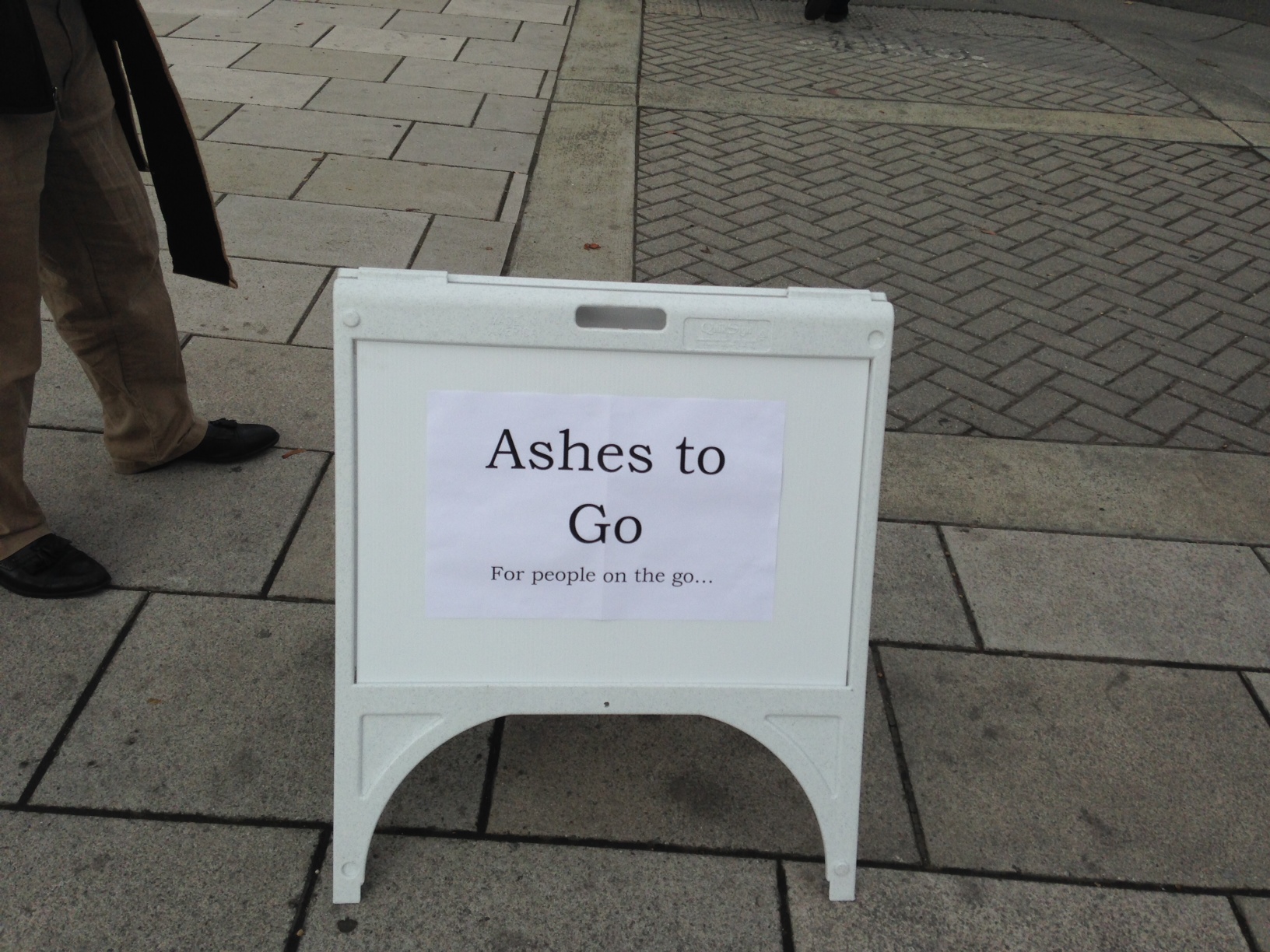
Ashes to Go

Image

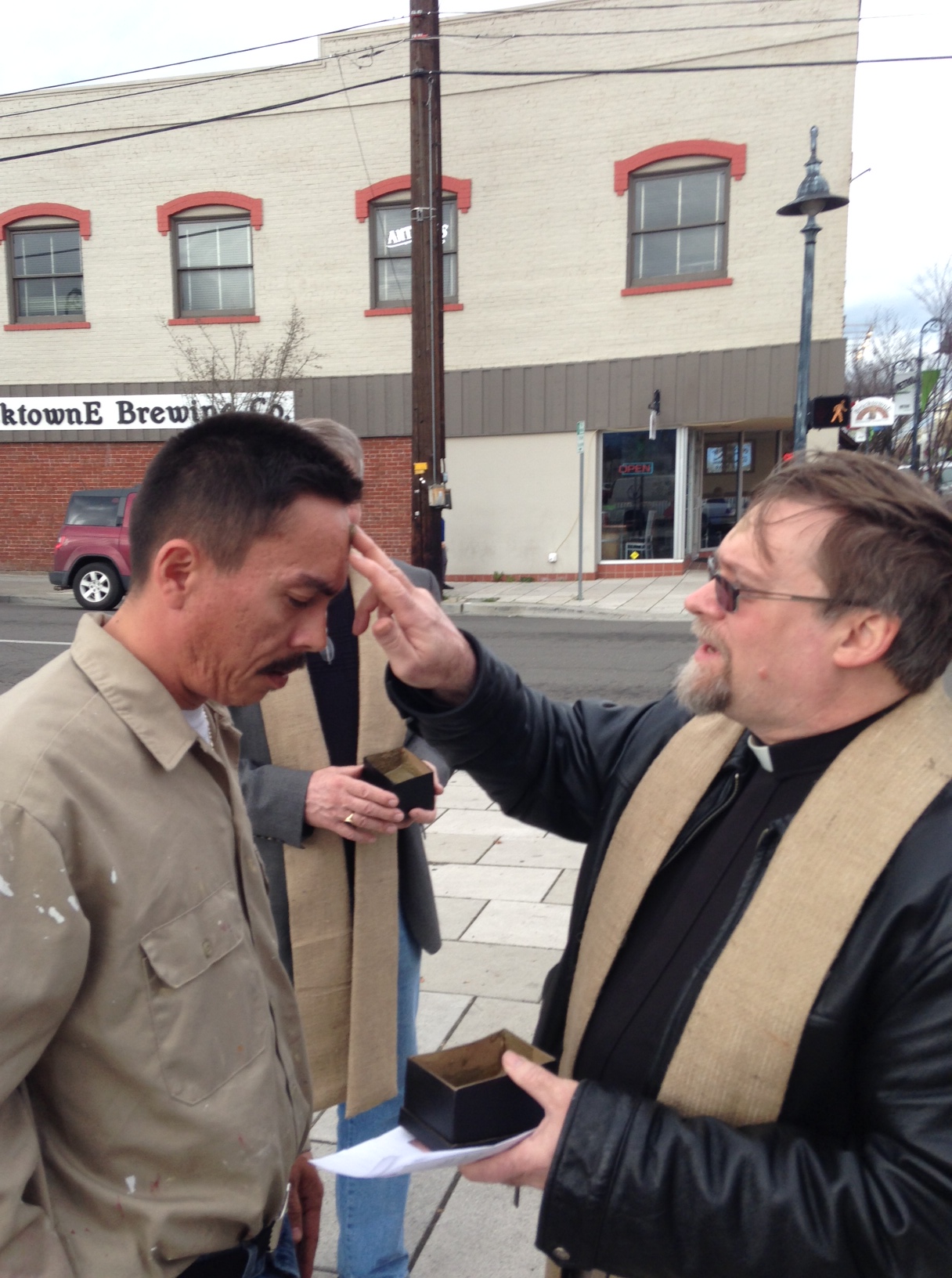
Father Joel, Mike and I hit the streets of Medford for our first Ashes to Go, where we offered the imposition of ashes to anyone who came by. Most people politely refused, but about half asked what Ash Wednesday was. I told them it was the beginning of Lent, and it was the day we reflected on our mortality and our sins.

Image

We reflect on our mortality, in my mind, for two reasons. First, by embracing that we will not live forever, I hope we will be able to get on with our lives. As I grow older, I realize how little time 56 years really is. What have I done with all those years? How many do I have left? What will I do with the ones I have left. Second, when we reflect on how fleeting brief life is, we can be amazed that our lives do mean something–to God and to others. How can we continue to make our lives count?

We reflect on our sins, because only by embracing our sinfulness can we find forgiveness. I learned this both by working in the psych ward at Fairbanks Memorial Hospital (the patients who refused to believe they will ill never got better) and in my own life, as I embraced who I was, warts and all. Amazingly, if we do that, we can truly experience the fact that God loves us, warts and all. God does not just love us in spite of our faults–I believe God loves us through our faults.

Image

As we shared the meaning of Ash Wednesday, we got into some really good discussions with some of the students coming out of Rogue Community College. One in particular was getting ready to do a speech on Mindfulness and Meditation for his speech class, and we discussed mindfulness, Buddhism and Christianity. He talked about Buddhist meditation and shared with him about Ignatian spirituality.

Some people approached us and asked for the imposition of ashes. Others seemed to say, “Sure, why not?” while others thanked us and said they were unable to go to their own churches, but appreciated the chance to be marked on the streets.

For too many years the church has waited for people to come to us. It is about time we started going to the people. It was moving at times, fun at times, uncomfortable at times, but rewarding the whole time.

I cannot wait until next year!

Image

Posted in Ash Wednesday, Church, Emergent Church, spirituality | Tagged , , , | 5 Comments

Walking the Spiritual Labyrinth

Image

EXODUS 24:12-18

12The LORD said to Moses, “Come up to me on the mountain, and wait there; and I will give you the tablets of stone, with the law and the commandment, which I have written for their instruction.” 13So Moses set out with his assistant Joshua, and Moses went up into the mountain of God. 14To the elders he had said, “Wait here for us, until we come to you again; for Aaron and Hur are with you; whoever has a dispute may go to them.”

15Then Moses went up on the mountain, and the cloud covered the mountain. 16The glory of the LORD settled on Mount Sinai, and the cloud covered it for six days; on the seventh day he called to Moses out of the cloud. 17Now the appearance of the glory of the LORD was like a devouring fire on the top of the mountain in the sight of the people of Israel. 18Moses entered the cloud, and went up on the mountain. Moses was on the mountain for forty days and forty nights.


Image

GOSPEL MATTHEW 17:1-9

1Six days later, Jesus took with him Peter and James and his brother John and led them up a high mountain, by themselves. 2And he was transfigured before them, and his face shone like the sun, and his clothes became dazzling white. 3Suddenly there appeared to them Moses and Elijah, talking with him. 4Then Peter said to Jesus, “Lord, it is good for us to be here; if you wish, I will make three dwellings here, one for you, one for Moses, and one for Elijah.” 5While he was still speaking, suddenly a bright cloud overshadowed them, and from the cloud a voice said, “This is my Son, the Beloved; with him I am well pleased; listen to him!” 6When the disciples heard this, they fell to the ground and were overcome by fear. 7But Jesus came and touched them, saying, “Get up and do not be afraid.” 8And when they looked up, they saw no one except Jesus himself alone.

9As they were coming down the mountain, Jesus ordered them, “Tell no one about the vision until after the Son of Man has been raised from the dead.

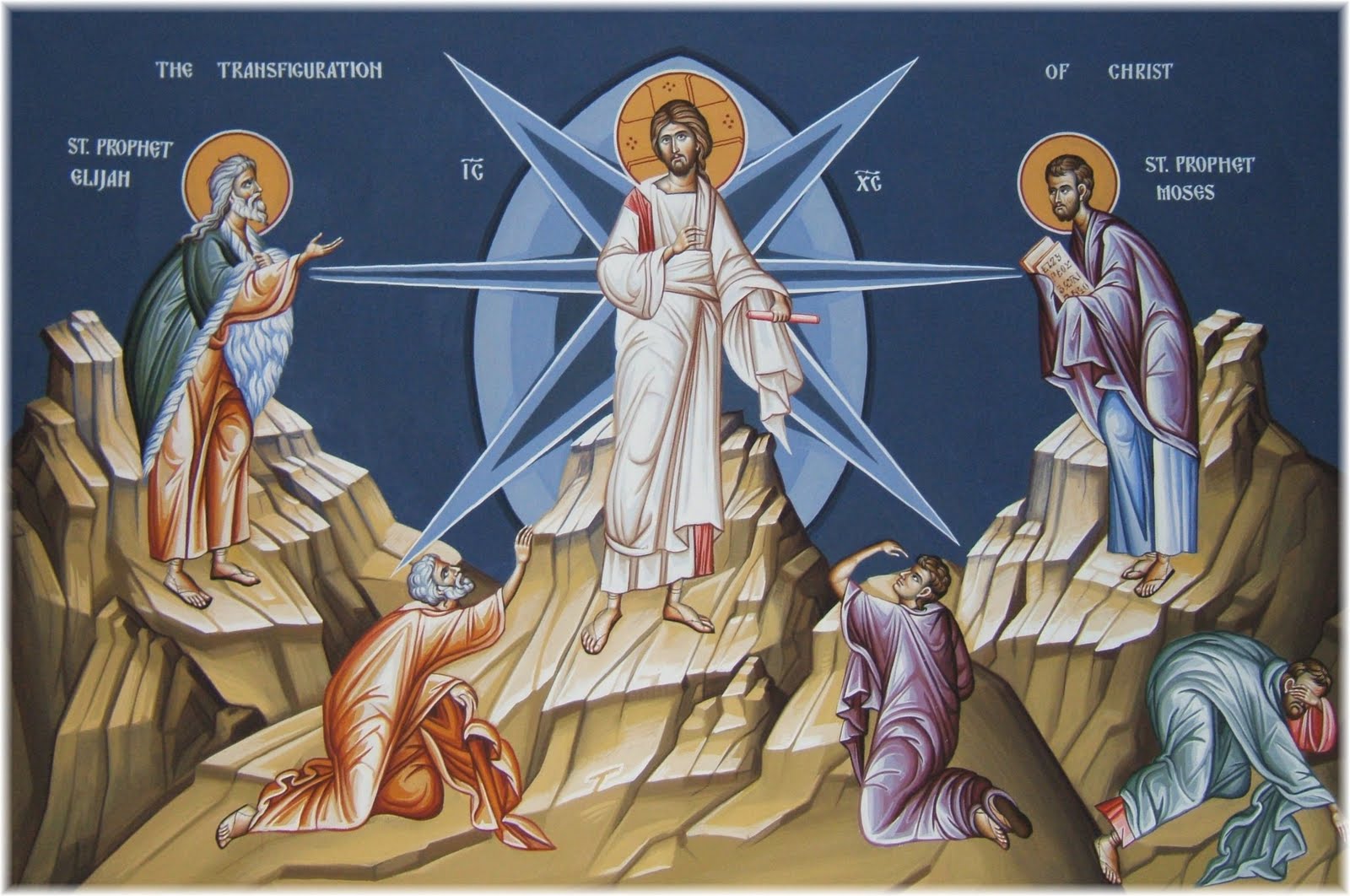
Transfiguration of Jesus;

Have you ever had a life changing experience?

I remember when my first child was born. One day I was just a guy, and the next day I was a parent! I held my newborn daughter in my arms and I felt a hundred wonderful things all at once, and I knew I was a different person. At the time I felt very different, I felt things I had never felt before. I knew I was different. I could exactly tell you how, but I knew I was somehow a very different person.

In the Gospel lesson this morning, we see Jesus and his disciples having a transforming experience—in this case quite literally.

In the story this morning, Jesus takes three of his disciples up a mountain, and an amazing thing happens. Jesus is transfigured. Now it is hard to say exactly what that means. The Greek word used is μετεμορφώθη (metemorphothē), from which we get the word metamorphism, and it basically means that Jesus changed. Well, actually the word Morphe means “to change.” Metemorphothē means the change goes beyond expectations—like a caterpillar to a butterfly. Morphe is when you clean up well—you change your clothes, you shave, you wash up. Metamorphe is when your essential nature is changed.

Matthew gives us a description—he says his face began to shine and his clothes were a dazzling white. When Moses came down from the mountain with the Ten Commandments, his face was also shining.

Jesus was changed—he was transfigured. For him, at that time, it was an instantaneous change. One minute he was Just Jesus, that guy they had been following around for the past few months, and the next moment he was Jesus, in all his Glory. It was as if Peter and James and John saw Jesus as he really was, the veil was lifted, and they saw him as the true Son of God that he really was.

There is a symphony conductor in Fairbanks, who is a large, rather ungainly person. I have seen him socially a few times, and he comes across as someone whose body is too big for him. He is a bit awkward and somewhat clumsy. But when you put the baton his hand, and put him before an orchestra, he is as graceful as a ballerina. When he is conducting, he is transfigured—and you get the feeling that you are watching his true self in action when you see him at the podium.

When Jesus was transfigured, Peter, James and John saw his true self. They saw Jesus in all his glory; they saw him as a true Son of God.

We have transfiguring moments sometimes.   We have moments in our lives where we are changed. Ours are usually nowhere near as dramatic. But we have transformative moments. Not all of them are directly spiritual in nature

I spoke about the birth of my first child. I was changed. Caitlin’s birth had transfigured me in ways I could not imagine. I was a father now.

That changed me. But it took a while to realize how deep those changes went.

Seven months after her birth, I was out rock climbing with a friend. Now before Caitlin was born, I used to go climbing at least once a month as soon as it was warm enough. Caitlin was born in September, and it was late April before I got back to climbing.

I was halfway up the first pitch, when I started thinking about my daughter. And I started thinking that if I fell and hurt myself, who would be there for her. I had all sorts of thoughts I had never had on a rock before, and it was really bothering me, and I realized at some point that I did not want to be on that rock. (Which is not the best thought when you are already about a 100 feet off the ground!)

All that was tied with learning to be a father. And I did have to learn to be a father. When we were coming home from the hospital, I remember putting her in her car seat, and looking the nurse, wondering when she was going to say, “Wait a second. We can’t let you take that baby home. You have no idea how to be parents.” She would have been right! But she didn’t do that. She let me drive off with that baby!

When we encounter God, we are changed people.

Claude and Susie Swaim lived next to the last church I served. Susie was a charter member, and lifelong faithful member of the church. Claude was not a believer. He made that clear to me when we first met. But Claude attended as much as any other person, because he loved his wife, and his wife loved the church, so Claude took good care of the church. He would wake up when it was forty below, and make sure the furnace was working in the church, and if it was not he would fix it. He rebound the damaged hymnals. He cleaned the gutters. He had been a trustee, but they found out that he did not believe in God, so they basically fired him. But he still helped out around the church.

When I met Claude he was ninety, so he had slowed down some. One weekend we were at a church retreat, and Claude was there with us. Now I have to tell you that Susie was one of the sweetest persons you could ever meet, and it broke her heart that Claude was not a Christian. And during this retreat, God had been working on him.

Well one night of the retreat, everyone from our church met together, and had an impromptu prayer meeting, I prayed for everyone in the group, including Claude. After he was finished he started talking. He said that was the first time he had been included in a prayer, or really anything in the church since the trustees fired him. He said he had been going to this church since it was established, and that he was finally ready to make a commitment to Christ, become a Christian, and join the church. Well we baptized him that very night. He was 95 then, and we didn’t want to take any chances!

Later his daughter, who was a very strong Baptist, and had very clear ideas about what a real Christian was, told me she didn’t think her dad was a real Christian. She thought he just became a Christian that night to get his wife off his back. Now the daughter did not live in Alaska, and did not see her father very often, so I guess I could understand why she might think that.

But I knew different. And I told her. Claude was raised in Tennessee and had a racist streak in him. It wasn’t strong, but it was there. It mostly came out at mealtime. Claude and Susie had moved to the Pioneer Home in Fairbanks, and they took their meals there. Several of the staff were African American, and when they were serving the table where Claude sat, he just quietly got up and went to a table where a white person was serving.

After his baptism, he was back at the home, sitting down for dinner, when the server came over, an African American woman, and said, “I suppose you are going to change tables, since I am serving this table.” And Claude looked at Susie and said, “Well, not that I’ve gone and gotten baptized I guess I ought to change my ways,” and he stayed at the table, and never changed tables again because of the race of the person who was serving him.

Claude was transformed. He had encountered God, and was transformed. Maybe not the way his daughter wanted him to be transformed, but he was transformed.

As we are all being transformed—transfigured, each in our own way.

In the Book of Romans, Paul writes, “Do not be conformed to this world, but be transformed by the renewing of your minds, so that you may discern what is the will of God—what is good and acceptable and perfect.” This transformation is a regular part of the Christian life.

It is what we do on a daily basis.

Oh our faces do not shine, like Jesus, or Moses in the Old Testament lesson we read this morning. But we are constantly growing, and growing toward becoming something glorious. And it is about more than just glowing faces.

Paul writes about Moses going up on the mountain, and how his face was glowing so brightly he had to wear a veil when he was with people. “Hey, you mind turning your face down a little bit. It is blinding me!”

And Paul says,

when God is personally present, a living Spirit, that old, constricting legislation is recognized as obsolete. We’re free of it! All of us! Nothing between us and God, our faces shining with the brightness of his face. And so we are transfigured much like the Messiah, our lives gradually becoming brighter and more beautiful as God enters our lives and we become like him.

But here is the trick. We don’t change up on a mountain top. Peter wanted to stay on the mountain. It was great up there! “Let’s build some tents, and never come down!”

But they could not stay there. They had to come off the mountain. When we have mountaintop experiences, we cannot stay there. We have to move on, to whatever is next.

I remember the first time I joined a church as an adult.

This church had a new member’s class, and during the class we were asked to share our spiritual journey. One fellow shared about a group he was in during high school; they met every day during lunch for prayer, they did weekly Bible studies, they volunteered at a homeless shelter—it was obviously a very significant time in his life.

And his story ended there–which seemed really unfortunate, because he was in his mid-thirties, and high school was a good fifteen years behind him. It was as if he had this mountaintop faith experience, but his whole faith journey stopped there.

He was never able to get his faith off the mountain, and into his everyday life.

For us, the Christian life is not just about the glowing moment. The changes that we undergo are slower, and harder, and done right here where we live. Mountain tops are great for the view. But the fertile ground is in the valley.

When I first came to Medford, Bob Haddon took me up on Roxy Anne, and I was able to look down on the valley. It was a beautiful day, and it was a beautiful view. Part of me did not want to leave. But I had to come down. I could not be your pastor from that mountaintop. I had to come down and live and work among you.

Remember the conductor I mentioned earlier? Yes he was graceful when he took up the baton, but do you know how many rehearsals and practices it took for him to get to that graceful state?  He had to work on it.

And so do we.

That’s why we come here every week.

This is our rehearsal time for glory. We share this meal, the Lord’s Supper, on Sunday, as practice so we can share our lives with others Monday through Saturday. We hear the word of God preached on Sunday, which is practice for hearing it Monday through Saturday. We give an offering on Sundays so we can offer our lives Monday through Saturday. We pray for others on Sunday, so we can pray for them and help them Monday through Saturday.

Image

We are entering the season of Lent. In this season we are going to see that Spiritual Walk is more a Labyrinth than a hike in the woods. Our journey over the next few weeks will have many twists and turns, because it is a real journey, one we make in real life, not just a Disney ride. We won’t always know where we are going. We start our journey on Ash Wednesday, with a time of penance and reflection. We will encounter temptation, as we look at the temptations of Jesus. We will journey with a rabbi who had a stranger encounter with Jesus, one that left him very confused, but more open to the spirit of God. We see an outcast woman, who wants to talk about anything but the most important thing in her life. We will see a very inconvenient miracle, one that most people want to claim did not happen, but one that changed a man’s life. We will see a man raised from the dead, and how that affects our lives.

We will walk a spiritual Labyrinth the next few weeks, and you get to practice on your own.

For the Christian life is a journey. We come off the mountain, and travel the valleys. It is about growth and progress, even if our growth and progress are slow. It is about change. It is about our encounters with God, some of them of the mountaintop variety. It is about life, the life we are called by God to live.

Posted in Church, Salvation, Transfiguration | Tagged , , , , , | Leave a comment

Anger Management Graduate School; Loving Your Enemies as the Way to Health

The call to love our enemies is not just a platitude to make Christianity look good; it is a practical way to live, especially if our worst enemy is ourselves! 


Image

GOSPEL MATTHEW 5:38-48

38“You have heard that it was said, ‘An eye for an eye and a tooth for a tooth.’ 39But I say to you, Do not resist an evildoer. But if anyone strikes you on the right cheek, turn the other also; 40and if anyone wants to sue you and take your coat, give your cloak as well; 41and if anyone forces you to go one mile, go also the second mile. 42Give to everyone who begs from you, and do not refuse anyone who wants to borrow from you.

43“You have heard that it was said, ‘You shall love your neighbor and hate your enemy.’ 44But I say to you, Love your enemies and pray for those who persecute you, 45so that you may be children of your Father in heaven; for he makes his sun rise on the evil and on the good, and sends rain on the righteous and on the unrighteous. 46For if you love those who love you, what reward do you have? Do not even the tax collectors do the same? 47And if you greet only your brothers and sisters, what more are you doing than others? Do not even the Gentiles do the same? 48Be perfect, therefore, as your heavenly Father is perfect.”


Right after 9/11 I got an email from a member of my church. As you may remember, the planes hit the twin towers on Tuesday, and I got the email on a Thursday. Basically the email said, “I hope you are not planning one of those “Love your enemy” sermons this week. That would be an insult to everyone in the church.”

Well, I had not planned to preach on the text we just heard the Sunday after 9/11, mostly because the wounds were still very fresh, but I think the email shows the struggle we have with this text. On one hand, we like to hold it up as the apex of Christian love. This is a passage that really does set Christianity aside. While you can find passages like this in other religions, they are not as overt as this.

On the other hand, this is perhaps one of the hardest verses in the whole of Scripture. Last week we talked about getting along when there is conflict between you and friend. This week we are talking about loving enemies—not inconvenient people, but enemies, real enemies. This is graduate school.

In my college days I had several friends who were Muslims. We usually did not talk about religion, but one day one of these friends said, “You know what the problem with Christianity is?” I thought he would bring up the Trinity, because we had already had a very confusing discussion on that topic (and I have to admit that I had created most of the confusion!) But that, to him, was not the problem.

“It’s all that ‘love your enemy’ stuff,” he said. “It makes you weak. It makes you weak for two reasons. It makes you weak because when you have an enemy, you are supposed to destroy him, not love him. And it makes you weak because you talk about it, you preach about loving your enemy, but you never really do it.”

The Greeks and the Romans had the same problem with Christianity. You know there are four words for love in the Greek language; Eros, which means romantic love, Philia, which means brotherly love, storge, which is friendship, and agape, which is unconditional love. Agape is the word Jesus uses in the Sermon on the Mount when he says love your enemies. The word agape was rarely used in Greek and Roman literature, because it was seen as the weakest and least desirable form of love. It was the of slaves, not masters.

And to honest, my Muslim friend was mostly right. This is a verse we like to quote occasionally, but not a verse we like to follow.

This morning I want to show that this verse may be more practical than we realize, and that it deserves more than to be relegated the dustbin of sentimental, but impossible sayings of Jesus.  This is not hopeful optimism about a utopian future, but good advice for getting through life on a daily basis.

Let me say that I am aiming this sermon at the same people Jesus aimed the Sermon on the Mount at—people who are interested in loving God, in being a follower of Jesus. There has been an ongoing debate throughout history on whether or not loving your enemies is possible for nations. I’m not going there this morning. I am not going to talk about how America can love its enemies. I’m going to talk about how WE, you and I, can love OUR enemies. There are reasons for that. First, this is a sermon, and not a lecture, and I think a sermon should concern your daily lives. Second, when it comes to politics, the church has been arguing over this verse for fifteen hundred years, and I am not going to settle that debate this morning. I would be glad to do a lecture about this one Sunday evening, but not here in worship. This morning I am going to give a sermon, not a lecture.

That said, the first practical thing about the call to love our enemies  is that it keeps us from being reactive. Let me explain. There is a part of our brains called the amygdala which determines our basic responses. It is responsible for our fears, our anxiety, and our basic sexual instincts. When you freeze, or run away from a situation you amygdala is in control. We call that the lizard part of our brains, because a reptile’s brain is mostly just this area.

Look at two toddlers playing. One wants a toy that the other has, so he just takes it. The other child gets angry, and takes it back, so the first kid hits him, and retakes the toy. Or the toy is taken, and the child cries.

That is the amygdala in action. When you get into fight with someone, and they say something, and you react by either storming off, or saying something back without thinking, that is your lizard brain in action.

Now as humans, we have complex brains, and the lizard brain is only a small part of our cerebral system. We don’t have to do what our lizard brain tells us to do. We can get scared, but still show courage. We can get sexually aroused, but not act on it. And we can get angry, and not retaliate.

In other words, we can be responsive, without being reactive. Reactive is when our lizard brain takes over. Last week I talked about getting angry at someone and calling them up. When I made that call, the lizard part of my brain was in full gear, and it was sending me all sorts of signals—none of them good.

But you see, we have another part of our brain, which I am going to call the Wizard brain, and the wizard brain is that part that says, “I know your boss just made you angry when he said you had to work this weekend, but don’t hit him with the stapler.” When your child has been acting up, the lizard part of your brain wants to yell at them, or even hit them, but the Wizard part of our brains keep us from saying, “If you keep crying I am going to give you something to cry about!”

When Jesus says; “if anyone strikes you on the right cheek, turn the other also,” he is saying that we need to listen to our Wizard brain, not our Lizard brain. When we get hit, we react by hitting back. And Jesus is saying, “Do not be reactive. Be responsive.”

Reactive comebacks are rarely helpful comebacks. When we are reactive, we are not totally in control of our actions. We say things that we know we shouldn’t say. We do things we know we shouldn’t do. A reactive response rarely makes a bad situation better, and it often makes a bad situation worse. I remember getting in to a fight with my first wife, and saying to her, “You are acting just like your mother.” I KNEW I should not have said that, but my lizard brain was in control. And needless to say, that was NOT the right thing to say.

And one of the biggest problems in relationships today is that people get reactive. And when they get reactive, it is rarely a good outcome, whether it is a marriage, a work situation, a friendship, or church committee, getting reactive is not helpful. If it sounds like I have talked about this before, I have. When I worked with kids at the Presbyterian Hospitality House, I quickly learned that most of them were there because they were reactive, and not responsive. Their lizard brains were in control, and that got them in trouble. We had to teach them to be responsive, to listen to the Wizard brain, not the lizard brain.

When we are reactive, we are not in control, but when we are responsive, we are in control.  You cannot be reactive and love your enemy. It is impossible. Your lizard brain is incapable of any love.

Now here is the good news. We control our responses. If hit, we are capable of responding by turning the other cheek. We just have to practice using our Wizard brains. If someone does something to hurt me, I can lash out, but what good will that do? Or I can choose my response, based on what would be best in the situation.

When Jesus says we are to love our enemies, he is saying, Use your Wizard brain, not your lizard brain!

Now the second way this passage is practical is closely tied to the first. You may be wondering who your enemies are? You maybe be saying, I don’t have any enemies. An enemy is someone who is out to get you. And they intend to hurt you somehow.

But we have a lot of opponents. An opponent is someone who disagrees with us. We have a lot of those people in our lives. If you are a Democrat, your opponent is the Republicans, and vice versa. If you are on the side of management, your opponent is labor. If you are theologically progressive, your opponents are conservatives.

But one thing I have noticed these days, is that opponents can quickly become enemies. I may disagree with you on a political, or theological matter, but that does not make me your enemy, and yet we are quick to draw lines.

It has been said that people can actually live without a god, but not without a devil. We can be quick to demonize our opponents. We need someone on the other side and we need to them to be really bad people. One of the easiest ways to organize people is to set them against a common enemy. If I really wanted to draw you together as a congregation, I would find someone or something that we could all hate, some enemy, and we would work together to destroy our enemy.

If you are in the Tea Party, then liberals are not just people who disagree with you, they are ruining our country. If you are a liberal, Tea Party folks are the ones ruining our country. And both organizations make a lot of money demonizing the other side.

 If you believe in traditional marriage, then those people who believe in same sex marriage are ruining the institution of marriage, and if you believe in same sex marriage, then those people who don’t agree are homophobic, and destroying civil rights. And again, a lot of people are making a lot money by manipulating people into being enemies on this issue.

We tend to draw lines, we put people on the other side of those lines, and we make them an enemy.

Is this the way God wants us to work out our differences? Is this God’s best intentions for humanity? Did God want HIS church to squabble and split over who can get married, or how we do communion, or what music we sing? Did God imagine Right Wing and Left Wing churches? Did Jesus imagine that one day His body would be split into a million different pieces, and that Christians would take pride in how much they despised other Christians? Did Jesus imagine that we would one day define our righteousness by which other Christians we look down on?

We will always have people who disagree with us. That is a given. But do they need to be our enemies? Can we live without devils?  Can we be better than that?

And that brings us to my last point. Who is the biggest enemy we face? We have met the enemy, and he is us.

 We are our own worst enemies. Nine times out of ten, what we say about our enemies is also true of us.  Not always, but often. When we judge someone else, we condemn ourselves.  Is there a person here without fault? Of course not. Is there a person here who is beyond the love of God? Of course not. Are your enemies without fault? Of course not. Are you enemies beyond the love of God? Of course not.

Jesus ends this part of the Sermon on the Mount by saying, “Be perfect, therefore, as your heavenly Father is perfect.”


Now that sounds impossible, but you need to know the word Jesus uses for perfect is telios, which really means whole, or mature, or ripe. Being perfect does not mean that we do not have faults. It means we accept them.


It took me years to learn it, but did you know that God loves me, not in spite of my faults, but that God loves me, faults and all? As a matter of fact, without my faults, God cannot use me?

You see, I want to deal with my faults by rejecting them. And usually when I do that, I end also rejecting people who have the same faults I do. We tend to despise in others what we despise in ourselves. Or we just despise ourselves. Neither is healthy. And what we can accept about others is what we can accept about ourselves. It is no accident that the first principle of AA, or of any twelve step program is to accept that you are an alcoholic, or that you have problems.

But when we have faults, rather than reject those who have same faults, and make an enemy of them, or to reject ourselves, God wants us to put our faults into his loving hands. Because then God can really go to work on us. The Christian life is not a self-help program where we work on erasing our faults so we will one day be good enough for God. It is about accepting the love of God AS WE ARE, and letting God work on us.

You know Michelangelo’s statue of David? It is a majestic, towering, strong figure of David. When he was carving, Michelangelo said he wanted to portray the David who protected his sheep by slaying lions.

The irony of that statue is that it is a flawed piece of marble. After it was mined from the quarry it was discovered to have a huge crack running through it. It was a beautiful piece of marble, with the exception of that crack, which made it useless. So the city of Florence had a contest to see if their best sculptors could do anything with it. Michelangelo spent hours studying it, and from the crack, from the flaw, came up that strange pose of David. His legs are at a funny angle, and they are at that angle because of the flaw in the marble. But that stance is what gives David his power.

God takes the flaws in our lives, and if we are willing, God will work within us to make something beautiful of that flaw.

As to the flaws in others, that is between them and God. We cannot fix ourselves by fixing others, nor can avoid our own flaws by focusing on the flaws of others.

The call to love our enemies is the call to a very challenging life. It is not easy, especially when we are the enemies we are called to love. But it is a practical life, and in the end, a rewarding and sane life. 

Posted in Uncategorized | 3 Comments

Jesus Is Not Jeeves; Time To Do Away With Divine Personal Savior and Personal Valets

Reach out and touch faith 
Your own Personal Jesus 
Someone to hear your prayers 
Someone who cares 
Your own Personal Jesus 
Someone to hear your prayers 
Someone who’s there 

–Depeche Mode, Personal Jesus

I grew up in a tradition where people were encouraged to accept Jesus as their “personal savior.” What is interesting about that is that tradition also takes a very literal view of the Bible, and would say that our theology must be based on the Bible. However, the words “personal savior” never appear in either the NRSV  or the NIV versions of the Bible. 

Actually that last sentence is not totally true. The word personal does appear in the NRSV: A fool takes no pleasure in understanding, but only in expressing personal opinion. (Proverbs 18:2) and a few times in the NIV, most notably John 7:18: Whoever speaks on their own does so to gain personal glory, but he who seeks the glory of the one who sent him is a man of truth; there is nothing false about him. And the NIV does refer to personal servants. But never to a personal savior. 

And there is the problem. When we refer to Jesus as a personal savior, we almost always end up making Jesus our personal servant. 

 Image


Since when did “Jesus is Lord,” the earliest confession of the early church, turn into “Jesus is my gentleman’s gentleman”? While it is true that Jesus did come to earth to be your Lord, he is not your Personal Lord, nor is he your Personal Savior. Jesus is Savior of the World, and came to save all people. And that is the other problem. When we make Jesus a personal savior, we make a very parochial god. While we do not mean to, we usually end up thinking that as personal savior, Jesus came to save people me, and by extension, people like me, and by further extension, only people like me.  That Jesus came to save Africans, convicts, drunkards, Presbyterians, homosexuals, and Baptists seems to escape us. 

So why use a non-biblical term where the Bible is very clear. Jesus is Lord. Not a personal savior.  Clearly Jesus is a savior, and does save individuals, but he came, not for individuals but for all humanity. For God so loved the world


I believe Jesus hears our prayers. I believe Jesus saves us. But I believe he saves US, not just me. I need other people to be saved, so that I can be saved with them. We are not alone. That is the great message of love that is found in the Gospel. But I am not loved alone. I share the love of God with all humanity.

Often I that find harder to stomach, but that is what is behind those radical sayings of Jesus, sayings like: You have heard that it was said, ‘Love your neighbor[i] and hate your enemy.’   But I tell you, love your enemies and pray for those who persecute you,   that you may be children of your Father in heaven. He causes his sun to rise on the evil and the good, and sends rain on the righteous and the unrighteous.   If you love those who love you, what reward will you get? Are not even the tax collectors doing that?   And if you greet only your own people, what are you doing more than others? Do not even pagans do that?   Be perfect, therefore, as your heavenly Father is perfect. (Matthew 5:43-48)

Posted in Uncategorized | Tagged , , , , , , | 1 Comment

Image


GOSPEL MATTHEW 5:21-37

21“You have heard that it was said to those of ancient times, ‘You shall not murder’; and ‘whoever murders shall be liable to judgment.’ 22But I say to you that if you are angry with a brother or sister, you will be liable to judgment; and if you insult a brother or sister, you will be liable to the council; and if you say, ‘You fool,’ you will be liable to the hell of fire. 23So when you are offering your gift at the altar, if you remember that your brother or sister has something against you, 24leave your gift there before the altar and go; first be reconciled to your brother or sister, and then come and offer your gift.25Come to terms quickly with your accuser while you are on the way to court with him, or your accuser may hand you over to the judge, and the judge to the guard, and you will be thrown into prison. 26Truly I tell you, you will never get out until you have paid the last penny.

27“You have heard that it was said, ‘you shall not commit adultery.’ 28But I say to you that everyone who looks at a woman with lust has already committed adultery with her in his heart. 29If your right eye causes you to sin, tear it out and throw it away; it is better for you to lose one of your members than for your whole body to be thrown into hell. 30And if your right hand causes you to sin, cut it off and throw it away; it is better for you to lose one of your members than for your whole body to go into hell.

31“It was also said, ‘Whoever divorces his wife, let him give her a certificate of divorce.’ 32But I say to you that anyone who divorces his wife, except on the ground of unchastity, causes her to commit adultery; and whoever marries a divorced woman commits adultery.

33“Again, you have heard that it was said to those of ancient times, ‘You shall not swear falsely, but carry out the vows you have made to the Lord.’ 34But I say to you, Do not swear at all, either by heaven, for it is the throne of God, 35or by the earth, for it is his footstool, or by Jerusalem, for it is the city of the great King. 36And do not swear by your head, for you cannot make one hair white or black.37Let your word be ‘Yes, Yes’ or ‘No, No’; anything more than this comes from the evil one.”

 RIGHT RELATIONSHIPS IN THE KINGDOM OF GOD

There was once a king who needed to hire a driver for his coach. He periodically had to make trips along a mountain pass, and the road was very narrow. When he interviewed prospective coach drivers, he told them about the road, then asked, “If you were my driver, how skillfully could your drive that road?” The first driver said, “I could drive so that the wheel of your carriage was even with the edge of the cliff.”

The second said, “I could drive so that half the wheel was off the cliff.”

The third one said, “I could drive so that the wheel was next to the mountain was never more than an inch from the mountain.”

He’s the one that got the job.

The king did not care how close you could come to danger, but about how you could stay in safe territory. It was not about how close someone could come to edge of the danger, but about how they could avoid it.

In the passage we read today, Jesus is like the king. He is not interested in how close you can get to the edge without falling off, he is telling how to stay close the mountain. Except that Jesus is talking about relationships, not about driving mountain roads. When it comes to relationships, he is showing us how to keep our wheel close to the mountain, how to stay as deep as you can in safe territory, not how to skirt danger.

The style he uses here is “You have heard…But I say.” The “You have heard” part is the edge of safe territory. The “But I say” part is Jesus telling us to stay deep into safe territory.

If you didn’t know anything else about Jesus, you would think he is just extending the Law of Moses, making it sharper and more stringent. But remember, this is the teacher who starts this sermon with the words, “Blessed are the poor in spirit,” blessed are those who do not have it all together.” Rather than think of Jesus here as making the existing law, think of him as keeping us in safe territory.

For example, Jesus says, You have heard that it was said to those of ancient times, ‘You shall not murder’; and ‘whoever murders shall be liable to judgment.’

Well, I think we can all agree that killing someone is definitely an example of going over the cliff. If it comes to that, you have probably been driving with one wheel half over the edge for a while. Jesus is saying, “Don’t let it get to that point!”

Because, frankly, few of us are probably going to kill anyone this week. If the standard were simply, “don’t kill each other,” I would not have much of a sermon to preach. Actually I would hate to have to serve a church where that sermons WAS needed!  But Jesus wants to take it a step further. Actually many steps further.

But I say to you that if you are angry with a brother or sister, you will be liable to judgment; and if you insult a brother or sister, you will be liable to the council; and if you say, ‘You fool,’ you will be liable to the hell of fire.

Now I don’t think we are supposed to read this literally. I don’t think he is saying, “Whatever you do, don’t call someone a fool, or you are going to hell!” What he is saying is that in a healthy relationship you keep a handle on your anger, and you don’t insult your friends.

He says anger contains judgment on the person who is angry. That’s actually pretty true. Think about the times you have been angry.

Now there are a couple of reasons we get angry at people. They do something deliberately to hurt us. That makes us angry. But how often is that real reason we are angry? We also get angry because we don’t get what we want. That has more to do with ourselves than with other people. I may you to do something, and you don’t do it, so I get angry, but a) have I really expressed what I want, b) can you actually do it, and c) should you actually do it?

Or we get angry because people do things we do not like. But a) is it our business, b) do we not like it because it irritates us, not necessarily because it is bad that you do it, and c) is it hurting anybody?

I have to admit that I have had very few times when I could be legitimately angry at another person. Almost always, my anger tells you more about me and my quirks than it does about the actions of other people. Yet, I can also tell you how dangerous anger is. It IS the edge of cliff for relationships.

Let me give you an example. One year I signed up my kids for indoor soccer. That is a big deal in Fairbanks in the winter. On the form, when I signed up, it asked where you would like for your child to have practices, and which nights were best for you. I put on my form that any night EXCEPT Wednesdays was ok, and that I preferred a practice sight in the Northwest part of Fairbanks, because that is where we lived. In fact, we literally had a school in our backyard.

Guess what team we got? One that was located in the extreme Southeast end of town and which practiced on a Wednesday night. You can imagine what I was thinking. Oh, and the insults I was forming in my head…

So I called up the league. I was angry, but I have learned that when you call in to complain about something, the person on the other end of the line is usually not the person who is responsible for whatever you are complaining about, and yelling at them just puts you in the end of the whatever line you need to be in to actually get your problem fixed.

So instead of insulting her and the soccer league, which I wanted to do, I just calmly explained the situation. She said, and I quote, “Once we have assigned a child to a team, we cannot change that.” Again, I bit back everything I was thinking, and simply said, “I know you are not the person who has caused  to this problem, but your organization asked what night and what part of town would be best for us, and you gave me the exact opposite of what I wanted. I am pretty angry about this, and given this situation, my children cannot play soccer this year.”

It was at that point the woman broke down in tears. I didn’t think I sounded that harsh, but she was sobbing.

So I put on pastor my hat, and asked her what was wrong. Her story came out. She was the person who had assigned the children to teams, but only because the person who was supposed to do it had not done it. Not only had they not done it, they had left all the forms on her porch the day before the assignments HAD to be made, with a note saying they couldn’t do it because they were going out of town for two weeks. She spent all night trying to assign teams, but really had no idea what she was doing, and finally just put randomly put kids on teams, so that at least they would be on a team for the first week of practice. She had been getting calls like mine all day long, and the other people were not holding back on the insults.

Well, when I heard the full story, I was not angry any more. I felt sorry for her, and I tried to encourage her, and to help her feel better. I told her she did the best she could, and I appreciated what she did, and that I was sorry she was put in that situation. I was really glad I did not say any of the insults I was imagining saying in my head.  She thanked me, and when we hung up, we both felt a little better about the situation.

By the way, she called me back, and asked where I lived, and which night would be best for my kids, and she changed their teams. That would not have happened if I had insulted her. Sometimes you do sow what you reap.

But let’s look at how seriously Jesus takes this:  So when you are offering your gift at the altar, if you remember that your brother or sister has something against you, leave your gift there before the altar and go; first be reconciled to your brother or sister, and then come and offer your gift.

Now notice what it says. If you are leaving your gift at the altar, and you remember that someone has something against you, leave your gift. It took me a while to really see what Jesus was saying here. I always read it as, “If you are leaving your gift at the altar, and you remember that you are angry at someone, then go be reconciled.” But no, Jesus is saying something different. If you are leaving your gift, and you remember SOMEONE IS ANGRY AT YOU, then leave your gift. It is not “if you are angry,” it is “if someone is angry at you.”

Now the temptation is to say, if you are angry at me, then that is your fault. You have to deal with that. You see, if I am angry with someone, then obviously they have done something wrong. But if someone is angry at me, then obviously they are just way too sensitive. If I am angry at someone, they must have done something deliberately to make me angry, but if someone is angry at me, well it is not my fault they took something I said or did the wrong way.

Now this is exactly what Jesus is trying to get at.

This is where Jesus wants us back off the edge, and stay in safe territory. Don’t wait until you are angry at someone. Live your life in such a way that no one is angry at you!

This is Valentine’s weekend, so maybe it is appropriate that we are looking at this next part: “You have heard that it was said, ‘you shall not commit adultery.’ Again, I think we can agree that adultery is going over the edge. But I say to you that everyone who looks at a woman with lust has already committed adultery with her in his heart.

Now, does this mean that looking at a woman is the same thing as adultery? No. I mean if that were the case, if you took a wrong look, you might as well finish the act! “Well, I looked at her with lust in my heart, so since that is already adultery, I might as well make it worth my time!” That is definitely NOT what Jesus meant.

When I was in high school, I was in a Bible study where this text came up, and our youth group leader told us that no one can help the first look, but if you took a second look then that was a sin—to which one of my friends said, “If that is the case, make sure the first look is a doozy!”

But again, Jesus is not laying down a new law. He is telling what happens when we stray toward the edge. If there is adultery in a marriage, then there are probably many other unresolved problems in the marriage. There are two problems with chronically wandering eyes. The first has to do with something someone taught me before I got married.  Always say “No” BEFORE you have to say “No.”  If you eye wanders, it will not be long before your heart wanders. I did a research project on the effects of porn for a counselling class, and found that statistically the more porn a man watched, the more dissatisfied both he and his spouse were with the relationship. Whether the porn caused the dissatisfaction, or was a result of it was unclear, but one thing was—the porn did not help anything.

And I can tell you this; in my years of counselling I have seen more than a few affairs, and I can tell you, almost no one ends up happily marrying the person they are cheating with. More often than not the cheater is using the person they are cheating with, to get away from the person they are married to.

Jesus wants us to back away from the edge.

The same is true of marriage. Is Jesus telling us that anyone who has remarried after a divorce is living in adultery? I don’t think so, but I think he is affirming the importance of marriage. There is a part in the Presbyterian marriage ceremony where the minister says that marriage should not be entered in to lightly. Now Jesus is referring to a situation where marriage is not held in great importance—where all you need is a decree.

Image

At the time he said this there were two notions of divorce. One side was saying that divorce was never permitted, and the other side said if your wife burned your toast, you could divorce her. Also, women were not permitted to file for divorce. Only men could, and when a man divorced a woman, she was often left without any resources, for her or her children.

Here Jesus is weighing in on the side of marriage. He is condemning divorce at the drop of a hat. When it comes to any relationship, Jesus is going to default to maintaining the relationship.

Divorces happen. But we should be a people who are on the side of marriage—healthy marriage. If the Presbyterian Church spent half as much time helping people have healthier marriages as they do fighting about WHO could get married, we would be a much healthier denomination. The institution of marriage is not weakened by letting people get married—it is weakened by not helping people stay married.

Finally, Jesus asks us to look at how we act in relationships regarding our promises. He is not saying that when the judge asks you to swear to tell the truth, the whole truth, and nothing but the truth under oath that you are sinning if you say “I do.” He is saying you should live your life so that you are trusted. Whenever anybody has to say, “I swear to God that is true,” you know you cannot trust them. I learned this raising kids. If you ever say you going to do something, your children will hold you to that until your dying day! I had to learn to not say yes, unless I was sure I could come through with what I was promising. Because if I couldn’t, I would sure hear about it!

This section of the Sermon on the Mount deals with relationships—specifically broken relationships. Jesus talks about what makes them broken, and the importance of fixing them.

We are surrounded by broken relationships. We are not perfect people. We are not always nice people. We get angry, often without real cause. We mess up relationships, even the most important relationships in our lives. We treat people like objects, we snub them, we demean them, we lie to them.

We build fences between ourselves and others, fences made of political differences, theological differences, social differences, racial differences, sexual differences, fences of disdain, of anger, of hurt feelings, of jealousy, of our insecurities, of hatred and of betrayal. That is who we are. We can read this part of the Sermon on the Mount as a continual condemnation of our worst aspects as human beings.

Today we heard words that could be taken as words of condemnation, words that none of us really live up to, but they should be taken as words of hope. Jesus is telling us what God wants of us. He wants us to reach out in love, not anger, to speak words of affirmation, not insults, to treat everyone as people, and not objects. God wants us to honor the relationships we have, not just go looking for new ones when the ones we are in start to falter. God wants us to speak with integrity.

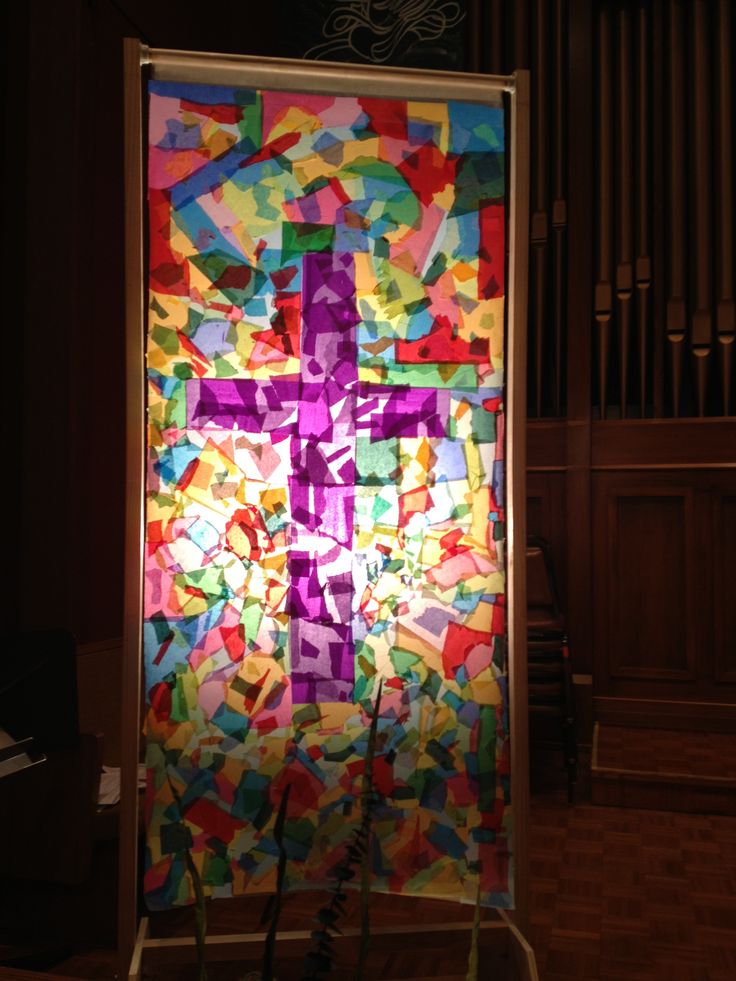
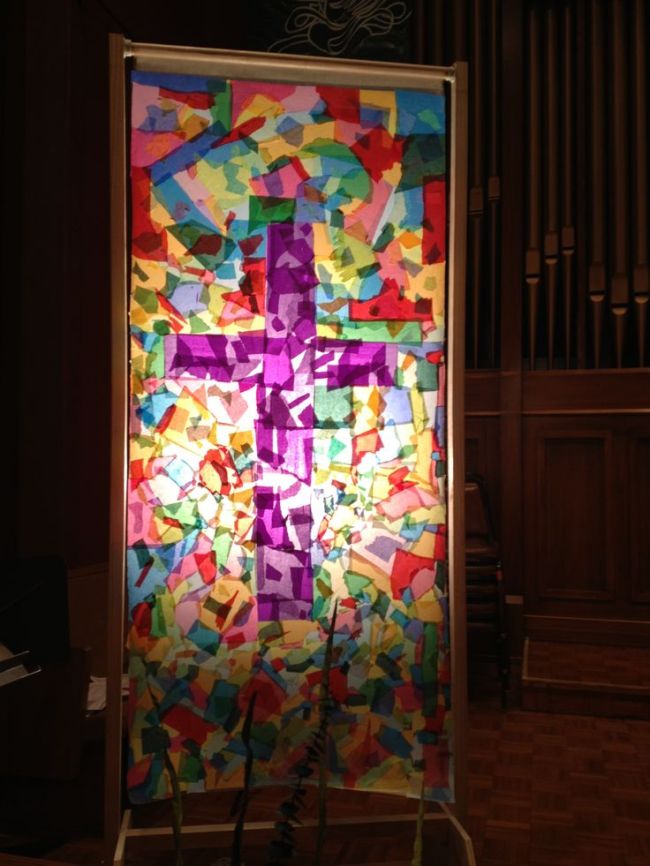
Last week we asked you to take the paper we passed out, think of a broken relationship, and tear up the paper, symbolizing that broken relationship. Some of you went to town on your paper. All these pieces of paper symbolize the individual pieces of our broken relationships. My guess is that these pieces of paper represent the anger, the insults, the infidelities, the divorces, and the dishonesty behind our broken relationships.
Image

But the collage represents God’s hope for our relationships. Yesterday a group of people came in here, and turned the symbols of our broken relationships into something beautiful. In the hands of a loving God, all the disjoint pieces of our lives can become symbols of faith, symbols of hope, symbols of love.

And so we meet at the cross.

Posted on by tmrichmond3 | Leave a comment

Keeping Love Alive

Image

Valentine’s Day, or as they say on Wall Street, Hallmark Day. I woke up this morning to a mobile made by The Redhead, with about twenty-five hearts, and each one had on it something we loves about me, or our relationship. Now that is love! 

Sometimes I wonder why love is so hard. It does not have to be, but I know from experience that it often is. Two people in a relationship can be like two gears meshing. Sometimes they fit well, and sometimes they don’t. Sometimes the gears are well oiled, and run smoothly, and sometimes they are not. (And sometimes there is a lot of grit in the gears!) Given the high rate of divorce (and in full disclosure, I am part of those statistics) it is a wonder why anyone would get married. But they do. Love draws people together. Love overcomes the misfit patterns that seem to gum up the works. Love is what helps recreate our gears to fit someone else’s.  Love is the oil that keeps the gears running smoothly, and love is what causes us to clean those gears out on a regular basis. 

I think the hardest part of relationships is that we forget to love. We forget the work it takes. That is understandable, because in the beginning it does not feel like work at all. We love doing what our beloved loves doing (even if, deep down, we hate it!) We love the talking and sharing the giving. We love to open up to the other person. It is not work at all.

Image

But give things a few years, and it does not come as naturally. And THEN is when it is most important to do the work. Yes, sometimes it feels like work. When you are child free, you can spontaneous. You can go out on romantic dates on the spur of the moment. You can make love on the dining room table, you can lounge in bed all morning on your days off. But children change things. Jobs change things. Age changes things. You have plan dates, plan sex, plan to have romantic moments. But the key here is PLANNING. You do HAVE to plan them, and you ought to plan them!  

The Redhead is great about that kind of thing. As I said earlier, I woke this morning with a Valentines mobile around my head! 

In his book Still Life with Woodpecker, Tom Robbins asks the question, “How do we keep love alive?” I don’t have the definitive answer to that, and to be honest, in my experience I know about how to watch it die, but I do know that keeping love alive is perhaps one of the most important things we can do. 

Image

Posted in Love, Marriage, Valentines Day | Tagged , , , | 2 Comments

A Time to Be Weaned

Image

Why is it that we argue about things we cannot change?

For example, recently there was a debate between a young earth creationist, and Bill Nye the Science Guy, which was apparently broadcast around the nation. (Full disclosure: I did not see the debate.) Why would any Christian think it is important what we believe about creation and evolution? I can see why this is important for scientists; they have to work with this stuff on a daily basis. But I am not a scientist, so as a Christian why is what I believe about creation or evolution of any importance at all? If the world was created in six calendar days, then it was and there is nothing I can do about it. If it evolved over millions and millions of years, then again that is what happened, and I can do nothing about it.

For Christians, the argument is abstract, and to be honest, most, if not all the of evidence is against a six day creation. Do we think that our faith invalidates scientific investigation? I read that in Tibetan Buddhism there is a belief that the moon is a flat surface. The Dalai Lama was looking through his telescope, saw shadows, and had to conclude that the moon was not flat. As far as I can tell, that change did not destroy the integrity of Tibetan Buddhism. I don’t think that accepting the science behind evolution will destroy the integrity of Christianity.

But I can tell you what will destroy the integrity of Christianity–Christians who do not love. If we got all Christians together on creation, and all Christians were to agree in a the literal biblical story of Genesis, pretty much nothing in the world would be changed. But if we got all Christians to agree that peace was better was war, that caring for others was better than accumulating tons of crap for yourself, that compassion was better than apathy, that we are all related as Children of God and that we ought to treat one another as Children of God, then the world could be changed. One of my seminary professors, Stan Hauerwas, had a sign on his door that read, “A Modest Proposal for Peace; that all Christians should agree not to kill one another.” If we could get all Christians behind THAT, that would make a difference.

It really is time the church grew up. We can no longer afford to be involved in these petty arguments. We can no longer afford to cling to our parochial view of the faith. Our faith is much bigger than any individual within the faith, and it can withstand differences of opinions. We can disagree on issues such as evolution, homosexuality, worship music, style of worship, without losing the integrity of our devotion to God. What we cannot do is fight and bicker, and let the fighting and bickering get in the way of our love. I can love God, and believe that God accepts a healthy sexuality that includes same sex relationships, and you can love God, and differ with me on that. I can love God and believe that God was mysteriously involved in creation, and you can believe that God created it all in six days. I can love God, and believe that not every single word of the Bible is relevant to modern life and you can love God and believe that every word was inspired and dictated.

Paul says, in I Corinthians 3:1-4:

 And so, brothers and sisters,I could not speak to you as spiritual people, but rather as people of the flesh, as infants in Christ.   I fed you with milk, not solid food, for you were not ready for solid food. Even now you are still not ready,  for you are still of the flesh. For as long as there is jealousy and quarreling among you, are you not of the flesh, and behaving according to human inclinations?  For when one says, “I belong to Paul,” and another, “I belong to Apollos,” are you not merely human?

The people were immature, Paul says, because they insisted that their group was better than the other group. What Paul wants them to see, what he emphasized throughout the whole letter to the Corinthians, is that they ALL belong to Christ. So rather than split off into factions, they need to support one another in love. And by “in love” I mean lovingly support one another AND support them as they love others.

That is what makes us the Church.

We can spend our time bickering over things that we cannot change, or we can change the world. It is up to us.

Posted in Christianity and Homosexuality, Church, Emergent Church, Jesus, ministry, religion and politics, spirituality | Tagged , , , , , , | 3 Comments

Live Salty

Image


GOSPEL MATTHEW 5:13-20

13“You are the salt of the earth; but if salt has lost its taste, how can its saltiness be restored? It is no longer good for anything, but is thrown out and trampled under foot.

14“You are the light of the world. A city built on a hill cannot be hid. 15No one after lighting a lamp puts it under the bushel basket, but on the lampstand, and it gives light to all in the house. 16In the same way, let your light shine before others, so that they may see your good works and give glory to your Father in heaven.

17“Do not think that I have come to abolish the law or the prophets; I have come not to abolish but to fulfill. 18For truly I tell you, until heaven and earth pass away, not one letter, not one stroke of a letter, will pass from the law until all is accomplished. 19Therefore, whoever breaks one of the least of these commandments, and teaches others to do the same, will be called least in the kingdom of heaven; but whoever does them and teaches them will be called great in the kingdom of heaven. 20For I tell you, unless your righteousness exceeds that of the scribes and Pharisees, you will never enter the kingdom of heaven.”

Salt and Light

Guess who is on the cover of Rolling Stone magazine this week? It is not a rock star, or an actor. It is not a politician. It is not a Hollywood celebrity. This week, Pope Francis is on the cover of Rolling Stone. Now he must be getting used to this kind of publicity, because recently the magazine The Advocate, a magazine for gay and lesbian people, named him person of the year!

What is it about this Pope that has people talking? I have friends who would never set foot inside of any church, especially a Catholic church, reposting articles about Pope Francis, with the comment, “This Pope rocks!”

What is it about this Pope?

He becomes the head of the largest Christian organization in the world, and what does he do? He starts questioning some of their deepest commitments. “Why are we putting so much emphasis on abortion and homosexuality,” he asked. “There are people out there who have immense needs! Let’s focus on that.” When asked about gays, he replies, “Who am I to judge?” And he just doesn’t say things. He does things.

He goes to a prison, and washes the feet of prisoners. He jumps out of his pope-mobile to take a selfie with an admirer. He kisses a man whose face is horribly disfigured, so disfigured that this man’s own father will not visit him. But the pope not only embraces him, he kisses his face. He sneaks out at night, not to buy drugs, or gamble or visit a mistress, but to work anonymously at soup kitchens and homeless shelters.

What is it about Pope Francis?

He is a salty man.

I think he not only understands, but he takes to heart the words of this mornings Gospel lesson.

You are the Salt of the Earth! You are the Light of the World!

13 “Let me tell you why you are here. You’re here to be salt-seasoning that brings out the God-flavors of this earth. If you lose your saltiness, how will people taste godliness? You’ve lost your usefulness and will end up in the garbage.


14-16 “Here’s another way to put it: You’re here to be light, bringing out the God-colors in the world. God is not a secret to be kept. We’re going public with this, as public as a city on a hill. If I make you light-bearers, you don’t think I’m going to hide you under a bucket, do you? I’m putting you on a light stand. Now that I’ve put you there on a hilltop, on a light stand—shine! Keep open house; be generous with your lives. By opening up to others, you’ll prompt people to open up with God, this generous Father in heaven.

Now this text raises a few questions for those of who live in the 21st century. I can understand being the light of the world, but what is this about salt? Many of us are on a salt free diet. We don’t think of salt as a good thing, even though we might like it sprinkled on our eggs and popcorn. My doctor told me to eat less salt.

I have to admit that I did not understand the significance of this until I saw the movie Gandhi. In the movie, and in real life for that matter, Gandhi initiated the Salt March. He walked 240 miles from his ashram in central India to the coast, and when it got to the coast he showed his defiance to the British by making salt.

Why salt? Well, the British had a tax on salt, and they essentially controlled the production of salt in India. It was a way for them to maintain their hold on the people. The reason the British wanted to control the salt productions was that salt was one of the most essential resources in India. In a hot climate, you need to salt for two reasons. First, to preserve foods. Second, and more important, in a hot climate you tend to sweat and when you sweat, you lose salt. If you lose too much salt, you will be prone to headaches, groggy spells, lethargy and in extreme cases, even death. When I worked in a factory one summer, the managers would come by and give us salt tablets after the heat of the day, to replace the salt we had sweated out.

In Jesus’ day, salt was an essential commodity for the people.

If Jesus were giving the same sermon today, he might say, “You are the electricity for the world.” Or, “You the Internet of the Earth.” Or, if he were talking to teens, “You are the smart phones of the world!”

Salt and light are essential to our well being. We need both to survive.

Sometimes we are tempted to think of church as a nice thing we do once a week, or once a month. We think of the church as something we go to, and not something we are. We think of church the same way we think of other social clubs.

But if Jesus is right here, the church is much more. It is something we ARE, not something we just attend. And it is a very, very important thing for the preservation of the world. That is a tall order, and one that makes me feel rather uncomfortable.

And we are called to be a salty church. We are called to be salty people, to live salty. We are called to be light.

In order to be salty, you have to engage with people. You have to get out of the salt shaker. I can put a salt shaker beside my eggs in the morning, but that is not going to do my eggs any good. The salt has to be on the food. We have to be out in the world.

How are we the salt and light? One easy way is how we reach out to the neighborhood around us. We are a downtown church, and while that is not always easy, we embrace that. We are willing to put up with all the disadvantages of being a downtown church, so that we can be salt and light in this community. So we have the food bank. We give out bags of food to people who need it. Those things we are doing well.

We are working in reaching out to children, although that is more of a struggle. But we have good people working on it.

Paul said, in his letter to the Colossians, “Conduct yourselves wisely toward outsiders, making the most of the time. Let your speech always be gracious, seasoned with salt, so that you may know how you ought to answer everyone.”

It is not enough to be salty with each other. We need to be salty out in the world. Let’s face it, the Church and Christianity has really bad PR right now. We are probably not as good as we like to think we are, but we are nowhere near as bad as many people outside the church think we are. We need to find create ways to engage the world. In his book Blue Like Jazz, Donald Miller talks about a booth he and some friends set up at a street fair at Reed College. Now Reed is probably one of the most secular schools in one of the secular cities in the country. The booth was a confessional. The sign on it invited people to come in for confession. But when people entered, they found it was not for them to confess their sins. Instead they found Christians inside who were confessing and asking for forgiveness for the sins of the Church over the centuries. We are sorry for the inquisition. We are sorry for trying to take over the political process. We are sorry that our own sense of self-righteousness has hurt so many people.

They were living salty.

Now let me say this. When I say that we have be in the world, I do not mean that we go out, grab a picket sign, and start protesting. I do not mean that find contentious issues, figure out what side we are on, and advocate for that. It is not enough to just grab a sign, and go join into the thicket of people who are out on the front lines fighting about various issues.

Being salty means you do it intelligently, in a way that people actually appreciate that you are there, and not just the people who agree with you. If we take sides on issue, then we are really no different from the world. Anyone can do that. That is not being salt.

For example, what would it mean to be salty as the church looks at the current school strike? I don’t think it means that we go and stand with one side or the other. We might personally think that one side is more right than the other, but if we were to go out, as a church, as the salty people of God, and tried to bring light to the situation, picketing on one side or the other would make us no different from all the other people out there. And we would lose our saltiness.

But we could, say offer something for all the parents whose kids have been out of school—an emergency “I know you have to go to work and don’t want to leave your kids alone at home all day,” kind of program. Our building is just a few blocks from ground central, the administrative offices. What if, in the midst of this conflict, we offered our building as a place of peace, a place where people could come and get away from the fighting? What if we went down to ground central and set up our own booth? “Meet and listen to your opponent!” You are welcome to come in here, but you have to sit and have coffee with someone you really disagree with. Maybe we set up a situation where people can listen to someone who disagrees with them, and learn to understand where they are coming from, so that they can resolve their differences.

What if we figured out that after the strike there is going to a lot of hurt feelings and broken relationships, and the churches of Medford got together and threw a reconciliation dinner, where we invited people from both sides, and provided them opportunities to try to move past their hurts? That might be salty enough.

I don’t if these are good ideas or not, but the point I am making is that we in order to be salty, we have to think salty. In order to be light, we have to be able to help people see things that they are not seeing now. Choosing sides and duking it out are easy, but we are called to be peacemakers.

Being salty means we do what we do as Christians.

Now here is the scary part about what Jesus said. In order to be salty, we have to keep our saltiness.  Jesus said, “If you lose your saltiness, how will people taste godliness? You’ve lost your usefulness and will end up in the garbage.”

How does salt lose its saltiness? Well, in reality it cannot. Pure salt cannot lose its saltiness. But back in the first century most people did not have pure salt. They got their salt from salt marshes, or the sea, or various other places. And often the salt was mixed with other elements. If you had a salt rock, and it got wet, the salt part of the rock would evaporate, but the other stuff would remain. And the other stuff is useless.

So we can become unsalty. We can put our light under a bushel. We can lose or hide what it is that makes us distinctive as the church of Jesus Christ. If we are not careful, we could easily start looking like any other social club, any other political party, any other non-profit organization. I don’t have anything against social clubs, political parties or non-profits. But we are something different. We are a church. We are all about the Gospel of Jesus Christ. We are all about the Kingdom of God.

So, you ask, what is the Gospel? There are many ways to say it, but for me it is the unconditional love that comes to us in Jesus Christ. It is bigger than just saying that Jesus died for our sins. That is but one action of a loving God. It is the entirety of God’s unconditional love. We embody the Gospel by loving God and loving our neighbor as we love ourselves.

So being salty means that we approach the situation understanding that God loves the people on both sides of the issue. If we start fighting about whose side God is on, then we are no longer salty. The fact is God loves the people on both sides, even when we think one side is clearly in the wrong! And in the end, we judged as salt, not by how right we were, but by how well we love.

Jesus did not say, “You can become the salt of the earth.” He did not say, “If you try hard enough, you can be the light of the world.” He said, “You ARE the salt of the earth. You ARE the light of the world.”

Live in the light. Live salty!

Posted in Church, Jesus, ministry, Presbyterian, religion and politics, Sermon on the Mount, spirituality | Tagged , , , , , | Leave a comment

Trying to Stand in Fallen World


images (1)

One of my favorite songwriters is Pierce Pettis, and one of my favorite songs of his is “Trying to Stand in a Fallen World.” If that does not describe the Christian life today, I don’t know what does.

Do you ever feel this way

Like there is no escape

And you’re out there all alone

In a place that’s not your home

If we take the Gospel seriously, we find ourselves in a place that is NOT our home. We realize that our values do not coincide with the values of people around us, and more unfortunate, with the values of the people who seem to be getting ahead. The values of the Kingdom of God–of sacrificial love, of forgiveness, of being poor rather than rich in spirit, of gentleness and kindness–are neither popular nor effective. And we do value being effective! As Flannery O’ Connor said, “You shall know the truth, and the truth shall make you odd.”

It is very tempting to respond to this alien situation by trying to make the world our home. We either try to force our values on the world at large, or we adopt the world’s values. We do not like the dislocation that the Gospel commends. We do not like being strangers in a strange land.

The problem with forcing the world into our mold is that we become what we are trying to overcome. When Christians try, through political means, to make the world the way they want their spiritual home, it is like they have come into someone else’s living room, and started to rearrange the furniture. No wonder people get pissed off when faith and politics start to merge. It is usually not about justice, or fairness, or opening opportunity up for all peoples, it is about Christians trying to recreate a past that never existed in the first place.

I can understand why we do it. It is hard to be homeless, and if we are faithful, in the words of the old Larry Norman (and Jim Reeves) album, this world is not our home. Or, as the Person Who We Follow said, “Foxes have holes, and birds of the air have nests; but the Son of Man has nowhere to lay his head.”

But we do not have to travel alone.

Do you ever feel this way
Longing for the light of day
Then I send to you my song
And I swear you’re not alone

It’s time to stop feathering the nest of the world with enough Christian kitsch and platitudes to make us feel comfortable. Instead, maybe those of us who see this is partly an uncomfortable journey, can band together, to help each other along the way. The only way we can stand in a fallen world is if we support each other.

Posted in Church, Emergent Church, Jesus, religion and politics, spirituality | Tagged , , , , , | Leave a comment