letters-229726_1280


Act One

Roseanne and Repentance

After flinging a racist tweet into the netsphere, Roseanne Barr wants to take it all back. In case you are one of the few people who have not heard about the controversy, she tweeted that former Obama aide Valerie Jarrett looked like the offspring of the Muslim Brotherhood and “Planet of the Apes.” In the day and half after the tweet she blamed the sleep drug Ambien for her tweet, said she was an idiot, tweeted a picture of Jarrett beside a picture of an ape, posted tweets from her supporters and threw herself on her sword. “I apologize to Valerie Jarrett and to all Americans. I am truly sorry for making a bad joke about her politics and her looks. I should have known better. Forgive me-my joke was in bad taste.”

The “joke” was in very bad taste, but Roseanne is not the first, nor will she be the last person to insult through drive-by tweeting. It happens with less famous people every day.

She asked for forgiveness. Should she get it? If so, when? Can a person ever be forgiven for their wrongdoing? What does it mean for her to repent? What would she have to do to prove that she is a “changed person,” and not just someone who got caught.

Before you answer that question, take a moment and think about a time you hurt someone. Did you want forgiveness? If you were forgiven, did you deserve it? If you weren’t forgiven, do you think the people who held back forgiveness did the right thing?

This is a tricky subject, and especially so for many people of faith for whom forgiveness is part of the way they relate to God and other people.

How do we get a handle on it? When should forgiveness be offered and when should it be withheld? If repentance is part of the process (and it really should be) what does that look like?

Considering the growing influence of the #MeToo movement, this becomes doubly important. While we might not want to create a caste system, with sexual offenders being the new untouchables, we certainly don’t want to excuse actions that damaged people. How do we thread this needle?

To get a handle on the issues, let’s take a look at two events. First, what happened with the president of a Southern Baptist seminary, and second, the story of a female rocker who was part of the Richmond, Virginia punk scene.


Act Two

Another One Bites the Dust

Paige Patterson, President of Southwestern Baptist Theological Seminary, was ousted May 23 by the Board of Trustees of the seminary. The announcement was done quietly as possible. Patterson was removed as president and named President Emeritus and Theologian in Residence. Along with the title he was given a physical residence, and now lives in housing provided by the seminary.

This announcement is strikingly different from other recent actions sparked by the growing #MeToo movement.  Patterson is NOT accused of sexual assault, sexual harassment, or having an illicit sexual encounter. His transgressions were more subtle.

In a 2014 sermon he said that women were created by God “beautifully and artistically.” A little strange maybe, not certainly not a fire-able offense. But then he went on to add a story about a conversation he had with a woman while her son and one of his friends were standing nearby. A female student walked by and the friend said, “Boy is she built.” The woman scolded the student, but Patterson intervened and told the woman (and these are his own words from the sermon) “Ma’am, leave him alone. He’s just being biblical. That is exactly what the Bible says.”

I am pretty sure that is NOT what the Bible says. Perhaps Patterson forgot the part where Jesus tells his followers if they look upon a woman with lust they have committed adultery in their hearts.

But the story does not end there.

In 2000 Patterson spoke at a conference, where he told the participants that abused women should not file for divorce.He stated he had never counseled a woman to divorce her abusive husband, although in some circumstances he recommended a temporary separation. Instead they should pray for their husbands, and be submissive “in every way you can.” Patterson recounts a story where he told a woman to pray for her abusive husband, but warned her that might set her husband off again. It did. She came to church with two black eyes one Sunday morning, and said, “I hope you’re happy.” As Patterson recounts the story, “I said, ‘Yes, ma’am, I am happy.’ What she didn’t know when we sat in church that morning, was that her husband had come in and was standing in back, first time he ever came.”

Apparently for Patterson, its admissible for man to beat his wife, as long as that brings him to church the following Sunday.

The story gets even worse. While he was President of Southeastern Baptist Seminary in Wake Forest, North Carolina, a female student came to the administration of the seminary charging a fellow student with rape. As she recounts the story to the Washington Post, it was a date rape incident.  A meeting was set up with Patterson and four other people who peppered her with specific questions concerning the rape. At the end of the interview she was told, by Patterson, not to report the rape, and school officials did not report it to the local police.

Patterson told her she should forgive her rapist instead of reporting it. (Think about this–the man is probably a minister in a Southern Baptist Church right now.)

Act Three

Sins of Omission

Patterson was called into account, not because he had committed sins of commission, but because he brushed the sins of others under the carpet. This takes us to a new level of accountability. It was Patterson’s sexual attitudes, not his sexual activity, his inaction, not his actions that came back to bite him. No one is saying he harassed them, no one is accusing him of improper sexual relationships. His “good old boy” attitude concerning sexual roles and behavior was the impetus that sparked his vocation implosion. If men act improperly, well, that is to be expected, because “boys will be boys.” Women are just supposed to suck it up, forgive, and forget. A young man who turns women into sexual objects is just acting according the nature God gave him.  A husband who gives his wife two black eyes has committed a minor pecadillo, which should be seen as a call to prayer, not a call to the police or social services. A man who rapes his date should be forgiven, not prosecuted, so his path to pastoral ministry should not be impeded by unnecessary legal complications.

I wonder how Patterson would have responded if a male student gave one of his professors two black eyes, or if it had been a male student who was raped by another man. I seriously doubt the response would have been a call to prayer and forgiveness. But because these incidents all happened to women, they were considered trivial and the men were excused from their bad behavior.

Until now.

The #MeToo movement has changed the landscape in more ways than were imagined. As a first step, women can tell their stories of harassment and abuse and there is a much better chance they will be taken seriously. They are less likely to be automatically disbelieved, or dismissed when believable. (At least that is true for some women. There are surely workplaces, schools, churches and the like that have not caught up with the times, but the tide is certainly changing.)

Patterson’s ouster now plants a flag firmly on the second step–it is no longer acceptable to be indirectly complicit. Even though he was innocent of overt harassment,  he did not condemn those who were, and for that he lost his position as president of the seminary.

There are those who felt Patterson’s ouster went too far, that this is a case of political correctness gone berserk. “Because Dr. Patterson has not said some things exactly right in our extra sensitive climate, he is being condemned by his enemies,” said one of his supporters in the Fort Worth Star-Telegram. “Who of us could withstand withering criticism and publicity of any misstatements we have made over the last several decades? Who of us could withstand having our statements taken in the absolutely worst light?”

Dr. Patterson “has not said some thing exactly right”? Telling a woman who had been abused to go back to her abuser, telling a woman who was raped she should simply forgive the man who assaulted her is not a misstatement–it is a severe misdeed for someone in authority, an oppressive sin of omission. This is not a case of overzealous “political correctness,” but of under-zealous enforcement of a safe environment for women.

It is encouraging that more than a thousand people e-signed a letter demanding his removal, and most of them were Southern Baptists. The letter says, “This pattern of discourse is unbefitting the sober, wise, and sound character required of an elder, pastor, and leader. It fails in the call to protect the helpless, the call of Christ to love our neighbor as ourselves, and the biblical standard of sexual purity. These comments are damaging, sinful, and necessitate a decisive response.”

There was a response, but at first it was not exactly decisive. While Patterson lost his position as president, originally he was going to be be able to keep his income, and was going to be given a place to live. He was  going to be quietly put out to pasture as a theologian-in-residence. But the seminary did an about face recently, and essentially fired him, as any other employee would be fired.

Had been able to function as a theologian-in-residence, I wonder what kind of theology he would be pondering.

Act Four

Forgiveness
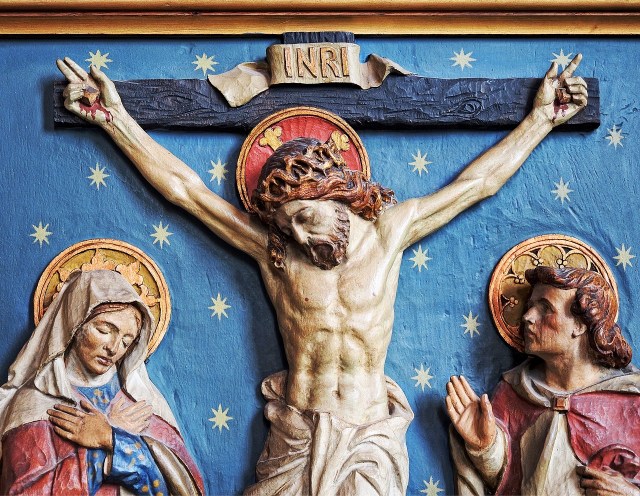
crucifixion-1749008_1280There’s another aspect to the story that raises some important issues for Christians who are supportive of the #MeToo movement–forgiveness. Patterson urged people to forgive those who had trespassed against them.  What is so wrong about that? After all, the carpenter who founded Christianity forgave the people who killed him as they were killing him. Forgiveness is at the heart of the Christian faith. Those who are forgiven by God, are in turn are called to forgive others. Millions of Christian pray every week, “Forgive us our trespasses, as we forgive those who trespass against us,” or as they say in the Presbyterian church, “forgive us our debts, as we forgive our debtors.” In other words every week Christians pray and ask God to forgive them only to the extent that they are able to forgive other people. No forgiveness given, no forgiveness received.

So what was it that Patterson did that was so bad? He urged one woman to forgive her rapist, and another to forgive her abusive husband. He is just telling them to be good Christians, right?

At heart the problem her is that the Church has an impoverished understanding of forgiveness, one that has been transmitted to the culture at large.

I was a whole three months into pastoral ministry when my neighbor, who had previously made it clear to me that she was not in any way religious, came to me for advice. She had been hurt by her partner. The hurt was deep, and was inflicted at a particularly sensitive time in this person’s life–while she was dealing with the death of her father, which had led to her coming out to her family. “Usually when stuff happens to me, I can just forgive them and move on,” she told me. “But this time is different. She really hurt me. I can’t let go of it. I can’t forgive her.”

“In the past,” I said, “you didn’t really have to forgive anyone. You could just brush it off and move on. That’s not forgiveness. That’s just not letting little things bother you. But this time you were really hurt, and forgiveness is going to be a lot harder.”

I couldn’t tell her to just forgive her partner and move on. She was not ready for that. She was still deep into the territory of her pain, and could not see her way out.

Too often forgiveness seems to mean that we try to minimize the hurt and then move on. It is one thing to forgive someone who has taken your parking place at the grocery store, or said something bad about you behind your back. It is quite another thing to forgive someone who has run the knife deep in your gut. Forgiving someone who has given you two black eyes, or who has raped you is a totally different situation.

Forgiveness does not mean we just forget about it, and move on like it never happened. That is, in the words of Dietrich Bonhoeffer, “cheap grace.”

My neighbor was eventually able to forgive the women who hurt her, but that only came after she had worked through the issues that led to her pain. During one of our talks I asked her if her relationship with her partner had been a healthy relationship. She hesitated a long time before answering, and finally said, “I have no idea what a healthy relationship is.” This is not to say she was at blame for her pain, but if she was going to get anything out of the process of forgiveness, she had to find a way to make sure that kind of pain did not visit her again.

Two months later she came knocking at my door. “I have a new girlfriend,” she said. “And it’s healthy!” It was from this new vantage point that she was ready to try forgiveness. Now she really could move past the pain.

Patterson was not advocating forgiveness. He might have used the word, but he was really  asking the women to justify the sin of their attackers by accepting their actions, and then acting as if the sins had not happened. He was trying to brush things under the rug, not make a place for forgiveness to happen.

He failed miserably. Instead of offering forgiveness as a process that could enhance healing, he short circuited it by portraying it as cheap and easy–just forgive your rapist, just forgive your abuser. Brushing sin under the carpet is not forgiveness. Forgiveness, real forgiveness, changes people. It changes the forgiver by having them realistically assess the pain they have received, and what they will do with that pain. It can change the person who needs to be forgiven by confronting them with their transgressions, and encouraging them to deal with the consequences of what they have done.

Act Five

Call Out

gig-3518406_1280A recent episode on NPR’s Invisibilia, focusing on the Call Out process in Richmond, Virginia’s punk rock scene, is good illustration of why we might need forgiveness and possibly even redemption as a part of the #MeToo movement. In the story we learn that a person is called out when they have violated community norms, especially norms surrounding sexual harassment and assault. (Who knew the Punk Rock scene would be ahead of the country on this?) This episode followed the story of Emily, a young woman who grew tired of the misogyny she had experienced by her fellow punk rockers. She started her own band, which had a decided feminist bent, and participated in several initial call outs of men who had behaved  inappropriately with others, including a fellow punker who had sexually molested her. When someone is called out, they are shunned and isolated. They are no longer allowed to participate in the scene. They are banned from concerts and all social events. No one else in the scene will talk to them.

A pivotal point for Emily was when one of her good friends was called out. On the one hand she had a big part in forming the call-out culture. On the other, this was her best friend. In the end she participated in the call out, and shunned her friend. She felt bad about it, but what could else she do?

Then Emily herself was called out. It turns out that in high school (at the time of the story Emily is in her mid-twenties) she posted nude pics of another girl without her permission. She had routinely slut-shamed other girls on-line, and was, in her own words, something of a bully. She was tried and convicted in a process she helped invent.

She lost everything. Her friends avoided her, her band fired her, and her whole social scene was now off limits. “I just feel like I’m in a limbo,” she said.”It consumes me. I lay awake. And I’m like… this is my life now. Nobody’s around. I have nobody to talk to.”

Here’s where the story gets even more interesting.

Herbert was the man who launched her call out. He knew of her high school bullying, but for him there was more to it than that. She insulted him personally. After Herbert initially called her out, Emily went to confront him. In Herbert’s memory, Emily told him she was surprised at the call out because it happened so long ago, and she also said that she was nice to him because he was a person of color. Emily remembers that encounter differently, but the damage was done. Because of what she said to Herbert that day, he felt she deserved to suffer, and suffer hard. When Herbert was asked if his reaction was harsh, he agreed it was.  “I knew that this was, like…a very harsh way to, like…take someone by the shoulders and just put them underwater.” Later in the interview he likens his feelings about the power he welded in the call out to ejaculating. He said he was getting high off of it. And he felt bad about that. But not enough to lay off her.

It was for Emily’s own good, he said. “I’m super comfortable with the harsh because I want her to learn from this. If you’re trying to progress, you’re going to hurt people along the way.” If the punk scene in Richmond was going to progress, people like Emily had to be hurt along the way.

If the #MeToo movement is successful, if it is going to be possible for women to live and work without fear of being harassed and assaulted, people will be hurt along the way. Men who abuse their power in the workplace may see their careers go down in flames. Men who sexually assault women may spend time in jail, and some for a very long time. If things are going to get better for people who have had the fuzzy end of the lollipop for most of their lives, they are going to get worse for those who shoved that end in their faces.

But going back to the question I raised with Roseanne–what if they repent? What if they beg for forgiveness, pleading that they are changed people?

The problem that Emily faced was, when and how can people know she learned her lesson? When can she be forgiven for what she did as a teenager? Could she ever be fully integrated back into the punk rock scene? How would it be possible for Herbert to forgive her? Could she ever forgive the man who was once her best friend? All those questions are still left open.

The story ended with Emily slowly working her way back into the scene, but only marginally. She was not allowed in shows, but she could sell tickets, outside the venue. Most people still shunned her though, and she felt very, very alone.

Act Six

Step Three

If the first step of the #Me Too movement is calling out sexual predators, and the second is calling out those complicit in the behavior, can the third step be repentance, forgiveness and possibly reconciliation? (For those who are turned off by the language, we are talking about true regret and change, mercy, and settlement.)

If that is going to happen then we have to do away with the flimsy form of forgiveness offered by churches that are more interested in moving on than on affecting real change. We have to disabuse ourselves of the idea that forgiveness is quick and easy, cheap grace, where all is forgotten, whether the offender has learned their lessons or not. Can we start thinking of ways to bring redeemed sinners back into the fold?

This is incredibly dangerous territory. Hearing Emily’s story, I feel reasonably sure she has learned her lesson, and the slut-shaming of her past is lodged firmly in her past. Patterson? It is not clear he learned anything, and if given the opportunity will act in the same way again. Roseanne’s series of post-insult tweets almost prove that she has not learned anything at all and is highly likely to repeat her behavior.

Any road to forgiveness must include a process where the perpetrators are made fully aware of the damage they have done as well as convincing assurances that the perpetrator will not re-offend.

Currently there is not a process where Patterson can be authentically confronted with the grave nature of his behavior. Using church language, he should be able to repent of his sins, there is no process where that is possible. In his tradition all it takes for forgiveness is a simple walk up the aisle during the fifth verse of “Just As I Am.” This is a strange place for the church to be in.

I know it is hard to think that Harvey Weinstein or Bill Cosby might experience forgiveness from any of the people they assaulted. And it is not my place to tell any person who has been assaulted that they should forgive the person who harmed them. Perhaps there are some people for whom vengeance is the only avenue. And I certainly do not mean to imply that forgiveness of any kind excuses behavior, or the consequences of behavior. Some people will only experience forgiveness from a jail cell. That was the problem that many Catholic bishops had. They thought that Christian repentance gave  offending priests a free “get out of jail” card.

The recent statement, Reclaiming Jesus, written by a group of diverse Christians, including Evangelicals, draws a clear line:

WE REJECT misogyny, the mistreatment, violent abuse, sexual harassment, and assault of women that has been further revealed in our culture and politics, including our churches, and the oppression of any other child of God. We lament when such practices seem publicly ignored, and thus privately condoned, by those in high positions of leadership. We stand for the respect, protection, and affirmation of women in our families, communities, workplaces, politics, and churches. We support the courageous truth-telling voices of women, who have helped the nation recognize these abuses. We confess sexism as a sin, requiring our repentance and resistance.

It is good to hear those words from a group that has been traditionally loosey goosey on sexual misconduct. But there needs to be a movement to go even further, a movement toward true repentance and forgiveness.


#

Act Seven

Roseanne Redux

Roseanne Barr asked for forgiveness, but shows no signs that she has learned anything about her behavior, no signs of forgiveness. After the insult she tweeted, “I’m not a racist, just an idiot who made a bad joke.” Racism can be cured, but being an idiot is permanent, especially when that is used to excuse bad behavior.

It doesn’t look like she is going to get forgiveness, at least not from her network, because it was just announced that there will be a Roseanne spinoff—without Roseanne.

Whether it is racist jokes or sexual misconduct, there are things our society cannot condone, and must condemn. When people step over a line, there should be a way for them to work their way back, but the way should not be cheap nor easy. Forgiveness, when given, does not guarantee easy access back to the kind of behavior that got people in trouble in the first place. It should make it clear to the offender why they should have never gone there, and they should be able to guarantee why they will never go back.

Americans love a good comeback story. But to come back, you have change direction.


<<<>>>

Posted in Church, forgiveness, Musings, Spiritual Growth, Theology | Tagged , , , , , , , , , , , | Leave a comment

The Healing Place

539dc307-a49b-410a-9f81-f2a51258ee89This is a bit different sermon for me. It has a very open-ended conclusion, if it even has a conclusion. Basically I want to know how we can help each other encounter the healing power of God. (Text at the end, as usual.) 

When Steve called to set up a meeting with me early on a Tuesday morning, I had no idea why a) he wanted the appointment and b) why so early in the morning. As it turned out, his wife was having surgery later in the morning, and he wanted to pray with me beforehand. The fact that a husband wanted prayer for his wife’s surgery was not out of the ordinary. The fact that Steve was a surgeon, and was extremely wound up about what was usually considered a routine surgery was a little out of the ordinary.
 
“I’m a doctor,” he told me. “I know how much is in my hands, and how much is not. I know how important it is to bring God in the room. I want God there with my wife when she is being operated on.”
 
His wife came out of the surgery with no complications, but it was an important moment for me. As much as I believe that God heals us through doctors and nurses and counselors and other professionals, I have come to respect the more direct role of God in healing as well. More than once I have seen people recover from life threatening medical situations, and the doctors who were caring for the person were mystified why. A few of the doctors I knew when I worked as a hospital chaplain were pretty open about their faith. “It’s a miracle,” were words I heard more than once.
 
# # #
 
The Healing Place
 
In my last sermon I talked about the calm within the storm, and I said that as the Body of Christ, we are the calm within the storm. We are the shelter from the storm. Just as Jesus rebuked the wind and the rain, so we rebuke the storms that enter our lives, knowing that God is bigger than the storms. Our relationship with God gives us a long-term perspective on events. As peole of faith we know, in the end, that evil will not triumph, that the storms will not undo us. They scare us, but they will not destroy us.
 
This week I am talking about the Healing Place, and I want to say first that we are also a healing place. Just as we are the calm in the storm, so are we to a healing place.
 
A friend of mine in Durham, North Carolina came from an Assemblies of God background. His father was an Assemblies of God pastor. But he contracted a chronic illness, one that did not end his career as a minister, but which had an effect on how he carried out his ministry. The congregation he served believed that God healed those who needed healing. Their pastor’s illness was almost an affront to them, as if God had abandoned him. And if God had abandoned their minister, they felt God had abandoned them. And so they drove him away.
 
“The church,” said my friend, “is the only hospital that shoots its wounded.” Instead of being a healing place, sometimes churches are the last place you can admit to having any problems.
 
# # #
 
A Story of Two Healings
 
This morning’s Gospel lesson is a story of two healings. The first is the daughter of the local leader of the synagogue. Jairus, her father comes to Jesus ands asks him to heal his daughter. Well, not asked. Jairus begs him to heal his daughter who is dying. Jesus agrees but on the way there he has an unexpected healing encounter. In the crowd of people followng him to Jairus’s house is a woman who had suffered from hemorrhages for the last twelve years. Now in that culture, the flow of blood made this woman unclean. And anyone who touched her also became unclean. She had to avoid human contact. When she met someone, she was obligated to tell them she was an unclean person.
 
When I was a kid we had a kid in our class who was more than a bit different from the rest of us. I lived in fairly affluent neighborhood, and almost all the kids in the school came from an upper-middle class background. But not Terry. His family was poor. His clothes obviously came from thrift shops. (Most of us did not know what a thrift shop was!) He didn’t always smell nice, like the other kids. Once, for show and tell, he told us of how his mother had stabbed his father during a fight. All of this led us to the obvious conclusion that Terry had cooties, which was the worst thing a kid could have. One day, during recess, Terry ran around telling the other kids he had cooties, and chasing them, to give them his cooties. I remember watching that, and it was the first time I saw what social ostracization was. Terry was an unclean person, and what was worse, he owned that. He saw himself as a person with cooties, and his response was to spread them to us. Maybe he thought that if we all had cooties, then we could friends.
 
The woman with the hemorrhage was Terry writ large. Like Terry, she reached out to touch others, specifically Jesus, but she did so, not to “infect” him, but to find healing. So she touched him. She did not even touch him. She knew that was wrong. She just touched his cloak. And Jesus knew, as soon as he was touched, that something happened, something special. He calls out, “Who touched me?” The woman came forward, and admitted the whole thing. In that context Jesus had every right to yell at her, to say, “Who are you to touch me like that?” That was probably what the woman expected.
 
But that is not what happened. Instead he embraces her. “Your faith has made you well. Go and peace. And be healed.”
 
Now here is the interesting thing. Her body was already healed. But there was a deeper wound, one that no doctor could cure. Her soul was damaged. She was an outcast. The deeper pain was the shame she lived with for all those years.
 
While this is happening some people come and to tell Jairus that his daughter has died. There is no more reason for Jesus to come. The battle is lost. She is gone, and there is nothing that anyone can do anymore. Not even Jesus.
 
Or so they thought. But Jesus is not one to be stopped by lost causes. He insists on going on the home, against the advice of those who thought they knew what was what. And he heals her.
 
# # #
 
The Lord of Lost People and Lost Causes
 
In the first instance, Jesus reaches out beyond social strictures to provide healing. Now here is the interesting thing. Her body was already healed. But there was a deeper wound, one that no doctor could cure. Her soul was damaged. She was an outcast. The deeper pain was the shame she lived with for all those years. Jesus does not see a woman who is a pariah to all around her. He sees a hurt person who needs healing. The real healing took place in her soul. She was a lost soul with a damaged spirit, and Jesus healed her.
 
In the second, he reaches past the lost cause and brings about a new possibility. Jesus does not see the hopelessness of the situation. He sees instead the possibility of God’s healing actions, which can work through him.
 
He is the Lord of lost people and lost causes, and can bring healing to both situations. And he does.
 
And he still does.
 
Now our maladies may not be as dire as that of the woman or of Jairus’s daughter. But we have them. You don’t have to be physically sick to need healing. We all have suffered the hurts of life, and some of those hurts, while old, may still be doing damage in us. Some of may be soul sick; there is a dis-ease within us that no doctor can cure.
 
# # #
 
How Can This Be?
 
So if we are the healing place, and Jesus is the healer, how does all this work?
 
It’s not gonna happen because I start calling people up and whomp you on the head saying “In the nahyme of Jezzzus, be HEALED!”
 
But it does happen through intentional prayer.
 
I participated in a healing service many years ago, which I will never forget. This was a raucus free for all, but a quiet service, where the congregation sang songs and hymns. Those who wanted to could come up for prayer. There were three teams at the chancel area, and we prayed with and for people as they came up to ask for prayer.
 
I remember one person vividly. A man I had known for a few years came up, and he said, “Four years ago my oldest son told me he had AIDS. I kicked him out. I rejected him. I never saw him again. A year ago I got word that he died. I don’t know where and I don’t know how.” Then he broke down crying. “I’m so sorry,” he sobbed. “He was my son, and I…” He couldn’t even finish the sentence. The two of us who were praying for him held his hands. And we prayed for him, and we prayed with him. We sat with him for a long time, while he cried and we prayed silently for him, and he prayed. His prayer was simple. “I’m so sorry, I’m so sorry. Forgive me. Please forgive me.”
 
And something started to change in him that day. He started to find healing. When I saw him, about five months later, he was volunteering with a group that provided care and counseling for AIDS patients. He was doing for others what he did not do for his son, and in the process, he found healing.
 
Now healing is not always as dramatic. It is not always within the context of a healing service. When we take time for the silent confession each week, you are essentially asking for God to heal us from the hurts we might have inflicted on others during the week, for the needs we may have ignored, for the sins that may have scarred us. I hope that is what we do during that time. Maybe not every week, but every week we need to.
 
Every Sunday we pray for people here in this congregation. I say, “What are the joys and concerns of your life?” and the people tell me. They share their prayer request. They share the joys they have in their hearts. After they have shared, I say, “Lord in your mercy,” and the congregation says, “Hear our prayers.” That should be, when needed, a healing act of prayer.
 
Often we pray for people’s physical needs, and that is right and meet to do. But I am sure that there are needs that do not get mentioned because they are either very personal or not appropriate to share in a public context. And I have to say, I’m not sure we provide enough opportunities for that. Some people come to talk to me privately, but as I was preparing this sermon, I began to realize that if we are to be a healing place, we need to provide more opportunities for healing. I would be interested in hearing from you on how you think we can become a more healing place.
 
In the end I need to say that we are not the healers. Christ is the healer. We provide opportunities for Christ to work. We provide ways for people to encounter the healing touch of Christ.
 
How can we best do that? How can this church provide a place of healing for you? Often in a sermon I end up talking about possibilities for ways to serve Jesus. This week I am asking you, “How can we help Jesus servce you? How can we provide a way for you to encounter the healing touch of Jesus? What can the church do to help you? This week I am asking you, “How can we be the healing place where Christ is able to do the work?”
 
To believe that God may heal is a radical act of faith. To believe that God can heal our souls, to believe that God can do things we think are impossible takes faith. Not your faith. OUR faith. We gather together to provide a community of healing, to support one another, to pray for one another, and let God work through us to heal one another.
 
Amen.
Text
Mark 5:21-43
 
21When Jesus had crossed again in the boat to the other side, a great crowd gathered around him; and he was by the sea. 22Then one of the leaders of the synagogue named Jairus came and, when he saw him, fell at his feet 23and begged him repeatedly, “My little daughter is at the point of death. Come and lay your hands on her, so that she may be made well, and live.” 24So he went with him.
 
And a large crowd followed him and pressed in on him. 25Now there was a woman who had been suffering from hemorrhages for twelve years. 26She had endured much under many physicians, and had spent all that she had; and she was no better, but rather grew worse. 27She had heard about Jesus, and came up behind him in the crowd and touched his cloak, 28for she said, “If I but touch his clothes, I will be made well.” 29Immediately her hemorrhage stopped; and she felt in her body that she was healed of her disease. 30Immediately aware that power had gone forth from him, Jesus turned about in the crowd and said, “Who touched my clothes?” 31And his disciples said to him, “You see the crowd pressing in on you; how can you say, ‘Who touched me?'” 32He looked all around to see who had done it. 33But the woman, knowing what had happened to her, came in fear and trembling, fell down before him, and told him the whole truth. 34He said to her, “Daughter, your faith has made you well; go in peace, and be healed of your disease.”
 
35While he was still speaking, some people came from the leader’s house to say, “Your daughter is dead. Why trouble the teacher any further?” 36But overhearing what they said, Jesus said to the leader of the synagogue, “Do not fear, only believe.” 37He allowed no one to follow him except Peter, James, and John, the brother of James. 38When they came to the house of the leader of the synagogue, he saw a commotion, people weeping and wailing loudly. 39When he had entered, he said to them, “Why do you make a commotion and weep? The child is not dead but sleeping.” 40And they laughed at him. Then he put them all outside, and took the child’s father and mother and those who were with him, and went in where the child was. 41He took her by the hand and said to her, “Talitha cum,” which means, “Little girl, get up!” 42And immediately the girl got up and began to walk about (she was twelve years of age). At this they were overcome with amazement. 43He strictly ordered them that no one should know this, and told them to give her something to eat.
Posted in Church, Healing, Jesus, ministry, Musings, Spiritual Growth, spirituality | Tagged , , , , , , , | Leave a comment

The Zen of Barbecue

14264823_10208535010471773_644638047421847609_n
Although I have been eating it as long as I can remember, I did not hear the words “pulled pork” until I was 44 years old and living in Alaska.
To me it was always and only barbecue. Put it on a bun, eat it chopped, sliced, or pulled, it is barbecue. When I say barbecue I mean one of two things: smoked pork butts, or a slow cooked whole pig. (Pork butts, by the way, are the front quarters of the pig. The back quarters are hams.) When it is a whole pig, you invite loads of friends and neighbors, and that is called a Pig Pickin’.
14324356_10208535008631727_106384554670063499_o(I am well aware that people in other regions of the country have different ideas about what constitutes “true barbecue.” In Texas it is beef, which I will admit is delicious. In Alabama they do chicken in a white sauce–also good. But I am at heart a Carolina boy, so for me, ‘cue is always pork.)

I grew up around some the best barbecue joints in North Carolina. i never appreciated what a treasure trove of porcine deliciousness I had in my own back yard until I moved away.
There is barbecued chicken, and barbecued beef and barbecue sauces, but in those cases barbecue is an adjective. When it is a noun, it is the stuff of pig cooked over low heat for a long time.
I was visiting some friends in Los Angeles (only my second time out of the South for any length of time), and the person I was staying with suggested we do a barbecue. I knew that smokers were in short supply, so the odds of making actual barbecue were pretty slim, but I figured we could do some chicken, and I jumped on the idea. Not barbecue, but close enough. “That sounds great! I’ll make my special sauce, and we can do chicken, because, well, barbecue takes more time than we have, and I can make some cole slaw (the red kind, not that generic mayonnaise based stuff) and I’m pretty sure we can jury rig the grill to do indirect heat so we can slow cook the chicken and….” My friend was looking at me like I started scat singing. She had no idea what I was talking about.
“A barbecue,” she said, a phrase I was unfamiliar with, “you know, hot dogs and hamburgers.”
That is a cook out, not “a barbecue.” You don’t have “a barbecue.” Remember, when barbecue is a noun, it is a piquant pork dish of unparalleled deliciousness. You can barbecue as a verb—hence the chicken and the beef. But when you are cooking hot dogs and hamburgers outside over a fire, that is grilling.
Some people cook pork in crock pot, drown it in a sauce and call it barbecue.
No.
No.
No.
If you need to put sauce on it, it is not good barbecue. The best barbecue can be eaten as is—it does not need to be drowned in sauce any more than a good steak needs to be drowned in ketchup. Sure, some people may prefer a little sauce with their pig, or a little A1 on their rib eye. Nothing wrong with that. But the sauce doesn’t make it barbecue any more than the A1 makes a sirloin a ribeye.
In our household we believe in the division of labor. I do the barbecue, the ribs and the chicken, while the Redhead does the brisket, and I get to do the smoking. We divide the labor by enjoyment. For me the zen of barbecue is the process. Usually I make pounds and pounds of barbecue, and then serve it to others. For the Redhead the zen of barbecue is the meat.
Sometimes I get carried away, and start dreaming of starting a BBQ joint of my own. I see myself standing among hordes of people eating my delicious food. I go from table to table, and people tell me how good it is. I’m like Rick in Casablanca, which was originally called, “Everyone Goes to Rick’s.” I might even buy a white dinner jacket. When I have those thoughts the Redhead reminds me of the BBQ guy I would see on my way to work everyday. He sat perched beside the huge smoker, and I know he started the day at 4:00 am, and that he did that every day, without a break. There was nothing in his face that led me to believe he was enjoying it.
That’s how we generally divide the labor in our household. I dream, and she is the realist.
My favorite BBQ story is the guy who asked if he could work with the one of the Q Masters. The Q Master told him to come early on Saturday, and when he got there, he was told to sit on a stump in the middle of the yard and watch everything. He took out his notebook, sat, watched and wrote. At the end of the day the Q Master asked what he had learned. He took out his notebook and started reading his notes. “The chicken goes in 20 minutes after the fire is started, and cooks for one and half hours. The pig is…” At that point the Q Master took his notebook and threw it in the fire.
“I told you to watch, not write,” he said. “You don’t need a laundry list telling you what to do. Just sit on the stump and listen. The chickens will whisper to you hen they need to be flipped. The pork will sing when it is finished cooking. The fire will wink at you when another log is needed. No list, no clock, no thermometer can tell you how to cook barbecue. You sit in the corner, and you just know.”
I am not there yet. I still listen to the themometer. But I am getting better.
I love the process, from buying the meat to preparing it to smoking it to pulling and serving it.
I used to get up early on Saturdays, prepare the meat–always pork butts. I put on the rub. I inject them with my secret injection sauce. I let the preparations do their magic while I start the fire. I have heard that some people smoke meat using a gas grill, but that makes no sense to me. The joy of cooking is the fire. I pour a ring of charcoal in the fire pit, fill the chimney with charcoal, and light that using two full sheets of newsprint. I have not bought lighter fluid in 25 years. You know that keroseny smell you get when you use lighter fluid? That is what gets in your meat.
Little things make it better. I grow and smoke my own paprika for the rub, and this year I will using my own cayenne pepper as well. I can be hard on my tools. I go through three or four injection needles a season. I used to go through thermometers like that, but the Redhead gave a me a fancy one, with blue tooth so I can check the temps on my phone while I am smoking. (So much for listening to the meat.)
bbq3I used to have a barrel smoker, the kind where the barrel is on its side with the firebox beside. I had to keep a close eye on the temps with that smoker. One side is always hotter than the other, so I had to have a different thermometer for each side, and frequently move the meat from one side to the other. It was drafty. The metal was thin, and there was no real seal to it. Smoke poured out all the edges. The fire took a lot of tending. A lot.
When I moved to Oregon I got a new smoker, leaving my old one to a BBQ buddy in Alaska. The new one is an upright barrel, and holds the heat. I can start the fire and go back to bed for a while, knowing that when I get up, the temps will still be in the 225-250 range. Maybe its not as fun as the old one, but I get more sleep.IMG_1680
 
It takes 14 to 16 hours to get the pork butts to the right temps. One hundred and ninety degrees. Any cooler, and it won’t pull. Much warmer and it drys out. The last three hours are the hardest. It smells like barbecue, but I know it is not ready. The temp tends to stall when it gets to 170 degrees and it can stay there for a long time. (The dreaded stall is when the juices in the act as a temperature stabilizer, and the meat gets stuck. Some people, when they hit the stall use a Texas Crutch—wrapping the meat the aluminum foil for the last bit. I only use the crutch when I am on a deadline.)
Making barbecue is an activity of leisure. There are sporadic bursts of action, punctuated by long hours of watching. I prepare the meat, start the fire, put the meat in the smoker, check the temps, wait, check the temps, put some hickory wood on the fire, and wait. And wait.
Around noon I will light up the first cigar, and around two I’ll crack open the first beer. And I’ll check the temps again, put more wood on, rake the ashes out of the grate, and wait. Another cigar. Put more charcoal in the chimney and add it to the fire. Wait. Another beer, and cigar. Wait. Read a bit maybe.
Around four the first friends will have smelled the smoke and will start congregating in our yard. More beer, another cigar, and check the fire again. The meat is slowly cooking and is running around 150 now. I wait. Then stoke the fire a little add some more hickory and wait. By now the yard is full of friends and some are starting to ask when it will be done. “When it’s done,” is all I can say, not knowing if this will be a 14 hour or 16 smoke.
More friends, another cigar. The temps hit 170, and I swear some of our friends seem to be drooling. The Redhead is making potato salad, and we throw some corn on a grill. More friends and more beers. The meat has stalled, so we all wait. I am tempted to stoke up the fire and get the temps up to 275, maybe even 300, but I know that is a mistake. My friends will just have to wait. And wait. We talk, and wait.
The meat moves out of the stall, and is now running 180, then 182 then 185. It is close and I feel like it should be done in the next five minutes, but in fact we still have at least a half hour to go. The thermometer starts to beep, warning me it is about time. We wait some more. Just a little while longer, I tell my friends.
And then, the magic happens. The thermometer beeps, telling me it is done. I take the meat inside, pull the butts with the steel bear claws I bought just for this purpose, and the Redhead starts taking it outside.
Let the feast begin!
1947983_10202266991695221_1812830651_n
Posted in Barbecue, Food, Musings | Tagged , , , , , | Leave a comment

Finding the Calm in the Storm

ThinkstockPhotos-471823398-resized

I love storms. Some people like sitting in front a fire, watching it burn, others like looking at kittens on the Internet…I like watching storms.   Well, to be honest, I love being inside where it is warm and comfortable watching a storm raging outside. I like watching the lightning and water beating on the streets, hearing the thunder and the sound of a downpour. To me there is something peaceful about sitting in a dry, warm room, watching the tempest. Or to be driving in the rain, where again I am warm and dry, but I can see the weather in turmoil outside.   

Now being out in the storm is a different matter altogether. I am not a fan of being drenched by a torrential rain pour, whipped about by the wind, and subject to lightning and thunder. Storms, for me, are a spectator event, not an audience participation one if I can help it.

When the Storm Hits

          I’m sure the disciples had experienced their fair share of storm in their lives. For the most part they were outdoor people. They were used to dealing with the weather, but that does not mean they liked it. They knew how dangerous a storm could be when you are on a boat. And the Sea of Galilee was known for sudden, sometimes violent storms. Most of the fishermen worked around the shores. They rarely went across it. The Sea of Galilee is 64 square miles, as compared to say, Crater Lake, which is only 33 square miles of area.

Well the disciples are crossing the Sea, and one of those storms comes up.

The disciples are freaking out, which they should because the situation is highly dangerous. They look to Jesus, because after all it was his idea to cross the lake in the evening. And Jesus is asleep! “Storm? What storm?”

He finally wakes up and looks at them as says, “Why are you afraid? Do you think that God brought me this far, just to let me die in a fishing accident? Do you think that the storm stills God’s hand? Do you think the wind blew away the Creator’s power? Do you think the Omnipotent God will melt in the rain? Why do you fret? Have you no faith?”

Actually though I identify with the disciples. The storm is not theoretical. The wind is not a Hollywood special effect. The rising and falling waves are not created by a water-park wave machine. Out on the Sea of Galilee things can get real gnarly real quick. They were right to be afraid.


# # #

Our Storms

Of course, the storms we face are not always weather related. In fact, for us the weather-related storms are the easiest to bear. It is life’s other storms, the ones that rage in our lives and in our society that threaten us. And there are storms aplenty.

Some storms hit the home front, where the peaceful tranquility we strive for is threatened. Relationships take strange turns and not all of them are pleasant. Children cause heartache, and later parents do. Even the best of marriages have rough patches.

There are storms at work, where winds blow bad tidings that might affect our overall financial security. I remember when I worked for Sen. Thomas, I lost sleep in the months before every election, because I knew he could lose and I would be out of a job. Today there’s no telling when a firm will be downsized, or moved to North Dakota, leaving behind a trail of unemployed people. Perhaps some of you have experienced that.

Illness comes as a storm, whether it is ours or someone who we love. Something minor, like the flu can turn into something major, and even if it doesn’t it can create turmoil in your life. And even though we don’t like to think about it, we all know that a major illness could be just around the corner.

Major life changes, like divorce, marriage, birth of children, or grandchildren, or the death of a loved one can bring storms into our lives. Sometimes storms can be caused by positive events, like a marriage or a birth, or a retirement, because change adds stress to our lives.

And all of those things can lead to a crisis of faith. Or sometimes we can experience a crisis of faith that is not tied to any external event, but to our own internal wrestling with faith. All of sudden we can be assailed by doubts, where once we had firm beliefs. I’ll tell you a little secret–even ministers can be subject to this.

Denali, the highest mountain in North America, stands tall and alone in the midst of the Alaska Range. It creates its own weather patterns. There can be a raging tempest at the top, while the air is calm and placid all around it. Like Denali, some people create their own weather patterns. They are able to turn blue skies dark with one fell swoop. They are the storm! I once saw a sign on a co-worker’s desk that said, “I don’t suffer from stress; I am a carrier.” Let’s just say that fits a lot of people well.

I haven’t mentioned the firestorms that are going on at a national level, or even within our own community.

Like the disciples in the boat, any of us can be in a situation where one moment the skies are blue and clear, and the next we are in a deluge.

Like the disciples in the boat, we fear for our safety. Even if we are not in danger of death, the fierce winds, the battering rain, the lightning strikes around us, threaten the wellbeing of our souls.

The fact is we cannot just wish away life’s storms. In Matthew Jesus talks about two houses, one built on shifting sand and one built on solid rock and he says when the storms come, not if, but when—when the storms come only one house will stand.

What storms do you face in your lives? Not all of you are facing a storm now, but some of you are, and at some point, all of us will. What storms threaten your life, your peace, your security?

And what can you do about them?

# # #

  We Are the Calm in the Storm

What do we call this places where we worship? A sanctuary. By definition, a sanctuary is a place of refuge, and that is what this place is. If you come here with a storm brewing in your life, this is the place where you should find Jesus in the boat with you. And when I say this place is a sanctuary, I mean more than the building.

We are a sanctuary. Yes, the building can bring calm to a troubled soul, but even more we can bring calm to a troubled soul. Jesus is our sanctuary, and we are his sanctuary to the world.

Back in the ‘70s Bob Dylan sang,

          I was burned out from exhaustion, buried in the hail

          Poisoned in the bushes an’ blown out on the trail

          Hunted like a crocodile, ravaged in the corn

          Come in, she said

          I’ll give ya shelter from the storm

          WE are the shelter from the storm.

Some of you are going through storms, and some of you are in a hurricane. Many of you are not. For those going through the storms, we are here for you. You should be able to come here on a Sunday morning, and find here a calm within the Storm.

And you should be able to come here and help to create a calm within the storm.

Jesus woke up and looked at the disciples and said, “Why are you fretting? Do you think this storm will undo you? Do you think I have no power? Do you think that because I was asleep, I had left you? Do you think God has forgotten you, that he no longer loves you, just because a storm is raging? I am here. I am here for you.”

You may be very concerned about the situation in the country or the situation in the world. Good. We need that. I am concerned to. You may be concerned about the way things are going in Medford. Good. So am I. You may be very concerned about something in your own life–you need to be. But you also need a place where you can find Shelter from the storm. The storm will rage. That is a given. But not in here, and not within our community. We are a sanctuary.

Posted in Uncategorized | Leave a comment

How to Really Relax

IMG_1677

For years I have bemoaned the passing of front porches, although until now I have never lived in a house that had a front porch of any real substance. The idea of porch sitting on a lazy, warm Saturday afternoon, or after dinner on a weeknight, shooting the breeze with my wife, drinking sweet tea or or a T&T, waving at passing neighbors, smelling the night air, and hearing the sounds of a neighborhood has been an enduring fantasy with me ever since I saw “The Man in a Hurry” episode on the old Andy Griffith show.

hqdefaultI spent a few summers working at a church camp that was anchored by a huge old Southern beach house complete with two-story, white columns, and a wrap around porch that was larger than most houses I have either rented or owned. But it was set far off the road, the porch faced the ocean, and the only “neighbors” who might drop by were either pre-teen campers or twenty-something counselors escaping from pre-teen campers.

But as I write this I am sitting on my front porch on the west side of Medford, Oregon, about two blocks from downtown. And it is grand. The house is a two-story 1910 craftsman, with a very small front yard, and a very large front porch. It has four obelisk style white columns which are being slowly decorated by our newly planted jasmine vines which are slowly winding around them, a two-foot high pony wall with potted plants sitting on the ledges, and usually an Irish Wolfhound and dog of mixed ancestry sleeping on it.

Starting in April the Redhead and I practically live on the porch. Usually she wraps up her work (she designs and sews clergy stoles) around 4:30, and when I get home, sometime between 5 and 6, she has a T&T waiting for me. We sit and talk, usually about the days events, issues at the church I serve, or just solving all the world’s problems. We watch the parade of people who amble down the sidewalk in front of our house, and some stop to talk. We try to corral our dogs when the go barking after the canines on the other side of the fence. I might have a cigar or two. Those evenings are slow and relaxing. In the morning it is our coffee nook, sipping the caffeinated deliciousness and smelling the waft of jasmine in the cool humid air of the somewhat early hours of the day.

I have a little table where I can write, and the parts of my sermons are written here (as is this piece).

It is everything I thought a front porch should be.

Our part of King Street is fairly cramped neighborhood. The space between the houses range from ten to two feet, and there is a constant parade of people walking on the sidewalks in front of the house, pushing strollers and/or walking dogs. Some we have gotten to know well, and they stop by a chat for a spell, some we are getting to know, and others just give us a friendly wave and continue their walks. Music from the neighbor’ houses and yards floats onto our porch, which is mostly fine, except when the guy across the street play his death metal while cooking out. I can’t complain because my music drifts over his yard a lot. (Right now my neighbors are being treated to Canned Heat’s Woodstock Boogie.

At our last house the yard was surrounded by a wooden fence with high bushes and we could hardly see the street. It was as if we didn’t have neighbors. When people walked by, which was rare, we could hardly see them, and they never waved. It was serene, if your idea of serenity is hideout.

We hear and see kids playing in their yards, and neighbors doing yard work. Dogs bark as other dogs parade by the houses, and often the dogs that are barking are ours. Many of our neighbors garden and we trade gardening tips, seeds, starts, herbs, strawberries, and when the tomatoes start to ripen I’m sure they will be passed around. When I smoke meat in our front yard, I compensate the neighbors for the smell of smoke and slow-cooked pig by passing along the extra barbecue. This being Oregon at least one of our neighbors grows pot, and we were offered a baggie as a housewarming gift soon after we moved in. (I’m pretty sure that word had not yet gotten around that I was a pastor.) Neighbors come over to borrow tools and to help with yard and house projects.

It’s not all idyllic. Occasionally the angry strains of domestic arguments spill into yards, and we learn more about the our neighbors than we want. Two houses on our block are probably drug houses, and we have had to call the police more than once when the meth addict down the street came home to steal stuff from the person she used to live with and he didn’t take too kindly to her presence and the shouting match threatened to turn into violence.

But there is life here, and on our front porch we have a front row seat to our community. Maybe we just lucked into a great neighborhood. Maybe, because we are so tightly packed here, we just know that life will be much more pleasant if we all get along. I’m sure some of our neighbors voted for Trump, and some belong to churches that are more conservative than mine. But we don’t talk about such things. We are neighbors first.

After we have had enough relaxing, we go in and watch the news. These days it is mostly talking heads attacking other talking heads, interrupting, name calling, and insulting each other. I think to myself, they would probably like their jobs a lot better if they could talk on a front porch.

Posted in Musings | Tagged , , | Leave a comment

Berry, Gardening, God, and the church

WB


The original inspiration for this sermon was Wendell Berry and Eugene Peterson. Long ago Peterson taught me a new way to read Berry. Every time he talks about farming, or agriculture, substitute in “church.” Berry writes lovingly and scathingly about modern agriculture—to say he is not a fan of agribusiness is like saying the lamb is not a fan of the wolf (although Berry, while genteel, is hardly lamb-like). Berry writes about sustainable practices, on the farm and in life, practices that call into question many of the modern values in our consumer society. Berry taught me to think of myself, not as a consumer, but as a producer. The consumption of goods for the sake of consuming goods in an illness, or as one of Berry’s friends, Edward Abbey wrote, “Growth for the sake of growth is the ideology of the cancer cell.”
Anyway, both Berry and Peterson taught me to look at the particular soil of the individual churches I serve. What worked in North Carolina at an upper class suburban Presbyterian church would not work in a university based Presbyterian church in Alaska, or a predominately retirement-aged church in Medford. To quote Berry: We have the world to live in on the condition that we will take good care of it. And to take good care of it, we have to know it. And to know it and to be willing to take care of it, we have to love it. He taught me to love the churches I serve, and by loving them he means knowing them and loving them for who they are. Berry writes, “To be interested in food but not in food production is clearly absurd.” To be interested in the Church, but not in the care and feeding of church members is clearly absurd.
The first draft of my sermon was about the Church, not about individual spiritual growth. The Redhead moved me in the better direction, at least for a sermon. She was right, because the words seem to touch people where they live. But this is all true of churches as well.
There are many models for understanding what a church is. Since the 1940s the church has been seen as a business, and pastors were trained to be managers. You can see this in play today when people talk about marketing the church, about defining what our product is, about setting achievable, measurable goals. A colleague of mine was invited to a sales seminar by one of his parishioners who told him, “Phil, this is right down your line. After all, you are really a salesman of the Gospel.” Now the reason that is a popular metaphor is because there are some things that helpful there. I may not be a salesman of the Gospel, but I am a communicator, and while I am not a CEO of the church, or even a mid-level manager, a lot of what I do requires managerial know-how. After all we are an incorporated organization with a budget of $400,000, and we have some valuable assets, this building, the organ, that we need to maintain.
The first metaphor for a church was political. The very Greek word for Church, ekklasia, means a political assembly of citizens. This was the basic institution of Athenian Democracy. Since Jesus used the term “Kingdom of God” a lot in his preaching, it makes sense that was the word the early Christians chose to describe their particular gathering. In ancient Israel the basic political body of people was called the Qahol, which was translated later into Greek as Ecclesia.
Over the centuries there have been many metaphors to describe the church, but I have to admit that the one I like best is the one found in the sermon text for last week, which was why I wanted to preach it about the church. The principles are the same.
One thing works in one church, but that very same thing, done the very same way fails in another church. The soil is different for each congregation. Some things cross over. In every garden, no matter where it is, you put seeds in soil, you make sure the plants have sunlight, you water and weed, and you harvest. But how and when you do those things is very different from place to place.
In churches all over the world a lot of the same thing happen. Sermons are preached, songs are sung, sacraments are celebrated, committees meet. There are pot lucks and other fellowship activities. But the way they are done are often different. Sometimes very different. It all depends on the soil of the church you are in. If things are going to grow, you have to respect the soil.
I believe the church is an organic thing. This particular church has a distinctive style of its own. Mission and music are very important to my congregation. If I ever suggested getting rid of our organ, it would be the last thing I suggested!
Some pastors come in, according to Peterson, and take the fertile soil of a congregation, bulldoze it away, and build the religious equivalence to a strip mall. This new program, that new worship technique, a canned series of sermons and futile attempts to imitate larger “more successful” churches are all untried and untrue methods to grow a church. Yes, they may work in some churches, but to think you can take a program that works in a suburban evangelical community church, and implement it in a downtown, mainline church is just short of crazy. And after you have stripped away all the fertile soil (driven off the people who have loved and sustained the church over the years) what do you have left? An empty strip mall.
berry 4Instead we should nourish what is already there. According to Berry, “If we can’t afford to take good care of the land that feeds us, we’re in an insurmountable mess.” If you can’t afford to take care of the particular congregation that sustains the church, you have just created an insurmountable mess. If you don’t like what is already there, if you cannot adapt to the people who are a part of the congregation, then you need to move on to a place more to your liking. If the people are truly dysfunctional, which does happen, then you are not doing them a favor by propping them up. Nature has its own ways of taking care of dysfunctional systems.
Berry believes we do better to adapt to our environment, rather than forcing the environment to adapt to us. “If we do not know how to adapt our desires, our methods, and our technology to the nature of the places in which we are working, so as to make them productive and to keep them so, that is a cultural failure of the grossest and most dangerous kind. Poverty and starvation can also be cultural products —if the culture is wrong.”
Berry is a contrarian, if you haven’t figured that out by now. You have probably seen the bumper sticker, Think Globally, Act Locally. Here is Berry’s take on that:

I don’t think ‘global thinking’ is futile, I think it is impossible. You can’t think about what you don’t know and nobody knows this planet. Some people know a little about a few small parts of it … The people who think globally do so by abstractly and statistically reducing the globe to quantities. Political tyrants and industrial exploiters have done this most successfully. Their concepts and their greed are abstract and their abstractions lead with terrifying directness and simplicity to acts that are invariably destructive. If you want to do good and preserving acts, you must think and act locally. The effort to do good acts gives the global game away. You can’t do a good act that is global … a good act, to be good must be acceptable to what Alexander Pope called “the genius of the place.” This calls for local knowledge, local skills and local love that virtually none of us has and that none of us can get by thinking globally. We can get it only by a local fidelity that we would have to maintain through several lifetimes.

When writing about promises, the kind of promises people make when they marry, the kinds of promises people make to each other, Berry says, For when we promise in love and awe and fear there is a certain kind of mobility that we give up. We give up the romanticism of progress, that is always shifting its terms to fit its occasions. We are speaking where we stand, and we shall stand afterwords in the presence of what we have said. Berry stands firm on the ground that nourishes him, and stands ever in the presence of what he has written.

Addendum
Last night I watched the news in horror as I saw families torn apart by our recent immigration policy. I knew not how to react, except in disgust and fear. And I reached for Berry, who gave me little consolation. “It is a horrible fact that we can read in the daily paper, without interrupting our breakfast, numerical reckonings of death and destruction that ought to break our hearts or scare us out of our wits. It ought to, but we just finish our breakfast.”  I wish for a country where the news can actually interrupt breakfast and dinner. Until then…well, we might find out just how bad it can get.

A Selected Bibliography: Berry also writes novels and poetry. I have read the poetry, but not any of his novels. The non-fiction keeps me busy enough. One day I will read them.

A Continuous Harmony: Essays Cultural & Agricultural, 1972, Harcourt, Brace; New York, Shoemaker & Hoard (2004), Counterpoint (2012)

The Unsettling of America: Culture and Agriculture, 1977, Sierra Club, San Francisco, Avon Books (1978), Sierra Club/Counterpoint (third edition, 1996)

Standing by Words,1983, North Point, San Francisco, Shoemaker & Hoard (2005), Counterpoint (2011)

What Are People For?, 1990, North Point, San Francisco, Counterpoint (2010) 1582434875

Sex, Economy, Freedom & Community, 1992, Pantheon, New York

Another Turn of the Crank, 1996, Counterpoint, Washington, DC

Life Is a Miracle, 2000, Counterpoint, Washington, DC

In the Presence of Fear: Three Essays for a Changed World, 2001, Orion, Great Barrington, MA

Citizenship Papers, 2003, Shoemaker & Hoard, Washington, DC, Counterpoint (2014)

It All Turns on Affection: The Jefferson Lecture and Other Essays, 2012, Counterpoint, Berkeley

Posted in Church, Church Growth, Leftovers, Spiritual Growth, spirituality, Wendell Berry | Tagged , , , , , , | Leave a comment

We are the Garden of God

o-GARDENING-TOOL-facebook


A friend of mine got a letter from the national office of one the major po****l parties last week. He is not a member of that party, and is in fact very concerned about where that party is heading. So he wrote them a carefully worded letter back, full of passion, vim and vigor, which he then posted on Facebook. Now I am not here this morning to talk about the po****l party, the letter he got or the letter he wrote back, but about the last sentence in his Facebook post.  “I am down to my last 3 days at school and looking forward to more time in our greenhouse, watching the plants grow…”

Receiving the one letter and writing the response were clearly stressful for him, and to alleviate the stress he is planning a period of plant watching. For him, getting back to something organic, something slow, something that sums up the essence of natural, is a way for him to relieve stress. I understand that. There is something peaceful about gardening, about putting a seed or a plant in the soil, watering it, making sure it has sun, maybe a little fertilizer, and watching it grow.

Of course anyone who has ever gardened knows it is not all peace and serenity. There is a lot of work that goes into gardening, and when, for the third year in a row, your cucumbers don’t cuke, or your beans just ain’t gonna be, or you get root rot, aphids, earwigs or any number of maladies and pests that inhabit gardens, it can be anything but a serene experience. Gardening is a lot of work.

But still I understand where my friend is coming from. In spite of all the hassles that come with gardening, there is something about it changes the pace of our lives and our expectations, something that makes us take the long view, something that teaches us patience and tender care, and an better understanding and appreciation for where we are.

There is a lot in the Bible about growing things. The Psalms liken the righteous life to a tree, planted near running water. Paul talks about the fruit of the Spirit. A lot of Jesus’ parables were based on agricultural metaphors. You have the parable of the sower, the parable of the workers in the vineyard, the parable of the wheat and the tares, the parable of the budding fig tree, the parable of the bare fig tree, and the two parables we heard in this morning’s Gospel lesson, the parable of the mustard seed, and the parable of growing things.

That last one, the parable of growing things, is found only in the Gospel of Mark. It is one the least known parables, but I think one of the most endearing. It is really simple. A man plants seed. It grows, sprout, stalk, head, and then full grain. The farmer has no idea how it grows, he just knows it does. Then it comes to fruition and is harvested. Simple. But a powerful metaphor.

We can start to get a handle on its meaning by saying we are like the seed that is planted in the ground. As a plant grows up, it changes, from seedling to stalk to full grown plant. Then it changes more. It blooms, then it produces fruit. It takes a lot of work to nurture a seedling. From birth to death, we change. We start off as seedlings-infants—when we require a lot of nurture and care, and we slowly grow up over the years, until we get to the point in our lives when we start producing fruit, when we hit our productive years. How does that happen? Scientists who are looking at the process of aging, so they can reverse it, are stuck on this. They can see the effects of aging, but they can do nothing to stop it. They don’t really understand what causes the effects.

Our spiritual lives are like the planted seed. I can tell you have been a pastor for many years, and I have watched people grow spiritually, I have even been a part of their spiritual growth, but I can’t tell you how it happens. There are things I can do and they can do to help our spiritual growth, but how we grow spiritually—that is a mystery. How is it that one day someone who has never been to church before suddenly shows one Sunday, and the next and the next? How is it that a person who I suspect has slept through 90 percent of my sermons is now sitting up in anticipation of learning something, and now peppers me with questions after the service? How is that that the person who has been struggling with aspects of their life, or their spiritual life, suddenly seems to make a breakthrough? They grow, but I know not how.

So I resonate with the parable. There are times when I have grown, and I can’t tell you how.

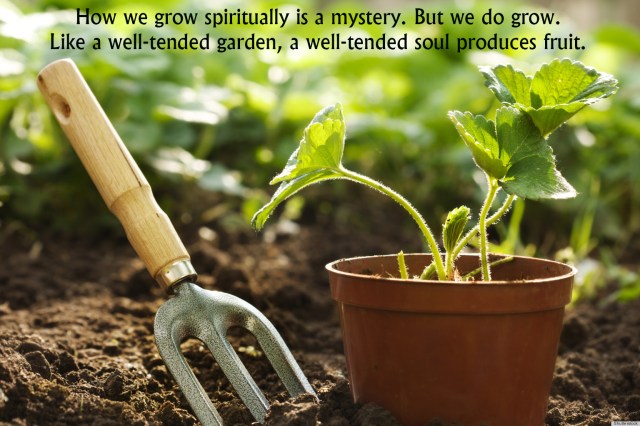
How we grow spiritually is a mystery. But thing is, we do grow. And just like a garden, where I cannot tell you what makes my peppers grow blossoms, I can tell you what I can do in general terms to take care of the plants under my care.

When our first Mother’s Day in Medford rolled around, the Redhead and I did what we normally did on Mother’s Day. We went to a greenhouse and we bought plants for our garden. In Alaska we grew everything in pots, because it was a short growing season, and if you were going to get any tomatoes, you had to bring them inside in late August or early September. But at our first house in Medford we had a grand garden space.

Not only did we do what we used to do in Alaska, we bought the kinds of plants we used to buy in Alaska. So in mid-May we bought and planted spinach, broccoli, brussels sprouts, and lettuce. By mid-June it had all bolted. We couldn’t plant things in Medford as though we were still in Alaska. We had to adapt our gardening to where we were, not where we came from.

One of the first things about gardening you have to learn is that not every field, nor every climate can grow just any kind of produce. One of the first things I learned about spiritual growth is that what works for me may not work for you.

When I first became a pastor I got a lot of books on spiritual development. Often there were programs attached, where you could do a ten-week study on how to improve your spiritual life, and I tried many of these. I started to notice a pattern. Sometimes the program, the course, the book, whatever it was, would work. I would give it to people, and they would grow spiritually. But then I would take the same program, the same course, the same book, and give it for different people, and it was like pouring salt water on a plant. People didn’t grow. Whatever worked for the last group didn’t always work the next group. Or might try a program and recommend to a pastor because it worked so well in my church, and it would fail miserably for the other pastor. Or vice versa—what worked for them would bore my parishioners to tears.

What makes us grow spiritually? There is really no one thing I can say that will work for all people in all places at all times. Sometimes people need to read the Bible more, sometimes they need to pull back. Sometimes they need to do more acts of services, some people need to do less. Some people need to spend more time alone, and others need to spend more time with other people. Some people need to learn and study more; others already know more than enough, and they need to get out of the books and put what they have learned into practice.

I look out among you, and we are a fairly homogeneous people. We have all chosen this place, this style of worship, this kind of social gathering. And yet what may work for some of you, what may help you grow your spiritual lives, will fall flat with the person sitting behind you.

Or you can say our church is like the seed planted in the ground; the parable works that way too. What works for our church may not work for other churches and vice versa.

The trick, as in gardening, is knowing the soil of soul. And knowing what you want to grow in your soul. We have to know ourselves. I may want to think certain things will work for me, but I have to be honest about who I am. More than once I have had people tell me they have a hard time believing like they used to. As I find out more about them, I usually learn that they had a great spiritual experience years ago, and they are still trying to live off of that. As I talk more I learn they are a different person than they were when they originally had that experience. And so it is no wonder that what worked for them in one period of their live is not as effective today. If they came to faith when they are a young adult, newly married, new baby, fresh start on their career, I am not at all surprised that when they hit midlife, they have different spiritual needs. I don’t eat the same way I ate when I was 20. Back then I would have a cup a coffee after dinner, maybe two. I would snack all day on junk food, I made popcorn every night, sometimes followed by ice cream. I don’t do those things anymore. I need different nourishment now that I am slightly older.

In the same way I cannot replicate the spiritual life I had when I was 20. I am not that person anymore. But I have to know that about myself. I have to have a pretty good idea of who I am today. Not who I want to be, or who I was 20 or 30 years ago. We have to know the unique soil of our souls in order for them to produce spiritual fruit.

Then we have to patient. When you are gardening, if you want a salad for dinner, you don’t just go out and plant lettuce in the morning. A spiritual life that mushrooms quickly is going to decline just as quickly, just like a mushroom. Like any growth of any substance, the growth in our souls is best when it is slow and sure. A little change that occurs regularly over a long period of time is often more substantial than a big change that happens all at once.

The Russian author Fyodor Dostoevsky recounts in one his novels the story of a man who was taken out to be executed by a firing squad. He was led out in handcuffs, blindfolded, made to stand in front of a wall. The major in charge of the execution said, “READY. AIM…You sentence of death is commuted. You will not be shot today.” Dostoevsky could tell the story so well, because that actually happened to him. Imagine how that experience could change your life. He says that as he was led out, he saw everything in vivid detail. He heard the birds singing, every note. He felt the warm sun on the back of his neck. And when his sentence was commuted, he vowed he would not live life to the fullest. He would take anything for granted any more. But, in a few months, it was as if that had never happened. He quickly went back to his own ways of seeing the world. He took a lot for granted.

The BIG changes aren’t always the most important ones. The really important ones are the little changes we make day by day.

You have to consistent to grow your spiritual life. Ok, so I planted my peppers, and I know I am going to be gone for a week, so instead of giving them a gallon a day like I normally do, on the Sunday before I leave, I pour twenty gallons of water in the soil. It doesn’t work that way! You have to water them every day. In our old garden I would spend two whole days at the beginning of the gardening season pulling out all the weeds that had grown up over the winter. I have to admit, more than once I got a little miffed that I had to spend part of my day off weeding the garden. “I did that, like two months ago! Why do I have to do it now?” Well, because if you want a good garden, you have to be consistent with watering and weeding.

The best way to grow a spiritual life is to be regular and consistent. Spending a weekend a year reading the Bible cover to cover may be a good idea, but frankly reading a little bit every day is going to be much better for you. I met a monk once who told me he read and meditated on a verse from the Gospel of John every day. One verse a day. He was, I think on chapter three when we talked. I mentioned how long it was going to take to get through the entire book, and he said, “My goal is not to finish reading John. My goal is to feed my soul every day.”

And in spite of the fact that it does not seem to be doing much from day to day, you still have to care for it, or you will see it doing a lot of things you don’t want to see it doing—like bolting, or being overtaken by weeds.

So what is one thing, one small thing you can do to improve your spiritual life this week? It does not have to be earth shaking. Maybe you can read one Bible verse a day, like my friend the monk. Maybe spend five minutes talking to God. Maybe you can give up one small thing, or take up one small thing. “I’ll come down and volunteer at the food bank for two hours every month, or every week. Maybe you can start telling the people you love that you love them on a daily basis. Maybe you can spend five minutes a day thinking about how you best serve God and come up with a plan to put that service into action. Maybe you can spend five to ten minutes a day alone in contemplation.

Maybe you can find a book that will nourish your soul, and read from that, ten minutes a day. Maybe do a daily devotional.

What do you need at this stage of your life? What can you do? Whatever you do, it does not need to be an earth-shattering change. It just needs to be one that will a) help your spiritual life, b) be something you can do consistently and c) something designed for YOUR spiritual life, not your neighbor’s, something that fits your soul.

And how can I help you? I said before the basic needs of a spiritual life are common to each individual, but the specific needs are unique to every individual. How can I help you find your way to a deeper spiritual life? What can I do to help water and nurture your soul? Because the last thing I want to say about growing a spiritual life is this; we don’t do it alone. There may be times when we do things by ourselves, but we are part of a spiritual community. That is why we have group Bible studies and book groups, corporate worship, and fellowship activities. You are a part of a spiritual community here.

And as part of the community we grow together. We are all connected. When you grow, that affects your neighbor and when your neighbor grows that affects you.

As Jesus said, the farmer doesn’t know how the crops grow, he just knows they will grow if he does the right things. How we grow spiritually is a mystery. But we do grow. Like a well-tended garden, a well-tended soul produces fruit. We are the crop of God.

May we grow with grace and love.

Amen.


TEXT: 

Mark 4:26-29

26He also said, “The kingdom of God is as if someone would scatter seed on the ground, 27and would sleep and rise night and day, and the seed would sprout and grow, he does not know how. 28The earth produces of itself, first the stalk, then the head, then the full grain in the head. 29But when the grain is ripe, at once he goes in with his sickle, because the harvest has come.”

Posted in Parable, Sermons, Spiritual Growth, spirituality, Uncategorized | Tagged , , , , , , , | Leave a comment

the-breakaways-2464355_1280 (1)

Posted in Uncategorized | Leave a comment

unforced rhythms


billy_sunday-the_truth

The Preacher

            The air was sultry hot, and the preacher was sweaty and tired, but still full of fire, and he was not about to stop–not until himself got a convert.

We were in the assembly hall at a Baptist beach church camp, and it was the final night. The preacher had been doing altar calls all week with almost no response, and tonight he was not to be denied. The problem he faced was that half the people in the hall were already saved and the other half were pretty determined to NOT be saved. I was in the second group that night.

My soul was not ready for eternal bliss for a variety of reasons, all of which had to do with being a typical 15-year old male. I, and everyone else in the hall, sat firmly in our seats.

The preacher was determined. He wanted some notches in his Bible Belt.

“I know…and the Lord has said this to me…that there is someone out there….one of YOU, who needs to come forward tonight, who needs to be saved TONIGHT! You dare not tarry.”

But tarry I did, even though the crowded room was getting hotter and hotter. And I was not the only person in the room to tarry. My friends were just as revolved as I was to stay cemented in their seats. The overhead fans were pushing sweltering humid air down on us and there was no cool beach breeze to ease our anguish. I wanted to get out of there something awful. I came to this camp because of a girl, and we had plans to meet on the beach after chapel, and I was good and ready for after chapel.

“I knew a boy,” the pastor continued, “Who tole his mama that he didn’t want to get saved yet, but that he would, and real soon. Said he wasn’t ready. His momma talked him into going to church one Sunday, and the boy was ready to be saved, but a drunk driver plowed into their car ON THE WAY TO CHURCH, and now that sweet boy is suffering ETERNAL damnation because he put off being saved!” At this point the preacher went into a pretty vivid description of eternal damnation, which ironically sounded a lot like what I was going through at that very moment. The fires of hell had nothing on the still summer air and the torrid thoughts winding and twisting through my mind in anticipation of the evening to come.

At one point I almost walked down the aisle, just to shut him up, but I knew there would be no way to get to the beach afterwards because they would want to rejoice with me over the redeemed state of my soul, and I was more more interested in getting down to the beach and doing something unredeemed.


# # #

Unforced Rhythms

I did not get saved that night. Nor did I meet that girl on the beach. She stood me up for an older guy.

Years later, I did have a conversation with God, one I needed to have, and it wasn’t at the bequest of a sweaty preacher who was looking for a body count. I was sitting alone on the back porch of my parents’ house, and just slowly realized it was about time I had a talk with the Almighty.

Somewhere during that conversation I was born again, I turned my life over to God, I accepted Christ as my personal savior, I was saved, I started my faith journey for real, I become a practicing Christian–call it what you want, my relationship with God changed that afternoon, and ever since then I have counted myself as a follower of Jesus Christ.

There was nothing coercive about it. It just happened, in a natural, unforced way.

Years later I would read Eugene Peterson’s translation of Matthew 11:28-30:

Are you tired? Worn out? Burned out on religion? Come to me. Get away with me and you’ll recover your life. I’ll show you how to take a real rest. Walk with me and work with me–watch how I do it. Learn the unforced rhythms of grace. I won’t lay anything heavy or ill-fitting on you. Keep company with me and you’ll learn to live freely and lightly.

The conversation I had with God had a lot more to do with the “unforced rhythms of grace,” than the demanding strident threats of a man whacking me over the head with Jesus.

I came to the table of faith because I heard Jesus “softly and tenderly,” calling me home, not because a pastor was yelling at me. The invitation came through some friends of mine who had become Christians, but who had, over the last year, truly cared for me as a friend, and who did not openly judge me, as well as my relationship to a church that also a very caring place.

Both my friends and the church exhibited the unforced rhythms of grace that lie at the heart of the faith in ways that made it irresistible. They did not push me to get right with God, and because they didn’t, I did. A coerced conversion is no conversion at all. If I am only bowing down to Christ because someone is pushing me down, my heart remains standing and unmoved–in fact it becomes more rebellious.

silhouette-1479058_1920            But when I open myself up to the unforced rhythms of grace, I join a dance that has gone on since before time and will continue as long as long as time does–and beyond. There are times when can I feel those rhythms deep in my bones, and the divine dance floor is open and I am swaying to the cadences of heaven. Sometimes it happens during worship, but it can also happen at a Grateful Dead concert (with literal dancing), a hike in the woods, or while reading a moving passage from an essay or novel. It can happen when I am working with the homeless around our church, or when I am counseling someone. It never happens when I am angry, impatient or irritated. It can never be forced.

David Bentley Hart, in The Beauty of the Infinite, makes the point that there is no room for coercion or violence in Christianity. Instead the church should strive with all its might to attract people through its embodiment of beauty posed on the edge of infinity. Beauty, he says, elicits desires that draw people to it naturally. The nature of the church should be its own persuasive force. We don’t need barkers standing outside the the revival tent, cajoling people to come in. We should be the kind of people who are naturally attractive–beautiful in our commitment to justice, to compassion, and to the infinite God.

Scaring or shaming people into faith is a losing proposition. It can only produce a scared or shameful people. Forcing the rhythms of grace messes up that very rhythm and leads to cacophony. The commitments that accrue from faith should flow naturally and beautifully from the lives of faithful. The Church should not need to persuade people to join–the form, commitments, and practices of the Church are the persuasion. If we are not a beautiful people we have no right to expect others to be attracted to us.

Many years ago, on Sixty Minutes, Andy Rooney said that on the whole he tended to be more pro-life than pro-choice, but that he liked the pro-choicers more than the pro-lifers. I think a lot of people feel that way around Christians. They may like the notions of grace and forgiveness, but in order to get through to them they have to go through a people who can be ungraceful and unforgiving as a normal way of practice. As one bumper sticker says, “I love Jesus, but I’m not crazy about his fan club.”

On the other hand, the unforced rhythms of grace are not just attractive, they are often irresistible. The day I did finally make a commitment to faith in Christ was the day I discovered the irresistible love of God. That is the faith that has stayed with me over the last forty years.

# # #

Dancing to the Rhythm

After what seemed to be an eternity of haranguing, the preacher finally gave up that night without a single soul walking down the aisle. From his point of view it was a wasted night. He was defeated, like Father McKenzie in the Beatles song. No one was saved. But he was pushing a product I don’t think he really believed in himself, which is why few others wanted to believe him. Why on earth would I let someone coerce me into making one of the most important decisions in my life when their very style of persuasion belies the heart of their message? If he truly believed in the love of God, he could have let that love shine through at least a little. If he truly believed in the power of God, he could have trusted God more to draw the people in.

He was an ad man pitching a product that he never really bought into himself. He was taking the beautiful rhythms of grace and forcing them into a constrained structure that never could and never will contain them.

As for me, I would rather dance to unforced rhythms.

Posted in Church, Conversion, Dance, Jesus, Salvation, spirituality, Uncategorized | Tagged , , , , , , , , | Leave a comment

Attacking the Good Work of God; Reflections on the Unforgivable Sin


1oB2NJXuRKa4h29YYHYn_FOG_1280x720


You heard about the man they found on a desert island? He was a strong practicing Christian, and when he showed them around the island and the life he made for himself in isolation, he made sure to show them the church he built where he could worship. One of the rescue party asked what the building across his compound was. “Oh, that,” he said. “That is where I used to worship.”

To say the Christian church is extremely divided today is like saying it is cold in Antarctica in the middle of their winter. We have Pentecostals and Episcopalians, Congregationalist and Catholics, Brethren and Baptists, not to mention Orthodox, Assemblies of God, what goes by the name The Christian Church. There are 13 different brands of Catholics, of which the Roman type is the largest.

One study found there are at least 200 different denominations in the country, not counting all the individual non-denominational churches.

And Presbyterians?

Well there is the Presbyterian Church (U.S.A.), the Presbyterian Church in America, the Orthodox Presbyterian Church, the Bible Presbyterian Church, the Cumberland Presbyterian Church, the Cumberland Presbyterian Church in America, the Evangelical Presbyterian Church, and the Evangelical Covenant Order of Presbyterians (ECO).

americanpresbyterianfamily001That doesn’t include all the other off shoots of the Reformed tradition: the Reformed Presbyterian Church of North America, the Associate Reformed Presbyterian Church, the Reformed Presbyterian Church in the United States, the Reformed Presbyterian Church General Assembly, the Reformed Presbyterian Church – Hanover Presbytery, the Covenant Presbyterian Church, the Presbyterian Reformed Church, the Westminster Presbyterian Church in the United States, the Korean American Presbyterian Church, and the Free Presbyterian Church of North America.

Whew! Talk about your split P-soup!

Almost all of these result from splits over the last 250 years of our history. One group differed from another, and felt they had to go off and form their own denomination. In almost every case there was someone or a group of people who looked at the others around them and said, I can’t be a Christian if I have to do it with you.

In today’s Gospel lesson we see the same dynamic at play in first century Palestine. The scribes have come down from Jerusalem to check out what Jesus is doing to their religion.

Who are the scribes? They are the people, based in Jerusalem, who are responsible for the maintenance and practice of the law. At this time very few Jews spoke Hebrew. They, and this includes Jesus, spoke Aramaic, a language similar to Hebrew the way Dutch is similar to English. The scribes knew Hebrew, the language of the Old Testament, and it was their job to preserve the language. They also were like the gatekeepers for the law. They interpreted the law for the vast majority of people who could not read it for themselves.

Apparently they have gotten word of this new preacher running around doing miracles, and teaching people about the law, and they are concerned because he is getting pretty popular, and he has not checked in with them on his interpretation of the Law of God. It is their job to maintain quality control, and they have come to hear Jesus to see what he is up to, and whether they need to stop it.

And their conclusion is that he needs to stop what he is doing. And they make that clear in no uncertain terms. “He has a demon,” they say, hoping that will scare the crowds off.

But Jesus counters their charges. “If I am a demon, then why am I trying to draw people to God? A house divided against itself cannot stand. That is not a great theological truth; it is common sense. Lincoln used this very verse when he said in 1858 that this country could not exist half-slave and half-free, because we would end up in a perpetual state of conflict. In fact that is that state of affairs that led to the bloodiest war in American History.

This is a good lesson for the church today. We are more divided than ever before in the history of Christianity. We have a hundred different ways to define ourselves as Christians these days. That is not bad in and of itself, but the problem is we define ourselves in a way that excludes others. And we tend to look at the others and say, “there is something terribly wrong with the way you are doing religion.”

Jesus attacks that attitude head on, and here is where the story starts to get sticky.

“Truly I tell you, people will be forgiven for their sins and whatever blasphemies they utter; 29but whoever blasphemes against the Holy Spirit can never have forgiveness, but is guilty of an eternal sin”

I don’t know about you, but when I hear this, the first thing I think is, “Have I committed the unforgivable sin? If I did, I didn’t mean to! Am I going to spend eternity walking around barefoot on hardwood floors full of Legos because I accidentally committed the unforgivable sin?”

Let me put your heart at rest.

Here’s the scene. Jesus has just gotten into a tangle with the scribes.

And Jesus, standing there and looking at them, starts talking about unforgivable sins. His remarks were pointedly aimed at the scribes, not the people who had gathered around him.
All eyes were on him, and he had his eyes on the Scribes and he told them they had committed an unforgivable sin.

What was their sin? They accused him of having a demon, of being a demon. They pointed the finger at him and said, “You are evil.” Once you do that, there is no room for further conversation. It is one thing to say, “I really disagree with you on this issue.” It is quite another to say, “Well if you believe that, you are truly evil.” Once you go there, there is almost no going back. Few people are willing to shake hands with the devil and let bygones be bygones. When it comes to Satan, there is no reaching across the lines to find a compromise, or at least a way to co-exist together. Most people, if they think something is truly evil, will have nothing to do with it.

And the scribes just said Jesus was a devil. And here’s the rub—they said it because he had healed people. First he had healed the man with the withered hand, which we read about last week. After that little escapade his fame spread and all sorts of people were coming to him. And he healed many of them.

The scribes saw this and they did what many people do who see something they cannot understand—they demean it. Rather than face the uncomfortable question, “You guys are supposed be God’s people—why aren’t you able to heal people like he does?” they cut off the conversation at the knees. “He is a devil!”

We see this throughout history, where people disagree and before long someone is calling someone else a heretic, or an infidel, or a witch and then it’s not long after that the someone gets ex-communicated, burnt at the stake, hanged, or shot.

So when the scribes called Jesus a devil, they had committed an unforgivable sin—calling the work of God evil. There are more than few instances in the Bible where Jesus does something miraculous, something wonderful, like healing people, and gets accused and condemned for it.

If we condemn the good works of God, what chance do we have of having those works come our way? If we condemn hope, what hope can we possibly have for our own lives? If we call what is obviously good “evil,” what good are we?

If you are sitting here today wondering if you might have committed the unforgivable sin inadvertently, you obviously have not committed the unforgivable sin. You have room for God, and for the work of God in your heart. You have not looked at an obvious good and called it evil.

As I pointed out at the beginning of the sermon, we see that dynamic a lot these days. It’s not enough to have a disagreement; but often one side will try to demonize the other. We see it in politics, we see it in social issues, and we see it in the Church of Jesus Christ.   “I don’t see how you could call yourself a Christian if you believe that.”

Now why on earth would the scribes attack Jesus for doing good? I mean, if you see someone out there healing people, miraculously, you would think their first reaction would be, “Can I hang with you? ‘Cause you got some kinda power that is out of this world!” But no. They want to condemn him, demonize him.

In a way, Jesus does the same thing himself…but in a different way. He is not demonizing the scribes, but he does say that their behavior shuts them out of the Kingdom of God. For some people that is disturbing, because we don’t want to think that anyone is shut out of the Kingdom. I think that is why we don’t like the idea of an unforgivable sin. Everyone deserves a second chance. Everyone deserves forgiveness.

But that does not mean we baptize everybody’s behavior and let it be acceptable. I think what Jesus is telling us here is that are places where we have to draw a line. And for Jesus it is the scribe’s behavior.

I want to be clear. Jesus does not condemn them because they attacked him. When Luke tells this same story, he adds to it, “And everyone who speaks a word against the Son of Man will be forgiven;” What burns Jesus is that they are keeping people from enjoying the love of God.

What he says next reinforces that. Apparently his family was worried about him, and they sent some people to Jesus to tell them they were waiting for him outside. Now in that culture when your family wants something, you do it. But instead Jesus says, “Who are my mother and my brothers?” And he looked at the people around him, he said, “Here are my mother and my brothers! 35Whoever does the will of God is my brother and sister and mother.”

Where the scribes were trying to keep the way narrow, and if you don’t toe their line, you are on the outside, Jesus opens up the door for everyone. “Anyone who does what God wants them to do is part of my family.” The scribes saw themselves as gatekeepers. It was their job to keep the wrong people out. Jesus saw himself as a gate opener. “Anyone who wants to come in is welcome—they are a part of my family.”

We have too many gatekeepers. We erect theological gates, gates on social issues, gates on practice, and gates on what kind of music we sing to. We have too many people who want to define what it means to be an insider so narrowly that once you get in you only find people who are just like you are. People talk about true Presbyterians, true Christians, and if your theology does not match theirs, you are on the outside.

We are so divided. And to what purpose? To what purpose? It only weakens the church in the eyes of the world and keeps us from enjoying each other.

Jesus is not trying to keep people out—he wants to pull in as many as possible. He does not care what is in your past. He does not care whether you are a righteous person of God, a fisherman, or thieving tax collector. He does not care if you were a respected businessman, a struggling single mom or dad, and I’m pretty sure he even wants politicians to be a part of his family. He wants you to become a part of his family.

But here’s the deal. If you want to hang with Jesus, you have to be willing to hang with all the other people who are with Jesus. If you become a part of the family and then start wondering how all these other people got in the family, then you don’t yet understand what it means to be a part of his family.


In the first lesson this morning we heard Paul say, For this slight momentary affliction is preparing us for an eternal weight of glory beyond all measure, 18because we look not at what can be seen but at what cannot be seen; for what can be seen is temporary, but what cannot be seen is eternal.

What we see is the outer ways we are trying to relate to God. We worship one way in our early service and slightly different in the later service. One is more informal, and one is much more traditional. Neither way is right, and neither way is wrong. Other churches do it differently than us. They are not wrong in what they do.

There is an old Jewish saying, “Never make fun of the way a drowning man is swimming. He is doing what he has to do to survive.” Nor do we make fun of the way others worship. We are all trying to get through this life. We are all swimming in the waters of life, hoping to get through the best we can, trying to find a lifeline to God. Sure, we can open to swimming lessons, but how we swim through life is not what defines us.

Paul encourages us to look deeper. Some speak in tongues and wave their hands in the air when they worship, others stand, cross themselves and bow, while still others sit. Some use set liturgies as part of the service, while others sing for the majority of the service. Some sing hymns, others sing songs that sound more like pop songs.  All that is the outside stuff. What matters, Paul says, is what is inside us, what people don’t see. That is what God sees when God see us at worship.

It’s OK to like where you worship It’s OK to prefer a particular style of worship. But at heart we have to admit that is a matter of taste, not a judgment about who is in and who is out.

When I first came to Medford, someone asked if I was a Duck or a Beaver. I am finally ready to answer that question. Some of congregation are Ducks and some are Beavers.

And I stand firmly with my congregation.

In the same way, some of my family, the family of God, worship one way, some another. And I stand with my family.

Posted in Jesus, Love, Unity | Tagged , , , , , | Leave a comment