Love Your Enemies

love-your-enemies


Joseph

There is the idea that the Old Testament is the book of Law, and the New Testament is all about grace. That is broadly true, but there are large elements of grace and forgiveness in the Old Testament, and elements of Law in the New Testament. The two readings we have today show us how both Testaments can have unexpected surprises.

Today you heard the tail end of the story of Joseph. Let me remind you of what happened before we get to today’s passage. Joseph is the favorite son of his father Jacob. And he knows it. And he lords that over his other brothers. For example, he has a dream one night that there are eleven sheafs of wheat bowing down to one sheaf. He has eleven brothers, and so he interprets this to mean that one day his brothers will be bowing down to him, the youngest. Ok, so he was right about that, but it was not wise for him to go tell his brothers about his dream. Then he has a second dream that the sun, the moon, and eleven stars were bowing down to him.  They were already miffed about him being his Daddy’s favorite, and about the ornate tunic, or coat of many colors, his father had given him. One day Joseph goes out the fields where his brothers are working (apparently Joseph did not have to go out and work in the fields) and the said, “Look, here comes that dreamer! Let’s kill him! Well, they don’t kill him, but they sell him to slave traders, who take him to Egypt.

While in Egypt, after a series of misadventures, Joseph eventually becomes Pharaoh’s right hand man. If you remember, the Pharaoh had a dream about seven fat cows eaten by seven skinny cows, which meant there would be seven years of good crops, and then seven years of famine. It was Joseph’s job to manage the grain and all the other goods in the fruitful years so there would be enough food during the seven years of famine.

The famine does come as Joseph predicted, and guess who comes knocking on his door to ask for food? His brothers–the guys who sold him to the slave traders. How easy it would be to deny their request, assuring their death. If he wanted, he could give the word, and have Pharaoh’s men arrest them. The opportunity for vengeance has come knocking on his door. He can finally get his just desserts, he can finally make those who tried to destroy his life pay for their deeds. He can triumph over his enemies.

But what does he do? He forgives them. Unconditionally. He loves his enemies. He accepts them, and brings them into the fold.


Jesus

And now we come to Jesus.

27″But I say to you that listen, Love your enemies, do good to those who hate you, 28bless those who curse you, pray for those who abuse you. 29If anyone strikes you on the cheek, offer the other also; and from anyone who takes away your coat do not withhold even your shirt. 30Give to everyone who begs from you; and if anyone takes away your goods, do not ask for them again. 31Do to others as you would have them do to you.

He is talking about exactly what Joseph did some 3000 years earlier. Joseph looked the people who tried to kill him right in the eyes, and said he forgave them. Not only that, he welcomed them into his home, and made sure they were taken care of for the duration of the famine.

Jesus would have liked that.

These are hard words coming from Jesus. It is one thing to read of Joseph forgiving his brothers. It is quite another to look our own enemies in the eye, and forgive them. Yet that is exactly what Jesus calls us to do. God, according to Jesus, is kind to the ungrateful and the wicked. God, according to Jesus, is merciful. And Jesus tells us we should be merciful, we should be kind to the ungrateful and the wicked, just as God is.

And he takes it one step further. “Do not judge, and you will not be judged, ” he says. “Do not condemn, and you will not be condemned. Forgive, and you will be forgiven.” Of course he could have stated it another way. “Judge, and you will be judged. Condemn and you will be condemned. Hold grudges and grudges will be held against you.”

That is a harsh standard, one that is not easy to keep.

But it is an important standard. One thing that 5000 years of recorded history teaches us is that hate begets more hate. Hate and judgment are viruses that affect humanity. They do an incredible amount of damage, and they are contagious. The inoculations for hate are love and forgiveness, acceptance and kindness. Jesus calls us to love our enemies because it is good for us to do so. It is good for human race.


Loving Unlikely Enemies

Not all of our enemies are people. We face foes of many different types, and in all probability, if we have real enemies, they are probably not people. After all, we are very likable group of people–moderate in theology, moderate in politics, moderate in style. Who would hate us? Why would anyone choose to be our enemies?

On the other hand, the impersonal enemies we face are much more prevalent. What do I mean? I’ll start with a personal example from own life. There are many times when I feel that age is an enemy. The morning creaking of my bones, the ever-increasing aches and pains, the flow of years and the bittersweet lingering memories of times gone by–these appear as unwelcome intrusions in my life. I bet I am not the only one who feels that way. Of course fighting age is about as effective as fighting gravity. You’re just not going to win that battle.

But what if I embrace it? What if, instead of seeing the advance of years at the invasion of an enemy in my life, what if instead I welcomed it. What if, instead of dreading it, instead of fighting it, I accepted it as this time in life. It is neither good nor bad. It just is.

When I was a hospital chaplain I did a meditation program, and found it worked for people with chronic pain. I did a lot of reading on the subject and found two really interesting articles on pain management. The first involved meditation and pain directly. They took two groups of subjects, put rubber bands around their arms, had them immerse their banded arm in a bucket of ice water, and hold them under the water as long as they could. One group was told to think about their happy place. They would immerse their arms in the water, and as the pain of the cold water grew, they would think about being somewhere else, somewhere very pleasant. A beach, sitting by a mountain stream, at their favorite restaurant with friends. They were told to think of anything except the pain. And in fact these people were able to hold their arms in the cold water longer than people who did not do that.

The second group was told to concentrate on the pain. Get to know it. Think about how it felt, and what that compared to. Explore it. Get to know the pain. Feel the pain. Don’t try to run away from it; instead run toward it.

The first group of people, those who tried to think about anything but the pain, were able to hold their arms in the cold water for up to three minutes. The second group, those who were told to embrace the pain, could hold their arms under for up to seven minutes, and some were able to do it almost indefinitely.

The second thing I ran across was an interview with a pain management specialist, who I think was from Finland. He had an effective, but strange way of helping deal with chronic pain. When asked why he was so successful in helping people deal with chronic pain, he said the first thing he did was to try to get people to become friends with the pain.

To think of pain as an enemy is very easy to do. But that if it is not. What if, instead we can make it if not a friend, a least a benign acquaintance? What if we can learn to love even this enemy? I realize this may be more radical than trying to love a human enemy, but what if we were to embrace the various enemies that surround us–age, pain, depression, addiction issues, illnesses–physical and mental, and other negative circumstances in our lives. What if we can accept them, let go of our anger, let go of fighting, and learn to embrace the things that plague us. An alcoholic can only change if they embrace the fact they are an alcoholic. And sometimes there are circumstances we cannot change. I’m never going to change the fact that I am getting older. A cancer patient can undergo treatment, but they will be a cancer patient.


Conclusion

We can spend our lives fighting those things that plague us, fighting our enemies. Or we can learn to love our enemies. I realize how hard that is. And there is really only one way we can truly learn to love our enemies, and that is by loving God. Neither Joseph nor Jesus talked about loving enemies as a humanitarian gesture. They did not practice that because they were good people, but because they were godly people. Both wound their love of neighbor and of enemy around their devotion to God.

It sounds counter-intuitive–to love an enemy. But Jesus tells us it is the way to eternal life. It is the way to wholeness. It is the way to salvation.

Amen.

Posted in Community, Compassion, Forgive Your enemies, forgiveness, Jesus, Joseph, Love, Spiritual Growth, spirituality | Tagged , , , , , , , , , | Leave a comment

Total Depravity and Redemption

news

I have a Facebook friend who regularly posts about the inner peace he finds by avoiding the news like a plague. He has a kind of evangelical fervor about it (you too can enjoy this serenity, and all you have to do is turn off that CNN), which irks me a bit because I start my morning with NPR, Talking Points Memo, CNN, and Politico. I relax when I get home from work by tuning into CNN or MSNBC. Before I head to bed, I catch the last headlines of the evening, and a smattering of international news.

I admit it freely. I am a news junkie. I remember watching Huntley and Brinkley as a small child and when I was a paper boy, I always read the papers before I delivered them. I flirted briefly with being a journalist, and went as far as to attend Journalism school at the University of North Carolina in Chapel Hill.
Although I don’t always appreciate my friend’s public disavowal of keeping up with the events of the day, I can understand his reasons. The events of the day can be pretty depressing. It appears that things are getting worse on a daily basis.
But should that surprise us? In A River Runs Through It, Norman Maclean wrote, “As a Scot and a Presbyterian, my father believed that man by nature was a mess and had fallen from an original state of grace.” Being part Scot and mostly Presbyterian, this resonates with me. The old timey guys called it Total Depravity, the doctrine that none of us are as good as we could or should be. So being shocked at discovering the world is a mess is like being shocked to learn there is gambling at Rick’s bar in Casablanca.
My news-avoiding Facebook friend is a gardener by inclination and trade. He chose his profession well. A colleague of mine in ministry would retreat to his garden as often as he could, especially when the craziness of ministry started rearing its head. “You put the right plants in the right soil, and nurture the way it is supposed to be nurtured, and it grows. People aren’t like that,” he once told me. “You do all the ‘right’ things, and you never know what is going to happen.”
The world is a mess because people are a mess. Spending a life constantly surprised by sin and chaos in the world is a terrible way to live. It’s like walking out in the streets and being surprised by cars that whoosh by you.
That knowledge inoculates me from persistent outrage.
If I were prone to outrage, I would have to turn the news off, or learn to live in a perpetual state of shock and awe. But the lingering scent of total depravity in the air keeps my inner jets from continually burning out. I stay informed, but I do not despair. Nor am I jaded. In fact I consider myself an optimist. Being a realist about human nature does not mean you have to pessimistic about it.
The flip side of Total Depravity is redemption. While the world is a continual mess, it is also continually being redeemed. The new is not all bad news. Given the “If it bleeds it leads” mentality of many media outlets, it is encouraging to see hope spontaneously breaking out in unpredictable places. Watching the news informs my prayers because I believe that in a world turned nutty, God is still at work. Whether it is young people confronting the powers that be on climate change or gun control, outbreaks of compassion for the homeless, or the consistent effort of people trying to do good, cheerfulness keeps breaking through (in the words of Leonard Cohen.)
Paul wrote, “We know that all things work together for good for those who love God, who are called according to his purpose. The operative phrase in that sentence is “all things.” We tend to jump over that, and interpret Paul’s words to mean, “Everything is good for those who love God.” But no. “All things” means the good and the bad, the sublime and the mundane, the works of charity and the works of self-interest. God does not sort through “all things” before they come to us. We experience it all. The promise is that in the hurly-burly of all things, God is at work. We may want the results of God’s work to be instantaneous, but they often are not. Sometimes we have to wait a while to see the final outcome. There are some things we will not see on this side of the grave. But the promise still stands.
So I watch the daily news, and try to sort it all out. I react to the things I see, sometimes through prayer, sometimes through writing, sometimes through action, and sometimes I just have to wait it out. I’m not shocked by what I see, nor am I depressed by it. In fact I often get energized, motivated to fight the craziness by clutching to sanity, to respond to the evil in the world by doing good where and when I can. Total depravity is eventually superseded by redemption. And I try to do my part to make that happen.

Posted in A River Runs Through It, Compassion, Current Events, Evil, Growth, Hope, ministry, News, Social Justice, Social Ministry, Spiritual Growth, Theology | Tagged , , , , , , , , , , , , , , , | Leave a comment

Spiritual Politics and other Rare Breeds


Writing almost 50 years ago, Thomas Merton, a Trappist monk in Kentucky, wrote about what he called political principles spiritualized by the Gospel. In his book Conjectures of a Guilty Bystander, Merton’s reflections on society at large, he starts his discussion of politics by talking about the false distinction between “the natural and the supernatural.” The divide between the two is not as wide as many think. In fact, the two can often merge. “Christian social action,” he writes, “ conceives a man’s work itself as a spiritual reality.” He puts a finer point on that by saying our work can “recover a certain spiritual and holy quality, so that it become a source of spiritual renewal, as well as of material livelihood.”
He then outlines three things that make for political action that becomes spiritual action as well.

First, spiritual politics has to be human. It has to be about people, not processes. Anyone who has ever been caught up in a dehumanizing bureaucracy knows how important the human factor is. Jesus said that people were not made for the Sabbath; the Sabbath was made for people. The same is true of politics. While humans are political animals, according to Aristotle, our politics must serve our humanity, not repress it. And they must serve our common humanity. Politics that serve one group at the expense of another cannot have any claim to be spiritual, much less Christian.
Spiritual politics cannot serve the interests of corporations first. Contrary to the words of a former candidate for president, corporations are not people. They are driven by a profit motive, which is fine, but that can never trump the needs of real people. I am not being anti-business here. There are ways the business do serve people, and those should be supported, but to give a blank check to corporations on the chance that what is good for them is good for the people is naive at best, and more likely craven materialism.

Second, not only must it be human, it must be personal. Humanity is not one-size-fits-all being. It is not enough to just treat people like human beings. Even with our various ethnic and tribal qualities, we differ incredibly from person to person. When we view groups of people as groups, we miss the individuality of the human race, and fall into repressive stereotypes. Some of these can be harmless, like when my German friend brought ketchup to our first breakfast together because, “all American eat ketchup at every meal.” He was trying to be polite, but missed the mark. That was a social faux pas. But when it comes to politics, the stereotypes can be more dangerous. Muslims are terrorists. Immigrants are rapists and thieves. (”Some of them are good people,” does not count as a real qualifier.) Jews love money. Young Black men are hoodlums. Old White men are racists.

Grouping people into stereotypes is anti-human, and anti-spiritual. Dividing the world into “good people” and “bad people” is simplistic. The reality is that we are all have a much deeper moral texture, one that cannot be easily summed up by dividing us into good and bad people.
Etienne Gilson writes in The Spirit of Mediaeval Philosophy, “The work of creation is shattered, but the fragments remain good, and with the grace of God they must be reconstituted and restored.” Dividing the world into the righteous and reprobate just serves to divide us. Nothing is restored, nothing is reconstituted. A spiritual politic will see beyond the stereotypes, and move toward restoration, because it sees individuals, who all have both good and bad in them in. (Or to paraphrase Aquinas, who are created by God, and still retain the image of their creator, but who have had that image marred in them over time.)
Stereotypes depersonalize people, and render it impossible to truly serve people. When we cater to stereotypes we are diminishing our essential person hood.
Third, it emphasizes wisdom and love. There is knowledge enough in politics, but little wisdom. (Actually, in our current situation, we have jettisoned knowledge, and substituted feral instinct.) Politics is the art of calculated gains and losses, or as Harold Lasswell defined it, “who gets what, when and how.” It encourages self-interest, short-term gain, and a quid pro quo morality.
By emphasizing wisdom and love, politicians can move beyond this. Without wisdom and love, our political system will only serve those who have the ability to pay for what they want. Big interests, corporate and otherwise, well-heeled PACs, large donors, and politicians entrenched in all the above will continually subvert the public, often in the name of the public good.
A politics of wisdom and love will easily see beyond the short-term, beyond “what is in it for me?” beyond the tit for tat style of governance which marginalizes those who have no tits they can trade for tats. A politics of wisdom sees beyond the short term, and into the future. A politics of love sees beyond self-interest, and takes us in the realm of the common good. But a politics of wisdom and love is rarer in our political systems than a snowball in the Sahara.
But if we can pull the human, the personal, and wisdom and love into our political system, we will have a system that truly serves all the people, not just the favored few. Can we have that? Can we have a Christian politics? The odds are slim, and I’ll go into that in my next column.

Posted in Community, Compassion, Hope, Musings, Poor, religion and politics, Social Justice, Social Ministry, Uncategorized, Virtue, Wealth | Tagged , , , , , | Leave a comment

Growth in Grace

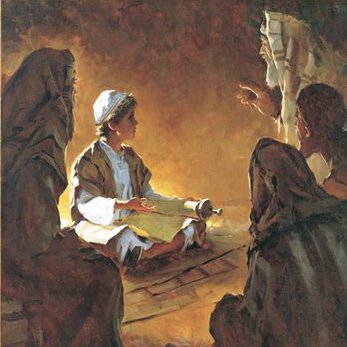
jesus-as-boy-temple


Parenting, as most parents know, can be a terrifying experience. Rewarding, yes, but also terrifying. Somehow you know, that when you hold that little bitty baby in your arms, that you are going to provide a good living for future therapists. I remember when we took Caitlin, my first-born, home. I carried her downstairs, and the nurse accompanied us. I put her in the car seat while her mother got into the car, and the nurse just watched us. I got into the car, started it, and waited for the nurse to say, “Hey, we were just kidding! There is no way we’re letting you take this baby home. You have no idea how to be parents!” But they never did. And her mother and muddled through it, like all parents.

As scary as it was to raise my kids, can you imagine being Mary and Joseph? You are not just raising a kid, you are raising the Son of God. Who, as it turns out, sometimes had his own priorities that differed from his parents.

We actually know little of the life of Jesus beyond the last three years of his earthly life. Two Gospels tell us a little something about his birth, and only Luke, in the passage we heard today, says anything about his childhood. We can read between the lines, but the letters there are very blurred. Joseph disappears after this story, and is only mentioned when people call Jesus “Joseph’s boy.” Which makes me wonder why Luke chose to include this story. Surely no one doubts Jesus’ commitment to be about his Father’s business.

So what is going on here. Why did Luke include this little story?


Two Theories and a third

Different people have different ideas. Some say Luke included to kind of humanize Jesus. Here you see as a kid, he was kind of a discipline problem. Not a bad kid, but he gave his parents some grief, like all children do. That’s one idea, except that in reality this makes Jesus look even more imposing. A twelve year old boy, sitting in the temple with the teachers of the law, amazing them with his understanding of the arcane points of Jewish legalism? That does not humanize him. At twelve my kids were pretty well versed on Harry Potter, and they knew a lot about the Bible, but not enough to amaze a gaggle of pastors.

Others say Luke is showing us how, at an early age, Jesus was committed to God. But again, is that ever in doubt? How many people, after reading the Gospels of Matthew, Mark and John, who did not include this story, think, “I wonder if he really means it?” That Jesus is committed to God is beyond doubt.

No, I think it is for a different reason, one that we find at the end of the story. The story is strange in and of itself, but the ending is even curiouser. His parent chastise him for giving them grief, and then Luke tells us, …he went down with them and came to Nazareth, and was obedient to them. His mother treasured all these things in her heart. And Jesus increased in wisdom and in years, and in divine and human favor.

The interesting thing this tells us is that Jesus a) was obedient to his mother after this, and that he increased in wisdom, and in “divine and human favor.” That he grew from a boy to man is obvious. That he grew both obedient and in wisdom gives us an interesting insight into Jesus. And into ourselves. The essence of the Christian life is growth. Jesus, who was fully God and fully human, had to grow into being the Messiah. And we grow into being people of Grace.


Growth

Growth is a natural part of life. If you aren’t growing, you are dying, so said that great prophet Bob Dylan. But sometimes we get the impression that our faith is not something that grows. Our theology can contribute to that. If we focus solely on the idea of sin and redemption, (We sin, God forgives us, we try not to sin again) then Christianity is becomes a process, kind of like flossing your teeth. You work every night to keep your teeth clean, and you work on a regular basis to keep your soul clean.

But what if it is more than that? What if the cleaning process is only the groundwork for something greater? What if, instead of the cleaning process, our faith was more like tending a garden than cleaning our teeth? The garden we are tending is our soul, and there some incredible things can grow.

Paul uses a different metaphor.

12As God’s chosen ones, holy and beloved, clothe yourselves with compassion, kindness, humility, meekness, and patience. 13Bear with one another and, if anyone has a complaint against another, forgive each other; just as the Lord has forgiven you, so you also must forgive. 14Above all, clothe yourselves with love, which binds everything together in perfect harmony.

Clothe yourselves, he says, but with specific garments. Compassion, kindness, humility, meekness and patience. Forbearance, forgiveness, and love. Like Jesus growing up, who had some things to learn, as we grow spiritually, we have qualities that we should be exhibiting. We are beyond talking about sin and forgiveness here. That is the starting point.

But it is only a starting point. So I understand that Jesus forgives my sins. Now what?

Now comes the fun part. Now we use the information to grow in the grace of God.  Its good to have compassion. But to grow in your compassion is even better. It is good to be kind, but to grow in kindness is even better. Humility–that is not a virtue for our day. Or is it? Humility is not the art of thinking that you are worse than you really are, that you are not as talented, not as smart, not as good, not as capable. Humility is when you put your talents to work, not for yourself, but for God. That is true humility. Meekness is not denying the strengths we have. It is when we use our strengths to serve others. And patience….to grow in patience is harder perhaps than all the rest. There is a book called I Prayed For Patience and Other Horror Stories.

But then Paul gives us three other virtues to consider. Forbearance–that is when we have patience with others. That is when, instead of thinking of the worst of other people, we think of the best. Forgiveness–we know what that means, it is just hard to practice at times.

Paul tells us to put on things, and the only way we can do that is to practice them. We practice compassion, we practice kindness, we practice humility, we practice meekness and yes, we practice patience. And when we do that, we grow, as Jesus did, in wisdom and grace.

The Christian life is like a water skier. If a person stops, they sink. But as long as we are growing, we find we are growing closer to God. The more we exhibit compassion, kindness, humility, meekness, patience, forbearance, forgiveness and love, the closer we are to God, the more we are like Jesus. And that, in the long, is the goal of the Christian life. Not just forgiveness, but to grow closer to God, to grow more like Jesus.

There is a on old story about two monks, one young and new to the order, and another, older and wiser, a teacher for the young novice. The younger monk ran to his teacher one day, crying, “Teacher, I have seen the light of God in my prayers!”

His teacher looked at him, and as he spoke his whole body began to glow, and he said, “Why not become the Light of God.”

Jesus said we are the light of the world. We glow with the light of God, not by mystical exercises, but by growing closer to Jesus, and we grow closer to Jesus by growing in compassion, kindness, humility, meekness, forbearance, forgiveness, and love.


TEXTS

Colossians 3:12-17

12As God’s chosen ones, holy and beloved, clothe yourselves with compassion, kindness, humility, meekness, and patience. 13Bear with one another and, if anyone has a complaint against another, forgive each other; just as the Lord has forgiven you, so you also must forgive. 14Above all, clothe yourselves with love, which binds everything together in perfect harmony. 15And let the peace of Christ rule in your hearts, to which indeed you were called in the one body. And be thankful. 16Let the word of Christ dwell in you richly; teach and admonish one another in all wisdom; and with gratitude in your hearts sing psalms, hymns, and spiritual songs to God. 17And whatever you do, in word or deed, do everything in the name of the Lord Jesus, giving thanks to God the Father through him.


Gospel Reading

Luke 2:41-52

41Now every year his parents went to Jerusalem for the festival of the Passover. 42And when he was twelve years old, they went up as usual for the festival. 43When the festival was ended and they started to return, the boy Jesus stayed behind in Jerusalem, but his parents did not know it. 44Assuming that he was in the group of travelers, they went a day’s journey. Then they started to look for him among their relatives and friends. 45When they did not find him, they returned to Jerusalem to search for him. 46After three days they found him in the temple, sitting among the teachers, listening to them and asking them questions. 47And all who heard him were amazed at his understanding and his answers. 48When his parents saw him they were astonished; and his mother said to him, “Child, why have you treated us like this? Look, your father and I have been searching for you in great anxiety.” 49He said to them, “Why were you searching for me? Did you not know that I must be in my Father’s house?” 50But they did not understand what he said to them. 51Then he went down with them and came to Nazareth, and was obedient to them. His mother treasured all these things in her heart.

52And Jesus increased in wisdom and in years, and in divine and human favor.

Posted in Church, Compassion, forgiveness, Growth, Jesus, Jesus Boyhood, ministry, Musings, Salvation, Social Justice, Social Ministry, Spiritual Growth, spirituality, Transformation, Virtue | Tagged , , , , , , , , , | Leave a comment

Silent Night

silent-night-holy-night-4

The First Silent Night

On Christmas Eve, 1818, in the small Austrian village of Oberndorf bei Salzburg, the members of the Catholic church gathered for the Christmas Eve mass. The priest, Joseph Mohr, had just recently come to the church. Two years earlier he wrote a poem and asked his organist, Franz Gruber, to set it to music for the service.  Instead of playing it on the organ, Franz Gruber played it on guitar.

That is all we know for certain about the first public performance of Silent Night. Stories abound. They had planned to play it on the organ, but church mice had chewed through the hoses that fed the organ pipes, and Gruber was able to transpose the music quickly for guitar. Or the church was beside the Salzach River, which had recently flooded, and so Mohr requested the song be played on guitar because the organ was damaged in the flood. Or he just thought it would sound better on guitar. We really don’t know. And the reason we don’t know is that the most famous, mostly widely translated Christmas carol, went virtually unheard soon after its first performance. For all we know, people went home that night complaining, “When I go to a Christmas Eve service, I expect to hear the organ, not some bozo on a guitar. And why these new songs. What’s wrong with the old ones?” But we really have no idea. After that night, the song disappeared for a while. In fact, they actually sung it AFTER the service, because the guitar was not seen as a fitting instrument for a church service, which leads some to believe that perhaps the organ was working that night.

Gruber, the composer, gave a copy of the song to Karl Mauracher, an organ builder, and the man who serviced the organ in the Oberndorf church. Mauracher passed it on to travelling families of folk singers, the Strassers and the Rainers. Singing families was a thing in Austria back then. Of course the most famous singing family was the von Trapp family from the Sound of Music. These two families toured with the song, and it started gaining in popularity. It was performed for Franz I of Austria and Alexander I of Russia, and by the 1840s was getting to be known in Germany. The first American performance was in New York in 1839. But Joseph Mohr’s name was forgotten. People were crediting the composer, Franz Gruber as the song writer, and attributing the tune various other more famous composers,  Haydn, Mozart, or Beethoven. In fact Joseph Mohr died without ever knowing how famous his little song had become.

In the 1850s the song had become so popular that the Royal Hofkapelle (court orchestra) in Berlin commissioned a search for the author and composer. They managed to located Franz Gruber, but by that time Mohr had died. Gruber recounted, to the best of his memory, the story of that first night it was performed.

The church where it was first performed,St. Nicholas, was destroyed by a flood in 1899. It was rebuilt in 1906, further upstream from the river, where it would be protected from future flooding. In 1926 the city began construction of the Silent Night Chapel, which was finally finished in 1937.


Silent Night

There are few symbols of Christmas more appropriate than Silent Night. Tonight is the 200th Anniversary of that first night when it was sung in Oberndorf bei Salzburg. Silent Night has been translated into more than 300 languages, which is impressive considering there are only 195 countries recognized by the UN. It has just been translated into Kurdish Soranî. Bing Crosby’s recording of Silent Night is still the third best selling single in the United States, behind White Christmas, also sung by Crosby, and Candle in the Wind by Elton John.

The Christmas Truce of 1914 was started when British troops heard the Germans across No Man’s Land singing Stille Nacht in their trenches. In countless churches across the world Christmas Eve services end with the singing of Silent Night, often by candlelight.

But the symbolism goes even deeper.

There are times when incredibly important things have incredibly humble beginnings. Silent Night was one. The birth of Jesus itself, which Silent Night so artfully represents, is another. When Mary and Joseph were looking for a place to have their baby, no one proclaimed, “The Son of God cannot be born in a stable! We must have only the best for his birth.” In fact the only people who had an inkling of what this baby would become, other than Mary and Joseph, were local shepherds, who were not exactly the cream of the crop of Bethlehem’s social elite. True, some wise men showed up later, but that only served to alert the King Herod, and the boy born on the road soon took to the road again, as a refugee from political violence. In fact that baby would grow up and tell the world that he identified with the poor and the outcast of society, so much that if you helped them, it was as if you were doing it for him.

This night we gather to celebrate the birth of a boy, in a far away time, at a far away place, a birth that few took notice of at the time. You would think that the Creator God, the Essence of All Being, the Infinite and Omniscient Lord of all that is, would come into this world with a lot more fanfare. But when the boy grew up, he said he came, not be served, but to serve–to serve all of humanity.


Germany

When I lived in Germany as a student, one of the things I was looking forward to was singing Silent Night at a Christmas Eve service in German. I attended the service at the chapel at the University where I was a student. We sang a lot of songs that night. One of them, I remember, had 9 verses, and we sang all nine. Later someone told me there were 17 verses to that song, so I guess we got off easy singing only the nine. I waited for Silent Night, but I waited in vain. We never sang it. I went to church the next day, on Christmas, thinking surely we would sing at the Christmas service, but again I was disappointed. I mentioned this to one of my German friends, who told me they don’t sing anymore. I asked why, and they told me the Nazis hijacked the song, and turned it into a nationalist anthem to support Hitler.

In fact you might have heard about the “War on Christmas” the last few years. What we have here is nothing to what the Nazis did to Christmas. They took out all references to God and Jesus, and replaced them with words that extolled the holy nature of the Third Reich. The wound from that abomination was still aching when I was there in the late 1980s. Maybe they have moved past it, and I’m not saying they never sing it there, but it goes to show how fragile holiness of that night can be in the short run. Our noise can pierce through the silence, the demons of our worse nature can shatter the holiness, but only for a time.

God has come to us in the person of Jesus Christ, born some 2000 years ago, to bring peace on earth. But like any peace, this peace God has brought can be shattered.

When it comes to the Incarnation, God taking on human flesh in the person of Jesus Christ, almost all theologians agree that Jesus did not just take on the flesh of the baby born in the stable–he took on all of humanity. When God created the world, the world took on the character of God, the same way a symphony by Mozart takes on the essence of who Mozart is. All people are tied together by God who created us. But we forget that. The God who created us is a bridge between all peoples, and between humanity and creation, but we keep erecting walls where there should be bridges. We break the peace God has created between us. We profane what is holy.

But the love of God is so much larger than our imaginations can fathom. It is more powerful than any force known on earth. Years ago some people tried to co-opt the message for nationalist purposes, but they are long gone, and the message of Peace on earth continues. Sometimes the noise of other voices threatens to drown out that voice, but it is an empty threat. The only way the message can truly be silenced is if the people who follow the King of Kings are silent. The only the peace of God can be truly broken is if the people of God refuse to put away, in the words of the great hymn, their “warring madness.”

But if we follow the child born in Bethlehem, we cannot help but be overcome with his love. We cannot help but be people of hope. We cannot help but to embody the joy of God.

Many years ago, when the world seemed to be on the brink of nuclear annihilation, when Kennedy was navigating the Cuban Missile Crisis, another Christmas song was written. We are not going to sing it tonight, but we will hear it played. Noël Regney and Gloria Shayne Baker were watching the crisis on TV and praying for peace. And they wrote the song, Do You Hear What I Hear. It was a much darker time than these times, but the hope embodied in that song is a tonic for us today.

Said the king to the people everywhere

Listen to what I say

Pray for peace people everywhere

Listen to what I say

The child, the child

Sleeping in the night

He will bring us goodness and light

The light overcomes the darkness when we let the Light of God shine in us. Hope overcomes despair, when we trust in God. Peace overcomes conflict when we follow the Prince of Peace before we pay homage to the rulers of this world. Joy overcomes sorrow and fear when we celebrate the coming of the savior of all people. Love overcomes hate when we come to realize how much God loves us, and we reflect God’s love in our lives.


Posted in Advent, Advent Carol, Advent Sermon, Christmas, Christmas Carol, Christmas Eve, Hope, Incarnation, Jesus, Peace, Preaching, Silent Night, Spiritual Growth, spirituality | Tagged , , , , , , , , , | Leave a comment

O Little Town of Bethlehem

bethlehem

In 1865, after the civil war, after Lincoln’s tragic death, a Philadelphia Episcopalian priest visited the Holy Land. While he was there he took a horseback ride from Jerusalem to Bethlehem on Christmas Eve, so he could attend Christmas Eve services at the ancient basilica erected over the traditional site of the nativity. That basilica was built in 326 AD by the Emperor Constantine. The service, a traditional Orthodox Christmas Eve service, lasted from 10 pm to 3 am, which is actually kind of short for a Christmas Eve Service.

But the length of the service was not what impressed this clergyman that night. “Before dark,” he wrote, “we rode out of town to the field where they say the shepherds saw the star. It is a fenced piece of ground with a cave in it, in which, strangely enough, they put the shepherds. . . . Somewhere in those fields we rode through, the shepherds must have been. As we passed, the shepherds were still ‘keeping watch over their flocks,’ or leading them home to fold.”

The clergyman tucked the memory away in his heart, and let it sit for a while, until three years later, it bloomed, and became a poem.

The clergyman was Phillip Brooks, and the poem he wrote was, O Little Town of Bethlehem.


History

Brooks was one of the most famous pastors of his day, but fame did not come quickly to him. He graduated from Harvard at the age of 20, and went back to his old high school to teach, and was fired soon after he started. He felt like a miserable failure, but decided to use his love of teaching for the church, and entered Virginia Theological Seminary in Alexandria, Virginia. He hit his stride there, and after graduating and being ordained, he became the rector of the Church of the Holy Trinity, in Philadelphia. He gathered national fame as a preacher, publishing several books of sermons that became best sellers in their. Although he was an accomplished theologian, he was also known for a dynamic children’s ministry. Under his leadership the Sunday School program at his church grew from 36 children to well over a thousand. It took 19 years, but still, that’s solid growth!

In spite of its rich and often complex theology, Brooks wrote O Little Town of Bethlehem as a poem for children. There is a little-known fourth verse, directed explicitly to children:


Where children pure and happy

Pray to the blessed Child,

Where misery cries out to thee,

Son of the undefiled;

Where charity stands watching

And faith holds wide the door,

The dark night wakes, the glory breaks,

And Christmas comes once more.

The reason we don’t sing that verse is the part where he calls Jesus the “Son of the undefiled.” The Undefiled he is referring to is Mary, and this was so close to the Catholic belief that Mary was born without sin, that Protestants just left it out. It’s a shame we had to let our differences over doctrine get in the way so often.

Brooks showed the poem to his organist, Lewis Redner, a real estate mogul who played the organ in his spare time for Sunday School program at the church. Christmas was coming, and Brooks wondered if Redner might be able to pen a little tune for the song. Redner agreed, but had a hard time coming up with one.

“The simple music was written in great haste and under great pressure,” Redner later wrote. “We were to practice it on the following Sunday. Mr. Brooks came to me on Friday, and said, ‘Redner, have you ground out that music yet to “O Little Town of Bethlehem”? I replied, ‘No,’ but that he should have it by Sunday. On the Saturday night previous my brain was all confused about the tune. I thought more about my Sunday-school lesson than I did about the music. But I was roused from sleep late in the night hearing an angel-strain whispering in my ear, and seizing a piece of music paper I jotted down the treble of the tune as we now have it, and on Sunday morning before going to church I filled in the harmony.” It’s hard to believe this well-known song was penned at the last minute. Redner added to his account, “Neither Mr. Brooks nor I ever thought the carol or the music to it would live beyond that Christmas of 1868.”

One of Brooks parishioners owned a book store, and decided to sell the carol as a pamphlet. It was not exactly a best seller, but the rector of All Saints’ Church, in Worcester, Mass., asked permission to print it in his Sunday-school hymn book, and he was the one who gave the tune its name: St. Louis. I don’t know if he was making the composer a saint, or if there was another St. Louis he had in mind.  Later Ralph Vaughan Williams set the words to an old English Folk song called Forest Green.

This is a children’s poem, yet the words are rich with meaning. I have to be honest and say that for years it was my least favorite Christmas Carol. Whenever I sang it, the words just rolled out of my mouth without ever getting to my brain, or my heart.

Then one year I was spending Christmas in Germany. My mother was supposed to come over, and we were going to head to England, where we would spend a Dicken’s Christmas together, but she got sick, and could not make it. It would be the first year I ever spent Christmas without extended family, and I was started to dread the season. All the students in the dorm where I lived were going home for Christmas, and I was a typically broke student. It did not look to be a happy Christmas.

I had one Christmas tape, Amy Grant’s Christmas album, which I played frequently as Christmas approached. One night I was cooking dinner, with the tape player on, and the phrase, “The hopes and fears of all the years are met in thee tonight.” For the first time, the lyrics got into my brain, and sank down deep in my heart. Fears I had, in abundance, hope I needed, and to think that both meet in the coming of Jesus hit me right where I lived. That stanza opened the whole carol up for me.

The hopes and fears of all the years… If you follow the news at all, this has to hit where you live. The market is tanking, the government is shut down, trouble abroad, trouble at home–and that was just last Friday! But as I sing this I understand that fears need to be wedded to hope. Our hope is in Christ, who overcomes our fears.

In the second verse we sing to God the King, but in the third verse we see how God’s gifts come to us.

How silently, how silently

The wondrous gift is given

The greatest gift is not announced with fanfare and pomp. And it is not a new car on Christmas day, or an Instant Pot, or new socks.

So God imparts to human hearts

The blessings of His heaven

The gift is not under a tree, or out in the driveway, or found in a box covered with wrapping paper. We find God’s gift in our hearts. And what do we find in our hearts? The blessings of Heaven. But there is a catch.

But in this world of sin

Where meek souls will receive him still

The dear Christ enters in

Yes, we have the blessings of Heaven in our hearts, but they exist there amid all the other things that lay in our hearts; the hopes and fears, the noise of the world, the desires that might lead us astray, the feelings of anger, hurt, and worst of all the foolish pride we harbor. All of this clouds our ability to really receive God’s gift to us. What is needed is a letting go. It is not the loud and boisterous who make claim to the blessings of the God. That is one way of getting what you want, but it is not God’s way of getting what God has in store for you. Where meek souls will receive him… We quiet our hearts, we quiet the fears, the longings, the pride, the feelings. And we make a place for Christ, the Son of God who was born, not in a palace, but in a stable.

The last verse is a prayer.

O holy Child of Bethlehem

Descend to us, we pray

Cast out our sin and enter in

Be born to us today

As Mary delivered the baby Jesus in the stable, he was born also in the hearts of those who follow him. Where does Christ live? Not in the halls of power, and those who seek to serve him with power only disgrace his name. Jesus is not an invading force.

Nor is Jesus found in the pomp and circumstances of the world, or even of the church. Nor is the Son of God found in traditions of the church, or the great theologies of the church. He must first be found in our hearts. If he is there, if he is in our hearts, then the pomp and circumstances of worship serve to magnify his presence in us. Then the traditions serve to help us know better the King of Kings. Then the great theologies can help us understand better who it is that resides in us. That Christ was born of Mary is a historical fact, which may or may have significance to us as a historical fact. But that Christ is born in us, that is a life-changing fact, one that takes Jesus out if the abstract, and into the concrete reality of our lives. For Jesus is born in us. In a sense we are all Mary, except that Jesus does not reside in our womb, but in our hearts. He is Emmanuel, God with us!

O come to us, abide with us

Our Lord Emmanuel


Amen.

Posted in Advent, Advent Carol, Advent Sermon, Christmas, Christmas Carol, Church, Incarnation, Jesus, O Little Town of Bethlehem, Preaching, Sermons, Spiritual Growth, spirituality, Transformation | Tagged , , , , , , , , , | Leave a comment

Joy to the World

joytotheworld+(1)

Introduction

A young child was once chastised by his minister father, for keeping his eyes open while he prayed. The boy said to his father,

 A little mouse for want of stairs

ran up a rope to say its prayers.

The father was not amused, and punished the child, who cried out,

O father, father, pity take

And I will no more verses make.

Well, fortunately for us, Isaac Watts did not keep that promise. Instead he went on to write more than 750 hymns, one of which we will sing today, Joy to the World.

Isaac Watts

When Isaac Watts was born, in Southampton, England in 1674, his father was in jail. The senior Watts, also called Isaac Watts was a minister in what was known in England as a nonconformist church, which basically meant he was not a member of the Church of England. He was jailed twice for his religious views, which was not lost on the Younger Isaac Watts. The boy was a genius. He learned Latin at the age of four, Greek at 9, French at 11, and And when he was 13 years old, he learned Hebrew. Other people saw the genius in the boy (it must have been hard to miss!) and offered to pay for him to attend Oxford or Cambridge. But because he was a religious dissenter, like his father, Watts was not allowed to attend either of these schools. Instead he went to London to study under The Rev. Thomas Rowe, who was also a dissenting minister. Watts then went on to serve a church in inner London, Mark Lane Independent Chapel, then one of the city’s most influential independent churches.

Although he was a dissenter, or non-conformist, Watts was a not a strident preacher, like many of his colleagues. He was pretty ecumenical for a guy who was ostracized by the religious establishment of his day. Although by all accounts he was a gifted theologian and philosopher, he is best known for the hymns he wrote, hymns that are sung today in churches of all denomination stripes.

Among the 750 or so hymns he wrote, were:

  • Come Holy Spirit, Heavenly Dove
  • Jesus Shall Reign Where’er the Sun (based on Psalm 72)
  • O God, Our Help in Ages Past (based on Psalm 90)
  • When I Survey the Wondrous Cross
  • Alas! and Did My Saviour Bleed
  • I Sing the Mighty Power of God (originally entitled Praise for Creation and Providence from Divine Songs Attempted in Easy Language for the Use of Children)
  • And the subject of this sermon, Joy to the World

This is a hymnal, published in 1844 for the Presbyterian Church. Every hymn in here was written by Isaac Watts. He was such a prolific writer of hymns that these books were often called Watts’s Books.

Back when Watts and his father were ministers, they only thing sung in their churches was the Psalms. This goes back to John Calvin, who was suspicious of anything that aroused emotion, including music. He decreed that only the Psalms, which were ancient Hebrew hymns, would only be sung in worship. As Watts watched the people in his church sing the Psalms, He noted: “To see the dull indifference, the negligent and thoughtless air that sits upon the faces of a whole assembly, while the psalm is upon their lips, might even tempt a charitable observer to suspect the fervency of their inward religion.”

Ironically, what for Calvin was a sign of piety, singing only Psalms, had become a barrier for people to really experience God in worship. So Watts decided the Psalms needed an update. In 1719 he wrote The Psalms Of David: Imitated In The Language Of The New Testament, And Applied To The Christian State And Worship, which contained Joy to the World. You may wonder why this hymn was included in a hymnbook based on the Psalms, but in fact Joy to the World is Watts’s version of Psalm 98.

 Make a joyful noise unto the Lord, all the earth:

make a loud noise, and rejoice, and sing praise.

Watts was not translating the Psalms so they could be sung as much as he was updating them so they could be better understood by the people who sung them. “They ought to be translated in such a manner as we have reason to believe David would have composed them if he had lived in our day,” he said. He made some major changes in the Psalms. First, he thoroughly Christianized these ancient Hebrew hymns, bringing Christ into all of them. It is hard to imagine a Jew in David’s day singing, “Jesus shall reign where’er the sun, doth it’s successive journeys run,” but that was Watts’s take on Psalm 72. He also turned the diatribes against enemies, which are found throughout the Psalms, into diatribes against temptation, sin, and Satan. He would leave out whole sections that he thought were not needed, and took the most “sublime flights of faith and love” (his words) and put them into the reach of ordinary Christians.

His work was not without controversy however. One of his detractors said, “Christian congregations have shut out divinely inspired psalms and taken in Watts’s flights of fancy.” His hymns were denounced by many as Watts’s Whims. Many people did not want that newfangled music messing up their traditional worship services. But the hymns endured.

Watts had to resign he post as a minister due to bad health, and became a private tutor to a wealthy family. He taught theology, philosophy and logic as well as writing hymns. The logic textbook he wrote was used at Oxford and Cambridge for more than 100 years.

But his real gift to us was the hymns.


Joy to the world

Joy to the World was not written as a Christmas Carol. As I said earlier, it is Watts’s take on Psalm 98, which is a song of praise for what God has done for the people. “O sing unto the Lord a new song; for he hath done marvellous things.” For Watts, the marvelous thing was the coming of Jesus to the world. The Lord has come, wrote Watts, and the Lord is our king. That is the greatest cause for the greatest joy. When Jesus was on earth, he taught his disciples many things, and at the end of his earthly ministry, on his last night with his disciples, he said, as we heard in the Gospel lesson this morning, “I have said these things to you so that my joy may be in you, and that your joy may be complete.”

Watts wrote his hymns so that people could experience Joy in worship, and here he tells us that our true joy comes with Jesus, and his coming to the world. Although it was not written as a Christmas carol, it is easy to see why it is sung at Christmas, when we celebrate the coming of Jesus into our world. In the second verse, it is not only people who experience the Joy of Jesus. “Fields & Floods, Rocks, Hills & Plains, Repeat the sounding Joy.” (Floods, by the way, meaning rivers.) When Watts says, Let earth receive her King, he is not just referring to the people of the earth–he is referring to everything on the face of the earth. The planet and all that is on it receives the King with Joy. As a philosopher and theologian, Watts would have studied Aquinas, who says the God is the essence of what it means to exist, and that everything that is, owes its existence to God. All of creation is infused with the essence of God, and all of creation carries within a spark of the divine. So, when the Eternal Word, the Incarnate Son of God comes to earth, the whole planet welcomes him. In some ways, the planet becomes complete when its creator comes to it.

But there is a special part of Creation. When God made the world, the creator looked at the creation and said, It is good. But when God made humans, the creator looked at them, and said,  ט֖וֹב   מְאֹ֑ד

“Very Good.”

As the earth opens itself to the presence of God, more importantly, our hearts open up to receive our King–the King of Kings, the Prince of Peace.

In the third verse Watts tells us why our hearts are joyful–instead of sin and sorrow, instead of thorns and thistles, we find blessings and richness. This is not to say that life is all hunky dory since Jesus came; but it is say that we are no longer under the thumb of all the bad stuff. He comes to make the blessings flow, overcoming the curse, overcoming the ways that life drags us down.

It is a King who has come, and he rules the world–not with power and might, but with righteousness and love. That is why we open our hearts to the King. He came to change hearts. We can make all the superficial changes we want, and sometimes we do need to change things in our society, but first and foremost, we need to change our hearts. We open our hearts to the coming King, and we find the world changes as we change.

It was Watts’s desire to bring joy back to the worship of the people. He did not want them mindlessly mouthing words that ran off their souls like water off a duck’s back. He wanted them to participate in the joy of worshiping their King, their Creator, their God.

I hope we find that joy in singing his gift to us today.

Posted in Advent, Advent Carol, Advent Sermon, Christmas, Christmas Carol, Isaac Watts, Joy, Joy to the World, Psalms, Sermons, Spiritual Growth, spirituality, Theology, Uncategorized | Tagged , , , , , , , , , , | Leave a comment

O Come, O Come, Emmanuel

O-Come-O-Come-Emmanuel


Introduction

I love Christmas for many reasons, but one is that during Christmas we get to see, very clearly, the link between the Old and the New Testaments. On the whole there two mistakes people make in trying to relate the two Testaments. The first is to assume that every word of scripture is equal to every other word of scripture. We might like to think that at times, but the fact is, some words take precedence over others. We don’t follow the Old Testament dietary laws for example, nor do we allow fathers to sell their daughters into slavery as prescribed in Exodus 21. We cannot construct a social ethic based on the book of Leviticus, or the history of the Kings of Israel.

The second mistake is to throw the Old Testament out altogether. It is, in places a very violent book. God, for example, on more than one occasion, demands that whole groups of people be slaughtered. A number of Psalms call for violence against our enemies. Slavery is not only tolerated, we are given rules on how to practice it. There is that whole thing about not charging interest, which would put banks out of business, and every forty-nine years all debts are forgiven, all slaves are set free, and all land goes back to the original owners. Capital punishment is allowed, but only in cases where there are eyewitnesses to the crime, and the eyewitnesses have to be willing to be a part of the execution.

But I think that is a mistake. There are beautiful parts of the Old Testament, and rich theology. If we throw out the Old Testament we are getting rid of the 23rd Psalm, the call of Isaiah to Comfort the people of God, beating our swords into plowshares, Sabbath rest, the complexity of the book of Job, the pathos of the Lamentations–doing away with the Old Testament would gut a lot of what we know about God.

So what does Christmas give us?

The focal point for all of our faith, Jesus Christ. And the hymn we are singing this morning brings it all to light for us.

O Come O Come Emmanuel is based on a very old liturgy that dates back to the Eight century, the O Antiphons. These choruses were popular in monasteries, and were sung starting December 17, eight days before Christmas. Each day a different verse is sung in the daily worship of monks and nuns.  They were called the O Antiphons because each verse starts with O. O Emmanuel, O Wisdom from on high, O Root of Jesse. By the way, an Antiphon is a short sentence sung or recited before or after a psalm or canticle.

In the Eighteenth century, the O Antiphons were turned in to a hymn, chanted in Latin, by the people. It first appeared in a Catholic worship book in Cologne, Germany. It made its English debut, using the tune we are singing this morning in 1851. The tune is a bit of a mystery though. The man who published it gave a cryptic reference as to where he got it, and no one could verify his sources.  You will be relieved to know that the mystery was solved in 1966, when an enterprising hymn researcher, and yes, that does exist as a job, found a 15th Century French manuscript that contained the tune we know today.

Each of the seven verses centers around a title for Jesus, as well as a verse from Isaiah that gives us that title comes from. Some of the titles are well known and obvious, such as Emmanuel or Wisdom from on High, while others are a bit more obscure, like the Key of David.

Each of these show us how the Old Testament points us to Jesus.

Wisdom

O come, Thou Wisdom from on high

And order all things, far and nigh

To us the path of knowledge show

And cause us in her ways to go

We start with wisdom.

They say that knowledge is when you know that a tomato is really a fruit, and not a vegetable. Wisdom is when you know not to put tomatoes into a fruit salad. Of all the great virtues listed by theologians over the years, I would say that today we are most in need of wisdom. Wisdom is the virtue that holds all the others together. We may be full of love, but we need to the wisdom to know when and how to practice our love for others. For example, out of love, I want to help every single person that comes through our doors. Weekly I have people in my office seeking some kind of help. I pray for wisdom when I listen, so that I might know how best to meet their need, if I can at all. Sometimes what people ask for is not what they really need. Wisdom helps me figure out who to help and how.

Isaiah says this about Jesus:

“The spirit of the Lord shall rest on him, the spirit of wisdom and understanding, the spirit of counsel and might, the spirit of knowledge and the fear of the Lord. His delight shall be in the fear of the Lord.” Isaiah 11:2-3

Throughout the Old Testament we find places where Wisdom is central, from the Proverbs to the story of Solomon. When we sing about Wisdom from on high, we are singing that the wisdom of Jesus far exceeds the wisdom of the world. As Isaiah told us of God, His thoughts are not our thoughts. His ways are not our ways, but we open ourselves up to the wisdom of God in Jesus Christ, we have access to the wisdom of the ages, the deep wisdom of the Universe.

Jesus is the fount of all wisdom. Knowledge is necessary, but without wisdom, it does little overall good. When we cultivate a deep and abiding relationship with Jesus, we find our wisdom can increase as well.


Lord of Might

O come, O come, Thou Lord of might

Who to Thy tribes, on Sinai’s height

In ancient times didst give the law

In cloud, and majesty and awe


The most basic confession in the Church is Jesus is Lord. The Hebrew word for Lord is Adonai. When we say Jesus is Lord, that means we bend our wills to the will of Jesus, we do what God requires of us as revealed to us by Jesus Christ. We are saying, in essence, that we are willing to follow the operating instructions of life. How many of you have ever bought Ikea furniture? If you have you know that it comes unassembled. Now if you are like some people, you dump the contents of the big IKEA box on the floor, and start at it, putting together your bed, or your sofa or your end table. And if you do it that way, you are very likely to end up with a big mess.

If we try to put together a church without following the instructions of our maker, we may end up with a big mess. If we try to put our lives together without following the operating instructions given by God, we may find that big mess is our lives.

Isaiah tells us, […] but with righteousness he shall judge the poor, and decide with equity for the meek of the earth; he shall strike the earth with the rod of his mouth, and with the breath of his lips he shall kill the wicked. Righteousness shall be the belt around his waist, and faithfulness the belt around his loins.” Isaiah 11:4-5 This hymn tells us that Jesus is that judge. Too often when we hear about God judging, we jump to thinking about Heaven and Hell, or God’s divine retribution. But that is only a small part. It is more like the judgment on the person who refused to take gravity seriously. God created us a certain way, and to live a certain way–in peace and love with one another. When we ignore that, when we refuse to recognize the authority of the teachings of Jesus, we break our heads on reality. We end up with things like wars, like hunger and poverty, like addictions.

But there is another section from Isaiah that traditionally goes with this verse: “For the Lord is our judge, the Lord is our ruler, the Lord is our king; he will save us.” Isaiah 33:22

He will save us! Its like following the instructions that come with something from IKEA. If we don’t follow them, we are likely to end up with a mess, but if we do follow them, we have what we want. Except that what we have, is not a bed or a sofa, but abundant life, both now and in eternity.

John 1:12, which I read last week, says: … to all who received him, who believed in his name, he gave power to become children of God.

Root of Jesse

O come, Thou Rod of Jesse, free

Thine own from Satan’s tyranny

From depths of hell Thy people save

And give them victory o’er the grave


I hate waiting. This verse, more than any other points us to the long arm of God working throughout all history. In a nutshell, the biblical story is that God created us in his image, but that we turned from God, again and again throughout all time, and by turning from God, we damaged our relationship with God, with each other, and with ourselves. The history of the Hebrews is the history of a people who were chosen by God, but who, time and time again, turned their backs on God. And their story is also our story. We were chosen by God, but time and time again, we turn our backs on God.

But God has been working in history to repair the breach. God gave the law to Moses at Mount Sinai, including the Ten Commandments, so we could know what was important to our Lord. God sent prophets to speak the Word of the Lord to the people. And, as we say in the communion liturgy, in the fullness of time, God sent Jesus Christ, the Father’s only begotten son, to become the bridge to restore our relationship to God. David, and the descendants of David were a part of God’s plan. The lineage of Jesus goes back to King David, but even further back than that, to David’s father Jesse.

God did not just wake up one day and say, “Hey, what if I send my boy Jesus to the people. That might help.” Jesus was not God’s plan B. Jesus was first, and foremost, always God’s plan A. So when we sing of


Key of David

O come, Thou Key of David, come

And open wide our heavenly home

Make safe the way that leads on high

And close the path to misery


I have a powerful ring of keys in my pocket. It is the A key to the church and it opens every single door in the building. There is nothing I cannot open, from the mail box to the sound and light board, to the doors of every office. It I ever lose these keys, it is going to cost a lot of money to re-key every thing.

In this verse we see that Jesus is the Key of David. What does that mean?

Isaiah 22:22 says: “I will place on his shoulder the key of the house of David; he shall open, and no one shall shut; he shall shut, and no one shall open.”

Jesus has the key to everything important, including the key to our hearts. In many ways we can be closed off to God, and to each other. We might want to share what is on our hearts, but for some reason we cannot. There was a couple who was attending my last church for about three weeks, and they both made separate appointments to see me. The husband came in first. He told me he was really liking being at the church, he loved the worship service, he loved the people, and most of all, he felt God was working in his heart in a way he had never experienced before. “But I have one problem,” he said. “I don’t know how to tell my wife about my new found spiritual life. She will think I am a religious nut.”

Two days the later the wife came in. She said a lot of the same things. She was growing spiritually, and felt closer to God than she had ever felt. “But I don’t know how to tell my husband,” she said. “He’ll never understand.”

“You two need to talk,” I said. “Not to me, but to each other.” And they did.

Jesus opens our hearts; he opens them to God and he opens them to one another. There are some keys only he has.


Radiant Dawn

O come, Thou Dayspring, come and cheer

Our spirits by Thine advent here

Disperse the gloomy clouds of night

And death’s dark shadows put to flight


Back when I was in college I decided to climb Mount Mitchell with a friend during Easter break. Mount Mitchell is the highest mountain east of the Mississippi River, but before you get all impressed on my mountaineering skills, I should tell you it is only 6,684 feet. You don’t even get above the tree line.

It was the spring, and the weather was gorgeous. My friend and I were wearing shorts and t-shirts on the hike up. And we were hot. We got to the peak, which was in the woods, set up camp, ate dinner, and that was when the cold front set in. I had a Spring sleeping bag, and no heavy coat, and I was cold–really cold. My friend was as cold as I was. We huddled in the tent, listening to AM on our transistor radio, waiting for the dawn when the sun would start to warm things up, and when we could pack up and get the heck off the mountain.


It was a loooong night. And it seemed to get colder and colder as the night went on. We shivered in our tent for an eternity, until finally the dawn broke. We quickly broke down our camp site in the emerging light, and started our hike back down the mountain. The dawn warmed the earth and after an hour of hiking, we were back in our t-shirts, finally warm after the long night.

When we are in darkness, we wait for light in hopeful anticipation.  The darkness could be an illness. It could be grief. It could be a long season of spiritual dryness, when we feel God is far, far away from us, and not the light in our souls.

Isaiah 9:2 says:

The people who walked in darkness

    have seen a great light;

those who lived in a land of deep darkness–

    on them light has shined.


Jesus is the light of the world, and shines his light on us. Sometimes his light is too bright for us to see him, like the sun is too bright for us to look at. But we can see by his light. We can make our way through this treacherous world. We can see, as the Psalm says, the paths of righteousness.

Desire of Nations

O come, desire of nations, bind

In one the hearts of all mankind

Bid Thou our sad divisions cease

And be Thyself our King of peace


“Why do the the heathen rage?” asks Psalm, or to put it another way, “Why do the nations conspire and the peoples plot in vain?” The answer the Psalmist gives is that the leaders of the earth ignore God. Now the Psalmist wrote this around 3,000 years ago, but not much has changed. Leaders of the world get too full of themselves, full of pride, whether it is national pride or just their own ego, and they forget that we were all created by God, and all share in the goodness of God. And so, throughout the centuries, humanity has been in a constant state of war. Perhaps it is necessary at times, but perhaps not.

When we sing this verse, we are not necessarily singing it for the nations of the world, but for the many faceted faces of the world-wide Church of Jesus Christ. Deep in our hearts, most people want to peace, they want prosperity, they want to get along. Yet all sorts of different things come from without to make this impossible at times.

When we sing this, we are singing to our King, the king of the church. If the nations must rage, the church should be able to remain at peace. One of my seminary professors had a poster on his door–A modest proposal for peace; that all the Christians in the world agree not to kill each other. The Church of Jesus Christ is a multi-faceted beautiful jewel, each face with its own shimmer, its own radiance, its own design. But it all comes together to make a beautiful whole.

If we keep our faces turned to Jesus, we don’t have time to focus on the various ways we are different. We only see how Christ works differently within us all. If we keep our faces focused on the Desire of Nations, we see what binds us all together, and makes us one in God.


Emmanuel

O come, O come, Emmanuel

And ransom captive Israel

That mourns in lonely exile here

Until the Son of God appear


The first verse of our Advent hymn is actually the last of the O Antiphons. They build up to this one thing; Jesus Christ, Emmanuel, God with us. No longer do we fear being separated from God. God came to us, and bridged the chasm between humanity and divinity with Jesus Christ, God in human flesh, God with us, Emmanuel. The mystery of the incarnation lies behind every verse of this hymn. We can participate in the wisdom of Christ, because Christ is in us. We can know that the Lord of Might calls us to his side, because Christ is Lord. We can reap the fruit of God’s work over countless centuries, because Jesus is the root of Jesse, God’s plan for all eternity. We can have the power of God unlocked for us, because Jesus is the Key of David. We can see by the Light of God, because Jesus is the Dayspring, the radiant dawn. We can hope for peace because Jesus is the desire of nations.

From start to finish we can experience the love and work of God through Jesus Christ because he is all of this things. All of this and more. We experience now, but only in part. We wait for the time when we can experience it fully, and so we sing, O Come, O come, Emmanuel! Come, Lord Jesus, come.

Amen.

Posted in Advent, Advent Carol, Advent Sermon, Christmas, Christmas Carol, Church, Incarnation, Jesus, O Antiphons, Old Testament, Sermons, spirituality | Tagged , , , , , , , , , | Leave a comment

That REAL Old Time Religion

hqdefault


This is one of the oldest hymns that is still sung today, and one of the few hymns sung by Eastern Orthodox, Roman Catholic and Protestant churches. It has a depth of meaning, and here I am just scratching the surface. But it is a great scratch! I once heard it sung in a German monastery, in their stone chapel. It was glorious! 


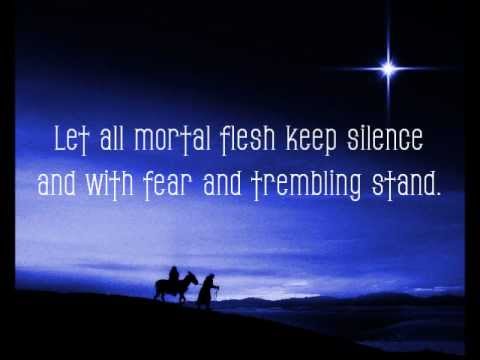
Let All Mortal Flesh Keep Silence

1 Let all mortal flesh keep silence,
and with fear and trembling stand;
ponder nothing earthly minded,
for with blessing in His hand
Christ our God to earth descendeth,
our full homage to demand.

2 King of kings, yet born of Mary,
as of old on earth He stood,
Lord of lords, in human vesture –
in the body and the blood.
He will give to all the faithful
His own self for heavenly food.

3 Rank on rank the host of heaven
spreads its vanguard on the way,
as the Light of light descendeth
from the realms of endless day,
that the pow’rs of hell may vanish
as the darkness clears away.

4 At His feet the six-winged seraph,
cherubim, with sleepless eye,
veil their faces to the Presence,
as with ceaseless voice they cry,
“Alleluia, alleluia!
Alleluia, Lord most high!”


Intro

If you were to take a Greek course in college or seminary, which is a strange way to start a sermon I admit, the first verse of the Bible you would probably work on is today’s Gospel text.  Ἐν ἀρχῇ ἦν ὁ λόγος, καὶ ὁ λόγος ἦν πρὸς τὸν θεόν, καὶ θεὸς ἦν ὁ λόγος. In the beginning was the Word, and the Word was with God and the Word was God. It’s pretty straight forward Greek, with the exception of the use of the reflexive “the was was God.” It’s easy Greek, but it is incredibly rich and complicated theology. The Word John refers to the is Jesus. John does not start his story of Jesus with the birth, like Matthew and Luke–he starts with the beginning of time. In the beginning, before all things existed, there was Jesus–the Word, the Logo of God. In verse 14 John writes, Καὶ ὁ λόγος σὰρξ ἐγένετο καὶ ἐσκήνωσεν ἐν ἡμῖν, “And the Word became flesh and dwelt among us.”

In Advent this year we are going to look at various Advent and Christmas Carols. If I’m not doing your favorite carol, you’re in good company, I’m not doing mine either. But the five carols all show us a different aspect of the Advent Story, the coming of Jesus into the world. The Hymn we are looking at this week, Let All Mortal Flesh Keep Silence was chosen today for three reasons: It is one of the oldest hymns still sung today, it captures the essence of the essential mystery of Christmas, the Incarnation, and it is a communion hymn that goes with our celebration of Communion today. You may want to have your hymnal open as I talk about it so you have the words before you. It is on page 347 of your hymnal.


History

The hymn starts with a phrase from the prophet Habakkuk: 2:20, “Let all the earth keep silence before him.” The hymn was originally written in Greek, and was first used in the Orthodox Liturgy of St. James, which dates back to 275 AD. But before it was used in the Great Liturgy, it was sung in churches throughout Asia Minor, modern day Turkey and Greece. In the Orthodox tradition, they sing most of the Liturgy, so it is still sung today on a regular basis in many Orthodox congregations today. People talk about that Old Time Religion, and here we get that in spades.

This Christmas Eve, we will sing Silent Night at a candlelight service, joining with millions of Christians all over the earth who sing that song on Christmas Eve. When I attended the Great Christmas Liturgy in Russia, they sang Silent Night. When we sing Let All Mortal Flesh Keep Silence, we are joining with Christians from almost the beginning of our faith. There is a place in our communion liturgy where I say:

Therefore we praise you,
joining our voices with choirs of angels,
with prophets, apostles, and martyrs,
and with all the faithful of every time and place,
who forever sing to the glory of your name:


When we sing this hymn with morning we will be joining “the faithful of every time and place.” Our voices will join with voices throughout the centuries who have sung a version of this as they prepare for Christmas, and as they prepare for communion.

This hymn would have remained in the Orthodox Church, and we in the West would have have heard were it not for the Oxford Movement in in the 1830s in England. During that time the Church of England was going through many changes, most brought about by the emergence of Quakers and Methodist. The radical informality of those two traditions were starting to infiltrate the Church of England, and whenever there is something new, there is always a reaction to it. In this case the reaction was to reclaim some of the more ancient liturgies of the Church, and a man named Gerald Moultrie translated this from the Greek, and it is his translation we will sing today. Ralph Vaugh Williams took a French tune, Picardy, and worked it into the tune we sing today.  This is one of the few parts of worship that the Eastern Orthodox and Western Catholic and Protestant churches share today.


Incarnation

This hymn that centers around a very theological subject–the Incarnation of our Lord, Jesus Christ. In Latin, the prefix in- means “in” and caro means “flesh,” so incarnate means “in the flesh.” When we say someone is evil incarnate, we are saying that the essence of evil has shown up in a human being, that the one we are talking about personifies evil. In Christian theology, when we talk about the Incarnation, we are talking about God incarnate, God coming to us in flesh and blood. Now this is one of the most basic, but also one of the most complicated Christian doctrines. If you have your hymnal open, look at the first verse.

 …ponder nothing earthly minded,

for with blessing in His hand

Christ our God to earth descendeth,


And later, in the second verse,

King of kings, yet born of Mary,

as of old on earth He stood,

Lord of lords, in human vesture –


The doctrine of the Incarnation is front and center for us at Christ

mas. As we sing in another carol, “Veiled in flesh, the godhead see, hail the incarnate deity.” That’s from Hark the Herald Angels Sing, by the way.

Theologians have been wrestling with the idea of the incarnation, since…well ever since there was Christian theology. We see it in both of the readings for today. In John we read that the Word of God became flesh and dwelt among us. God came to earth in the person of Jesus Christ.

In the Epistle lesson, Paul writes: Let the same mind be in you that was in Christ Jesus,

And then it goes into what many New Testament scholars believe is one the earliest Christian hymns.

6 who, though he was in the form of God,

    did not regard equality with God

    as something to be exploited,

7 but emptied himself,

    taking the form of a slave,

    being born in human likeness.

Now as theologians have discussed this over the years, and they have, they have come up with a lot of different takes, but almost all of them affirm one thing–God became a man in Jesus Christ because that was the best way to fix a huge problem that plagued humanity. One of the earliest, and in my opinion one of the best theologians who wrote about the Incarnation was Athanasius, back in the Fourth Century. He said the major problem facing humanity is corruption. For him there are two types of corruption that plague us: the first is the corruption of our hearts and wills, which is a moral problem, and the second is the corruption of our bodies, meaning we die, and after death, our bodies rot away.

These were two problems that people could not solve on their own. Our moral corruption was so severe, he wrote, that we can’t deal with it all by ourselves. We needed outside help. On our own, throughout history, we have not dealt with these problems very well. When it comes to our moral corruption, it is true that we are capable of some very good things, but it is also true that that in spite of all our advancements, we are capable of being perfectly horrible. And to make matters worse, sometimes, when we have the best of intentions, that is when we are actually at our worst. For example the various times people in the West tried to “civilize” people from other cultures. In the end there was always more damage than good done. God sent prophets to get us back on track, but when that didn’t work, as we say in the communion prayer:

… in the fullness of time,

out of your great love for the world,

you sent your only Son to be one of us,

to redeem us and heal our brokenness.


In the hymn, in verse three we sing,

as the Light of light descendeth

from the realms of endless day,

that the pow’rs of hell may vanish

as the darkness clears away.


Both are saying the same thing–God did not send a memo, The Father of all Creation sent his Son, to be one of us, to live as one of us, to take on our flesh. Jesus did not just take on human flesh, he took on OUR flesh, yours and mine. It gets a little cosmic here. But we are talking about God. And sometimes we are not cosmic enough. Athanasius writes,

For the Word unfolded himself everywhere, above and below, and in the depths and breadth: above in all creation, below, in the incarnation; in the depths, in hell: in breadth, in the world. Everything is filled with the knowledge of God.

St. Teresa of Avila says that God is in all things, even an ant. Everything abides in Jesus Christ, and Christ is in all. In the Incarnation God enters the world, and fills it with the divine, including us. Quoting Athanasius again, “He was made man that we might be made God.”

So while our celebration of Christmas, the Incarnation of the Son of God, is filled with things like red-nosed reindeer, and a jolly old man in a red suit, while we fill our holiday with candy canes, and trees and snowmen, and Grinches, and bells and lights, there is a stick of dynamite in the middle of our celebrations. The Almighty God, the Creator of all that is and all that will be, has entered into our world as a man, and has transformed the world by infusing it with his presence. And I say that without a hint of judgment because while we profess the extreme holy and sacred nature of the nativity, we also affirm that God is also found in the candy canes and trees and reindeer and the snowmen, and in the Lights.


Holiness

And God is found in this meal. In the second verse of the hymn we sing:

Lord of lords, in human vesture –
in the body and the blood.
He will give to all the faithful
His own self for heavenly food.


I said this was first used in the Liturgy of St. James in the Third Century. It was used as a preparation for Communion. The priest would stand before the congregation and say, Σιγησάτω πᾶσα σάρξ βροτεία, Let all mortal flesh keep silence! This is like when the bailiff in a courtroom announces the coming of the judge, but instead of saying All rise, the priest says, Silence before your God. With fear and trembling stand before him! Put aside the vain thoughts of your mind, and for God is here with you!

This is a holy meal. If God is found in all things in the Universe, there is a special way God abides in this meal. Over the years the church  have differed on exactly how God is present in the Lord’s supper, and in the end I think all are somewhat right, and all are somewhat wrong. The more we try to explain it, the more wrong we are. The more we just accept it, the more right we are.

We do not share this meal alone. In the liturgy, I will say:

Therefore we praise you,

joining our voices with choirs of angels,

with prophets, apostles, and martyrs,

and with all the faithful of every time and place,

who forever sing to the glory of your name:


In the hymn we will sing:


At His feet the six-winged seraph,

cherubim, with sleepless eye,

veil their faces to the Presence,

as with ceaseless voice they cry,

“Alleluia, alleluia!

Alleluia, Lord most high!”


Alleluia indeed! Amen.

Posted in Advent, Advent Carol, Advent Sermon, Athanasius, Christmas, Christmas Carol, Incarnation, Jesus, Musings, Preaching, Sermons | Tagged , , , , , , , | Leave a comment

The Heart of Thanksgiving

This sermon was given the day we celebrated the work of our organist, Ginni Peterson, who has been the organist at First Presbyterian Church in Medford for 57 years. She still has her chops! But, she is retiring at the end of the year. 

first-thanksgiving-getty-640266505


Thanksgiving is almost here. How can we, as Christians, best prepare ourselves for the upcoming holiday, other than preparing a feast and starting the Christmas decorating? What is Thanksgiving really about, and what can mean for us as Christians?

#

In the Old Testament Lesson we heard Hannah’s prayer, from I Samuel. Hannah was the wife of Elkanah, one of two, and was childless. Elkanah’s other wife, Peninnah, had born children, but not Hannah. And, people being people, Peninnah tauted Hannah. In that day and age, a wife that could not bear children was seen as inferior. Elkanah did not see Hannah that way. We are told that he loved her very much, but that was small consolation to Hannah. More than anything, she wanted to give her husband a child. Every year, when they went to temple, Hannah would pray and pray and pray, asking God to open her womb. She prayed so hard, that when the priest, Eli, saw her, he thought she was drunk.

And one day her prayers were answered. She became great with child, and bore a son, Samuel, who became a great prophet of God. In response to the birth, Hannah prays the prayer we heard this morning. It is a prayer of thanksgiving for the gift God had given her. Although the words Thank You do not appear in this prayer, it is her prayer of gratitude to the God who gave her a child. It is in many ways similar to Mary’s prayer in Luke, where she thanks God for her unborn child, Jesus. Both Hannah’s and Mary’s boys would serve God, and both Hannah and Mary would lose their sons to the service of God. As soon as Samuel was born, he was given to the high priest Eli, to raise for service in the temple. God had other plans for him, and he became one of the greatest prophets in the Old Testament. And of course Mary’s boy, Jesus, gave his life for the salvation of the world.

In her prayer, Hannah thanks God by recounting his actions. It a bit like going to an event to thank someone for their service, and recounting how they affected you and others. For example, we are thanking Ginni this morning for her years of service, and we might talk about her skills as a organist, her faithfulness in playing week after week, after week. We might recount the hours of practice she puts in every week before she plays, or we might talk about how just being around Ginni just makes you feel better. Hannah recounts how God looks after the those who are hurting, those who hunger, those who long for justice.

“He raises up the poor from the dust; he lifts the needy from the ash heap, to make them sit with princes and inherit a seat of honor.” Mary’s prayer is very similar:

“He has brought down the powerful from their thrones,

and lifted up the lowly;

he has filled the hungry with good things,

and sent the rich away empty.”

Both of these women offered thanksgiving prayers for the great thing God had done in their lives, heartfelt prayers that takes us into the heart of thanksgiving, which we will be celebrating this week.

#

Every year we have this holiday called Thanksgiving. It is a time of turkey, cranberry dressing, sweet potato casserole, and pumpkin pie. It is a time for families to get together. It is a time to watch football. The first Thanksgiving, back in 1621, was not called “Thanksgiving.” It was a fall harvest feast. Although we celebrate our Thanksgiving on the third Thursday in November, the original feast that it took place sometime between September and November.  The original 102 pilgrims who sailed on the Mayflower was whittled down to 53 by the time of that feast in 1621. They had managed to get through the first year, but just barely, and as the record shows, around half of them had died. Were it not for the local Wampanoag tribe, they might have all died.  But the second winter, they were more prepared. They had stored up food for the long winter, and had a surplus, enough to have a harvest feast. There were Indigenous people at the feast, 90 of the Wampanoag tribe, including their leader Massasoit, but we don’t know if they were invited, or if they just showed up. They roasted five deer and plenty of wild fowl, some of which might have included turkey, but we don’t know about that. And I am pretty sure they did not have that canned cranberry sauce prevalent at many meals today, or pecan pie.

We don’t if they continued having the feast on an annual basis. The documents from the pilgrims that survived only talk about the first feast. However they did have a thanksgiving celebration in July of 1623, which was not a harvest feast, but a day of prayer and fasting. Toward the end of the 1600s, some of the settlements in the New World combined the harvest feast with a celebration of thanksgiving, similar to what we celebrate today.

The Continental Congress declared the first national Thanksgiving on December 18, 1777 and then in 1789, George Washington declared the last Thursday in November a national Thanksgiving as well. But these were merely declarations and not official holidays. Future presidents did not continue the Thanksgiving declaration.

It was an editor, Sarah Josepha Hale, who researched documents about the first Thanksgiving, who was responsible for it becoming an official, national holiday. She wrote letters to five presidents: Zachary Taylor, Millard Filmore, Franklin Pierce, James Buchanan and Abraham Lincoln asking them to declare Thanksgiving a national holiday. In 1863, Abraham Lincoln, seeking to bring the civil war torn country together, worked with legislators to proclaim the last Thursday of November to be a national holiday called Thanksgiving. Now you may be asking, if Thanksgiving is supposed to the last Thursday, why are we celebrating it this week, which is the second to last Thursday. There are five Thursdays in November this year, and according to Lincoln’s proclamation, Thanksgiving should be next week.

Well, in 1939, a year in which November had five Thursdays also, FDR broke with tradition, and said Thanksgiving would be the fourth Thursday, not the last Thursday. He did that because the country was just pulling out of the depressions, and back in that day stores did not advertise for Christmas shopping until after Thanksgiving (the good ole days!). Moving Thanksgiving back a week would give stores and shoppers more time to prepare for Christmas. The move was controversial, and for years afterward some states still celebrated what they called Republican Thanksgiving, on the last Thursday.

In any case, this Thursday we will celebrate a traditional meal that goes back 397 years.

But from a Christian perspective the tradition of a Thanksgiving meal goes back to the beginning of our faith.


#

The Greek word for “thanksgiving,” is εὐχαριστία, from which we get the word Eucharist, one of the names for communion. Every month here we celebrate Thanksgiving, not with turkey and sweet potato casserole, but with the Bread and the Cup. In the Presbyterian Church we call it communion, but for centuries it has been known as the Eucharist, the meal of Thanksgiving. At the beginning of the meal I say,

The Lord be with you.

And also with you.

Lift up your hearts.

We lift them up to the Lord.

Let us give thanks to the Lord our God.

It is right to give our thanks and praise.

The prayer that follows is called the Great Thanksgiving, and starts, It is truly right and our greatest joy to give you thanks and praise, eternal God, our creator. The prayer then goes on to list the things that God has done for us in Jesus Christ, how at times humanity has lost its way in the world, and how Jesus came to call us back to God, and not only call us but to give us the way to return to God through him.

You made us in your image

and called us to be your people,

but we turned from you,

leaving sin and death to reign.

Still you loved us and sought us.

In Christ your grace defeated death

and opened the way to eternal life.

This mirrors several of the Psalms, where the Psalmist remembers and gives thanks for how God rescued the Hebrew slaves from the Egyptians, and how God gave them a way of living when they were in the Sinai Desert, and finally how God brought them to the promised land.


#

One of the ways we give thanks is to remember. We remember how significant people have changed our lives for the better. For example I might remember the things I got from my parents that taught me how to good person. Living in the segregated South in the 1960s, I remembered how they taught me to treat all people with dignity. I remember the people who mentored me over the years when I first entered ministry, and those who were there for me when I needed help with something. I remember who my wife has supported me in ministry, and I give thanks to all those people.

As a church, we remember how Ginni has brought the beauty of music to us for the last 57 years. The first time I met with the session, I asked them what they loved about this church–in essence, why they were thankful for this church, and over half of them mentioned Ginni. They talked about how, week after week, she brings angelic music out of the organ. They remembered a concert she had given here.

Another way we give thanks is to tell people of our gratitude. In prayer, we address God and thank God for all the the good we have received from our Creator’s hand. We tell the people around us how they have influenced us, and thank them verbally. For some people that just comes naturally. For others, it can be a hard thing to do. It can be even harder for some people to receive. Back when I was in seminary, we had a class where we talked about our experiences in our internships. One student, I remembered, talked about how hard it was for him to receive thanks after the service when people were exiting, and he was shaking their hands. “They tell me it was a good sermon, but I could only remember how badly it went, and how I could have done it better. What do I do?” he asked us. The teacher just looked at him and said, “You say ‘thank you!’ End of story.”

Some of things we may be thankful for are not things we were thankful for at the time. My father taught me the value in hard work when I was young, and I can truly say I was NOT thankful for those lessons at the time. I am now. But I sure wasn’t back then.

There are experiences we have that, in retrospect we can see how they changed us for the better, but we did not see them that way at the time. Losing a job may have led to a better job down the road, but at the time it can be a very painful experience. At the time we may be yelling at God–“Why did you do this to me? Why did you let this happen?” But down the road, we can give thanks for what happened.


#

What are you thankful for? As Thanksgiving approaches, why are you thankful? What fills your heart with gratitude?

I want to issue you a challenge. I said that a lot of thanksgiving had to do with remembering. Think back on your life. Who has made you who you are today? Who has had the greatest influence on you? What are some of the things that have happened in your life for which you are thankful.

Over the next few days, I challenge you to tell people “Thank you.” They may be people from your past, or they may be people you see everyday. Counting today, there are five days until Thanksgiving. Everyday tell one person why you are thankful for them. Every one of those five days, say “Thank you,” to at least one person.

And, over the next five days, I challenge you to say “Thank you” to God. You may thank God for the people who helped you along the way, people who are not alive today to hear it come from your lips. You may thank God for circumstances and situations that molded and shaped you. There is a prayer in the Episcopalian Book of Common Prayer, which I pray every morning:

We bless thee for our creation, preservation,

and all the blessings of this life;

but above all for thine inestimable love

in the redemption of the world by our Lord Jesus Christ;

for the means of grace, and for the hope of glory.

And, we beseech thee,

give us that due sense of all thy mercies,

that our hearts may be unfeignedly thankful;

and that we show forth thy praise,

not only with our lips, but in our lives,

by giving up our selves to thy service,

and by walking before thee

in holiness and righteousness all our days;

What are the blessings in your life? And how do you experience “the means of grace and the hope of glory”? This week, as we approach Thanksgiving, tell God “Thank you,” and maybe with the prayer, you might pray that you can show forth your praise for God, not just with your lips, but by giving yourself to his service.

Amen.


Posted in Gratitude, Magnificat, Sermons, Thanksgiving | Tagged , , , , | Leave a comment