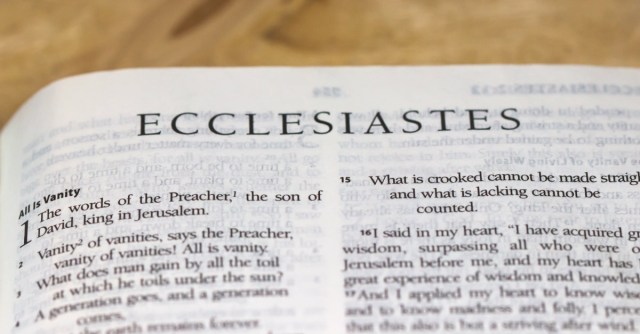
Ecclesiastes for Everyday: Day Seven

084v

12 So I turned to consider wisdom and revelry and folly; for what can the one do who comes after the king? Only what has already been done. 13 Then I saw that wisdom excels folly as light excels darkness.

14 The wise have eyes in their head,
but fools walk in darkness.

Yet I perceived that the same fate befalls all of them. 15 Then I said to myself, “What happens to the fool will happen to me also; why then have I been so very wise?” And I said to myself that this also is mere breath. 16 For there is no enduring remembrance of the wise or of fools, seeing that in the days to come all will have been long forgotten. How can the wise die just like fools? 17 So I hate life, because what is done under the sun was ugly to me; for all is mere breath and a futile attempt to herd the wind.


Woody Allen once said, “More than any other time in history, mankind faces a crossroads. One path leads to despair and utter hopelessness. The other, to total extinction. Let us pray we have the wisdom to choose correctly.”

He was trying to be funny, but Qohelet says basically the same thing, and he is deadly serious. In this section he talks about wisdom and folly, and starts by saying that wisdom is better than folly, just like light is better than darkness. Now he is beginning to sound like a traditional teacher of wisdom. Finally! The wise see clearly, he says, but the fool stumbles around in the dark.

But then Qohelet’s mood changes. He seems to notice that both the fool and the wise man suffer the same fate. They die, and are forgotten. The folly of the fool dies with him, but the wisdom of the wise man also dies with him.

This is just too much for Qohelet. That the wise man and the fool both eventually suffer the same fate is more than he can bear. “I hate life,” he says, “because what is done under the sun was ugly to me.”

One of the perennial questions of faith is why good things happen to bad people, and why bad things happen to good people. In his book, Man’s Search for Meaning, Viktor Frankl, a survivor of Auschwitz and two other concentration camps association associated with Dachau wrote the in the camps the good people died first. The ones who survived (and he includes himself in this) were the ones who were selfish, conniving, and willing to do anything to live.

We would like to think that only bad people get cancer, are audited by the IRS, or get killed in earthquakes, but the fact is no one is exempt. Qohelet would like to think that the wisdom of the wise lives after them, but a hard look at life tells him otherwise.

If you have been reading this devotional regularly, you may be getting a little depressed by this time. Qohelet does not seem to be the kind of guy you want to invite to do a guest sermon, much less be your regular preacher. Imagine a minister shouted from the pulpit, “I hate life!”

Is there any hope for us? This might be a good time to say that just because Qohelet is writing something that later became a biblical book, that does not mean is he right about everything. Remember, he had a somewhat limited understanding of God, and of life. However we must also remember that there are many Qohelets in our time. His view is not a foreign one to us. And he is irritating because he is so close to the truth.

Qohelet is pushing on this because he knows human nature. He knows our tendencies to grasp hold of things that we have no business hanging on to, and that by holding on to them, we merely make ourselves miserable. He wants to hold on to the notion that wise somehow get a special reward on some eternal plane, and the fact that he does not see that drives him to hate his life. It is possible he is just making a rhetorical point here. Why, you might ask, should he hate his life just because of that insight? Have your children ever shouted at you, “I wish I had never been born!” because you made them clean their room when they wanted to go out and play? Qohelet sounds almost as mature as that, and I think he knows that. He is making a bigger point. Holding on to the wrong things will make you as miserable as he is pretending to be in this passage. (If he really hated life all that much, would he have taken the time to finish the book?)

Thoughts and Questions

  1. If you could choose three things in your life that would outlive you, what they be? Why these three things?
  2. Qohelet is not going to give up on wisdom just because he is afraid it will not outlive him. He does have some kind of hope for the future. What is your hope for the future?
  3. On the other hand, what have you done in your life that best resembles trying to “herd the wind?”


Posted in Devotional, Ecclesiastes, Ecclesiastes for Everyone, Lent, Lenten Devotional, Qohelet, Spiritual Growth, spirituality, Uncategorized | Leave a comment

Ecclesiastes for Everyday: Day Six

reynolda-house.jpg

I made great works; I built houses and planted vineyards for myself; I made myself gardens and parks, and planted in them all kinds of fruit trees. I made myself pools from which to water the forest of growing trees. I bought male and female slaves, and had slaves who were born in my house; I also had great possessions of herds and flocks, more than any who had been before me in Jerusalem. I also gathered for myself silver and gold and the treasure of kings and of the provinces; I got singers, both men and women, and delights of the flesh, and many concubines.

So I became great and surpassed all who were before me in Jerusalem; also my wisdom remained with me. 10 Whatever my eyes desired I did not keep from them; I kept my heart from no pleasure, for my heart found pleasure in all my toil, and this was my reward for all my toil. 11 Then I considered all that my hands had done and the toil I had spent in doing it, and again, all was mere breath and herding the wind, and there was no gain under the sun.


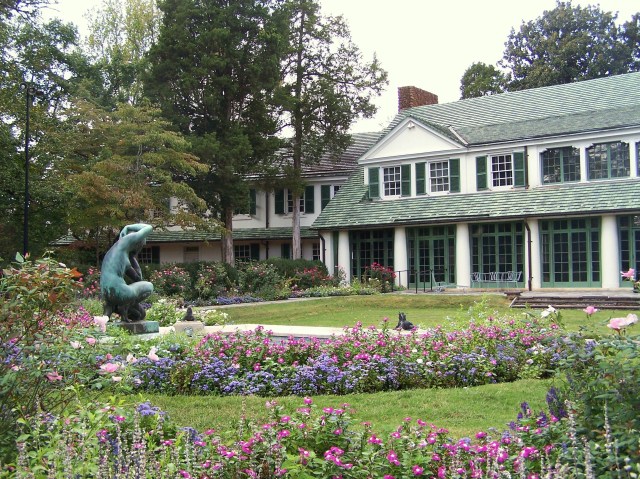
I grew up about a stone’s throw from Reynolda Gardens in Winston-Salem, North Carolina. These were part of the R.J. Reynolds estate, and includes his mansion, the gardens, and a huge, hilly field surrounding the grounds. Mr. Reynolds is long gone. The estate is now a museum, and has undergone a lot of transformation through the years. If Richard Reynolds returned to it today, he might not recognize it.

All his work was like mere breath.

Like Mr. Reynolds, Qohelet has the world at his disposal, and yet it brings him no long-term fulfillment. He says that he became greater than all who came before him, and whatever he wanted, he was able to get. And what did it all amount to? Mere breath. All his work was like herding the wind. It’s not that he did not enjoy all this. It’s not that it was all a waste of his time. But in the end he found that all his work was mere breath—impermanent. All his hard work was about as effect as herding wind.

The Buddha said we are miserable because we spend too much time chasing after things we cannot really have. Like Qohelet he also taught that much of life is mere breath, a herding of the wind. Notice that Qohelet does not say that any of the things he is talking about are bad things. But are just all temporary—mere breath.

In his novel One Hundred Years of Solitude, Gabriel Garcia Marquez recounts the story of Colombian family in a village. He takes the family from its humble beginnings in the village, to the peak of their influence, and then leaves us with a picture of their family residence taken over by the encroaching jungle. All that they worked for and all they accomplished was eventually consumed by the vines and weeds of the rainforest undergrowth. Qohelet was able to see at the end of his life (we assume he was an older man when he wrote this—This is the work of young buck) that all his work amounted in the end to nothing. Mere breath.

We can see this as a depressing insight. But we can also see it another way. Again, Qohelet did not say that all he did was bad. It was just impermanent. He is telling us, not that our lives are miserable, but that we should try to turn our accomplishments into something they are not. We work hard in this life. That is good. When we are gone, someone else takes over. That is also good. I remember the first time I visited a church where I had previously been a pastor. I saw all that the new pastor had done, and for a moment I thought, “It was as if I was never there.” But then I realized that was how it was supposed to be. I did not want that church to cling to me and the memories of me. I wanted them to grow, to become the church God wanted them to be. They could not do that if they refused to let go of my work there. They had to do what God was calling them to do after I was there if they were going to grow.

Thoughts and Questions

  1. Think of the really important things you do, things such as raising kids, or how you performed your job, or the work you put into your marriage. Why do you do these things?
  2. Why do you think it is important for some people to want to make a lasting change? Do you think the fact that whatever we do will eventually fade away one day is depressing, or just inevitable?
  3. Qohelet must have accomplished a lot in his life. His book actually belies his major thesis. We can assume it was written somewhere around 300-400 BC, and yet here we are, almost 2500 years later, reading it. Are there things that you believe will outlast us?
Posted in Devotional, Ecclesiastes, Ecclesiastes for Everyone, Lent, Lenten Devotional, Musings, Qohelet, Reynolda, Spiritual Growth, spirituality, Uncategorized | Tagged , , , , , , , , | Leave a comment

Ecclesiastes for Everyday: Day Five

thunder76b


2 I said to myself, “Come now, I will make a test of pleasure; enjoy yourself.” But again, this also was mere breath. I said of mirth, “It is wild revelry,” and of pleasure, “What use is it?” I searched with my mind how to cheer my body with wine—my mind still guiding me with wisdom—and how to lay hold on folly, until I might see what was good for mortals to do under heaven during the few days of their life.


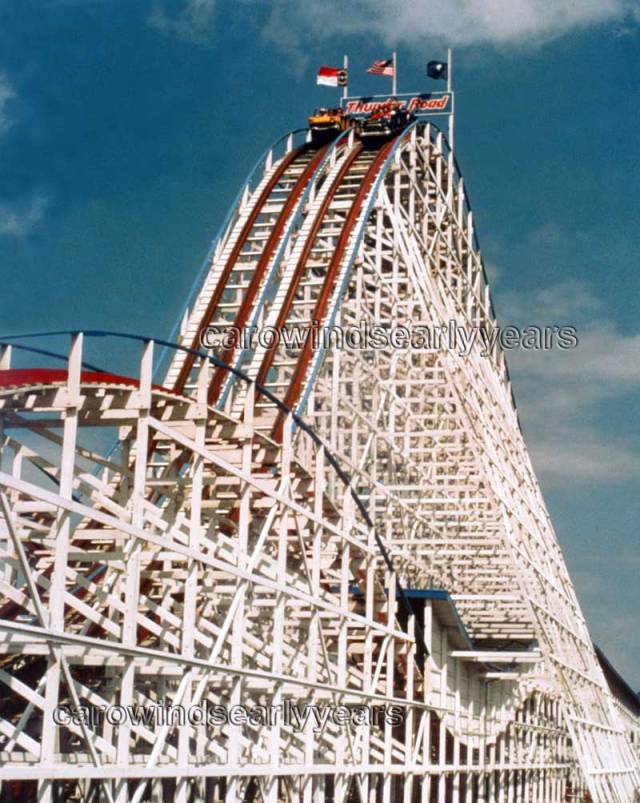
When I was in college I worked on a roller coaster at a theme park just outside of Charlotte, North Carolina. It was fun watching all the people line up for the ride, some looking a little scared, others looking forward the wild ride in store for them.

I rode the roller coaster many times while I worked there, and at first it was exhilarating. The anticipation as the coaster made its first ascent up the large hill, the quick, steep drops, careening around sharp corners, and a series of fast ups and downs made it an exciting ride.

Some of decided we would try for the world record roller coaster ride. That meant we would be on the coaster for about two days straight. Before we went to the management to ask if we could do it, we did a short practice run—about 30 minutes on the ride.

While I was excited about possibly setting a world record, I have to admit that by the time we did the eighth round, I was getting a little bored. There were too much movement to read, I couldn’t really concentrate on anything, and frankly the drops and turns began to lose their excitement. I was almost glad when the management turned down our request.

It’s an old story. Someone is looking for how to best live their life, and they turn to pleasure. “Eat, drink, and be merry!” And they eventually find out that pleasure is not all it is cracked up to be. Qohelet is no different. He learns that having fun is a fleeting experience. It is like riding an endless roller coaster. The excitement soon disappears. The revelry that wine brings about quickly fades into a hangover. Sure, you can pick up another bottle, but Qohelet is wise enough to know that just extending a fleeting experience does not prolong pleasure. It only deadens our ability to respond to it.

When it comes to pleasure as an answer to life, “There’s no there there,” as Gertrude Stein once said (of her home town, Oakland). There is nothing of substance. We have a quick thrill, then it is over, and we either move quickly to the next thrill, getting lost in the addictive chase for more and greater pleasures, or wonder why it is such a big deal in the first place.

If there is an answer to the problem of life, Qohelet is sure it is not found in pleasure.

Post Script: They tore that roller coaster, Thunder Road, down. Why? It was just not as exciting as the newer roller coasters. 

Thoughts and Questions

  1. Think of something you enjoy doing on a regular basis. Why do you enjoy it?
  2. One of Qohelet’s convictions is that our time here is very limited. He is asking, “What do we do with the few days we have?” Why not “Eat, drink, and be merry, for tomorrow we die”?
Posted in Devotional, Ecclesiastes, Ecclesiastes for Everyone, Lent, Lenten Devotional, Qohelet, Spiritual Growth, spirituality | Tagged , , , , , , , | Leave a comment

Remaining at the Beginning

4fbba0c879769108ee5a64394d3b1050

God

A Sunday school teacher was watching one of her student drawing furiously during class. “What are you drawing?” she asked.

“I’m drawing a picture of God,” said the boy.

“But no one knows what God looks like,” said the teacher.

“They will when I’m finished,” the boy replied.

That may be a humorous story, but it show how most of us really approach God. The God we worship tends to be, at least to some extent, a god of our own making. We have ideas about God that come from various experiences and   in our lives. For example, when I was a young kid, I remember when we were learning the Apostle’s creed in Sunday School. We got to the part about God the maker of heaven and earth, and the first thing that popped into my head was, If God made the heavens and the earth, then who made God?” which caused a little consternation from my Sunday School teacher, not for the first or last time I might add. And for some reason, I got the idea that God used his hands to make the world. I probably got that from a cartoon, or a movie. And the hands appeared first, and the hands created the rest of God. That satisfied me for a while, as least better than the Sunday School teacher’s explanation that there was nothing before God, and God always was. Yeah right. But then I had to ask myself, where did those hands come from. Who made the hands? As an adult, I now know that was a ridiculous idea, and I have since learned much more about God, but, to be honest, there is a small part of me that still favors the idea of the hands of God.

We all have our individual conceptions of God, some healthy, some not so healthy. Whenever I meet someone who tells me they don’t believe in God, I always ask them, What kind of God do you  not believe in, and they usually say something like they don’t believe a capricious god, who sits in heaven just waiting for us to mess so he can send us to hell. I tell them, I don’t believe in that God either.

Now this is not as big a problem as you might think it is. True, we do have our own, mostly individual conceptions of God. And to the extent they are unhealthy conceptions, like that of God as a cruel judge, we need to deal with that. But that our conceptions of God are incomplete and to some extent inaccurate is not a real big issue.

A long time a theologian named Anselm called God a Being than which none greater can be conceived. In other words, take the biggest thing you can think of. God is bigger than that. Take the most powerful thing you can think of. God is more powerful than that. Take the most loving thing you can think of. God is more loving than that. No matter what we think of God, our thoughts are at best incomplete. Another older theologian, Thomas Aquinas, said that God was pure being. He gets that from the passage in Exodus we heard this morning. Moses is told by God to go to Pharaoh and to tell Pharaoh to set the Hebrew children free from slavery. Moses asks a pretty pertinent question: When I tell Pharaoh that a god has told me to tell you to set the Hebrews free, he is going to ask, “What is the name of your God? Who told you to do this?” God replies, “Tell Pharaoh, I am who I am. You want a name? I AM.” Of all the things we can say about God, this is the only one that really captures the essence of God. God Is. Every other statement is incomplete. Every other statement is merely us groping blindly, with inadequate language, and inadequate ideas to describe the indescribable.


Father Almighty

We start off the Apostles’ Creed with a pretty controversial statement, at least one for our time. I believe in the God the Father…

Why is that controversial these days? There are a couple of reasons.

First, it assigns a gender to God. When we say the words God the Father, there is a tacit or overt assumption that God is male. While we might call God our Father, there is no way we can affirm that God is male, or female. God is beyond gender. In Genesis, when God is creating human beings, we hear, So God created humankind in the image of their creator, in the image of God they were created; male and female they were created. I heard someone say, “If we assume God is male, then men assume they are god.” In fact there are more than a few feminine images of God in the Bible. God gathers us like a mother hen gathers her brood.

The second problem is that there are a host of people who have real problems with their earthly fathers, and to call God a father just brings all that back. Some who had an abusive father, someone who might have been sexual abused by their father, someone who had an absent father is going to have a hard time seeing God as a loving Father.

And yet, for centuries Christians have said these words: I believe in God the Father. Should we just do away with it? Toss it into the theological dustbin, with other outdated concepts? Or is there a good reason why this is in the Creed? I think there is.

I just finished saying that God is far above and beyond our ability to understand, and that anything we say about God is incomplete. Including the statement “God the Father.” If you read the works of many theologians, you get the impression that God is so far beyond our ability to understand, that we cannot know God at all. But then we run into this: I believe in God the Father.

The word father assumes a relationship, and beyond that, a kinship. We don’t confess that we believe in God Almighty. We say we believe in God, the Father, Almighty. We believe in a God who has a relationship with us. If we strip that away, then we are left with an impersonal divine being, and any talk about the love of God, would be nonsensical. And if you strip love and concern from God, you no longer have the God of the Bible, the God of Abraham, Isaac and Jacob, the God of Jesus Christ. Paul writes in I Corinthians 8: Knowledge puffs up, but love builds up.  Anyone who claims to know something does not yet have the necessary knowledge; but anyone who loves God is known by God.

In the end, the primary conclusion we can draw from the Church’s historic confess of God the Father, is that God is a God of relationship. The word Father implies a child.  I did not become a father until I was 29 years old, when my oldest child was born. Before September 30, 1989, that word could not apply to me.

I have previously said that almost all of our talk about God is incomplete. Our best and most eloquent attempts to describe God are mere baby talk. If that is true, then we don’t need to put too much freight into any one description of God. Given the fact that God is not male, and that the notion of fatherhood can be problematic for some people, we don’t need to be wedded to that one term. We can talk about God as parent, although that sounds a little too institutional for my ears. We can talk about God as mother, for if indeed God is beyond gender, than nothing prevents us from switching from one gender to another. The exact words we use are of secondary importance. What we cannot lose is the essential belief that God has a relationship with us.


Creator

I believe in God the father almighty, Maker of heaven and earth.

Maker of heaven and earth. Not only do we believe that God has a relationship with us, we also affirm in the Creed that God our Creator has a relationship with creation. Now too often we get tangled in the wrong things when it comes to God’s creative actions. It is not hard to find vociferous and often vicious debates on exactly HOW our make made the world. You find people who believe in a literal, six-day creation, against those who believe in what is called intelligent design, against those who believe that evolution was part of the creative process of God.

And these are not recent struggles. St. Augustine, in 400 AD was struggling with how to interpret the first chapters of Genesis, and whether, as a Christian, he had to believe in a literal, six day creation. He finally decided that the first part of Genesis was allegory, and not to be taken literally. But he was not the first. Others before him and since have struggled with that. It is easy to get stuck on how God created the world, but Augustine, Origen, John Duns Scotus, Thomas Aquinas, and Bonaventure, all born before the 1400s, decided to  scratch the hows of creation, and went right into, what does it mean for us.

I’ll cut right to the chase and say what it means for us, is that God is a part of creation. The Psalmist says that the heavens display the handiwork of God. Back when I was in college I heard music from a new band, called Dire Straits. When I first heard I thought, “This sounds like Bob Dylan’s last album.” Well there was a reason for that. They were the back up musicians on Bob Dylan’s last album. Their character was a part of the music they made. It was uniquely theirs. The art of Van Gogh is uniquely his, and you don’t have to know a lot about art to recognize a Van Gogh. After listening to a lot of Jazz, I can Miles Davis, from Freddy Hubbard, or Don Cherry. Their character is in their art. So is God’s character in us, and in the world. There is a part of God in all of creation.

There is one other aspect of the creation that is important. The earth is not ours. It is God’s. We are stewards, caretakers of God’s creation. Now good people can disagree on various policies concerning the environment, but in the we will be called into account for how we take care of the creation. There will be a reckoning. When we care for it properly, we can see God in the world. When we don’t, we mar the image of God in the world.


Stay at the Beginning

The study of God, otherwise called theology, can be a very complicated subject. I personally enjoy it, and the more complicated the better. You would not believe how many things I deleted in writing this sermon, because a) we don’t have all day, and b) I had a hard time keeping it understandable. And that is important. In one of the books we are using for the Creed class, Ben Meyers, says, “In discipleship, the one who makes the most progress is the one who remains at the beginning.

The point of faith is not learning all you, although learning is good, and in world, fun. The point is the relationship. When you have a child, a lot of parents read parenting books, to try to get a handle on what it means to be a parent. And you can learn a lot of helpful things from the books. But at its heart, the essence of parenting is the relationship you have with your kids. Our faith starts with the relationship we have with God, and it should also end there. Yes, there is reading and learning along the way. That is helpful. But what matters is what mattered at the very beginning. The relationship.

I believe in God the Father Almighty, maker of heaven and earth. Amen.

Posted in Uncategorized | Leave a comment

Ecclesiastes for Everyday: Day 4

tmp730504370239569921

16 I said to myself, “I have acquired great wisdom, surpassing all who were over Jerusalem before me; and my mind has had great experience of wisdom and knowledge.” 17 And I applied my mind to know wisdom and to know revelry and folly. I perceived that this also is just an attempt to herd the wind.

18 For in much wisdom is much worry,
and those who increase knowledge increase pain.


The book of Ecclesiastes is in the genre of literature called “wisdom literature.” In the Old Testament the wisdom books are the Psalms, Job, Proverbs, Song of Songs, and Ecclesiastes. Yet here Qohelet says that wisdom leads to worry and pain. He says that he has acquired great wisdom, but that has been like trying to “herd the wind.”

It seems odd that a person takes Solomon as his role model is now telling us that wisdom is not all that it’s cracked up to be. But perhaps it is good to understand that wisdom has its limits.

When I was in college I had many, many question as I read and tried to understand the Bible. I finally decided that if I could learn the original language of the New Testament, Koine Greek, I would have a better understanding of the text. So I took a course in Greek, only to find that reading the Bible in Greek just raised even more questions!

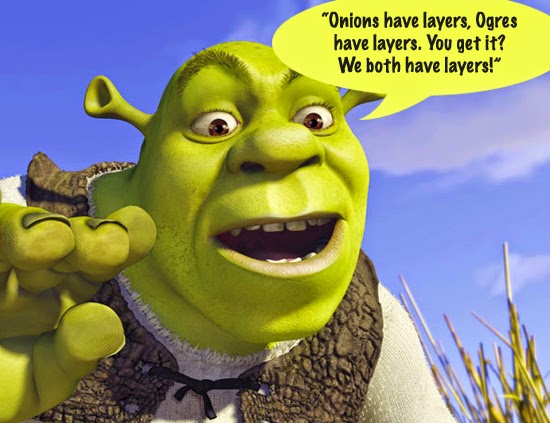
Sometimes wisdom or knowledge is like peeling an onion. There is always just one more layer to go.

It is said that ignorance is bliss. Sometimes it seems it would just be easier if we stayed in little hollow worlds, not questioning, and not even learning about the wider around us. We hear the news and learn what is going on in the world, and it makes us depressed. We diligently study the Bible and find it often raises more questions than it answers (especially in the book of Ecclesiastes!) We study the lives of our heroes and find they have questionable parts of their character, and are disappointed that they are not the people we thought them to be. As a politician once said, “Laws are like sausages. It is better not to see them being made.

However the correct quote is not “Ignorance is bliss.” The full quote, from Thomas Gray’s poem, Ode on a Distant Prospect of Eton College, is “Where ignorance is bliss, ’tis folly to be wise.”

Qohelet is not telling us to hide our heads in the sand. He is just warning us that seeing the world as it really is, that trying to be wise, is not always fun and games. Wisdom comes at a price, and the price is sometimes our blissful innocence. If we don’t know something, we can feel that we are not responsible for it. Once we have knowledge, we are responsible for what we know. If we are unaware of the problems in the world, we can blissfully and ignorantly ignore them. But once we learn about them, our ignoring is no longer a blissful option.


Thoughts and Questions

  1. Can you think of a time when you learned something that you would have rather not known? How did you deal with the unpleasant knowledge you had?
  2. Do you think Qohelet is speaking against knowing too much, or he is just warning of the consequences?
  3. Most wisdom literature encourages us to become more wise by warning us against folly. The Proverbs, for example, is almost totally about how to be more wise. Do you think that Qohelet is merely offering an opposing view of wisdom, or do you think he is just totally soured on it?


Posted in Devotional, Ecclesiastes, Ecclesiastes for Everyone, Lent, Lenten Devotional, Musings, Spiritual Growth, spirituality, Uncategorized, Wisdom | Tagged , , , , , , , | Leave a comment

Ecclesiastes for Everyday: Day 3

shutterstock_138466490

There is nothing new under the sun.
10 Is there a thing of which it is said,
“See, this is new”?
It has already been,
in the ages before us.
11 The people of long ago are not remembered,
nor will there be any remembrance
of people yet to come
by those who come after them.
12 I, the Qohelet, have been king over Israel in Jerusalem, 13 applied my mind to seek and to search out by wisdom all that is done under heaven; it is an unhappy business that God has given to human beings to be busy with. 14 I saw all the deeds that are done under the sun; and see, all is mere breath and an attempt to herd the wind.
15 What is crooked cannot be made straight,
and what is lacking cannot be counted.

Someone once said that the baby boomers (my generation) pretended to treat every phase of life as if they had just discovered it. When they were young, they pretended to invent youthful exuberance. As they aged, they pretended to invent the angst of middle age, and now they are pretending that they invented menopause and arthritis!
And yet all before them, and all who come after them go through all these phases of life. There is nothing new under the sun. The millennials who are having to deal with the economic ramifications of the 2008 recession are not much different from their great-grandparents who went through the Great Depression. Qohelet, who seems to be a person of age, sees that the circle of life does not change for every generation.
He says something that is very disturbing to the Hebrews of his day: Just as you forget the past, so will the future forget you. The Jewish faith is based on remembering. Remembering how God freed you from the slavery of the Egyptians, how God called Abraham to a new land, how God gave the Torah to the people, how God rescued them, time and time, from disasters.
But, Qohelet says, the people of God constantly forget what God has done.
He goes on to say that he has thought long and hard about the condition of human beings, and the prognosis is not good—at least not for him.
“It is an unhappy task, he says. An otter never thinks about what it means to be an otter. He just swims, eats, plays and breeds more otters. But people are not like that. We are capable of self-reflection. Socrates said the unexamined life is not worth living, yet Thoreau, thousands of years later said that the mass of men life lives of quiet desperation. You would think that all that examining would lead to greater happiness, but it does not seem to. “It is an unhappy business that God has given to human beings to be busy with.”
It is hard to a thinking a human. It is much easier to go with the flow, and not question anything. But Qohelet is questioning everything. He can’t help himself. For him, that is an essential part of what it means to be human, but it is one of the most unpleasant parts of being human. If you look closely at life you will see that all our effort is like trying to “herd the wind.”
It is hard because in spite of all our thinking, we cannot change very much about our world. Karl Marx once said, “philosophers have only interpreted the world, in various ways; the point is to change it.” But the world does not change. Marx envisioned a world where there were no rich people and no poor people. One hundred and fifty years after Marx there are still rich and poor, and in fact today the gap between the two has only grown larger.
What is crooked cannot be made straight. You can’t count jelly beans in an empty jar. What is will not change.
Thoughts and Questions
1. Throughout this study Qohelet confronts us with how he sees the world. Do you agree with what he says? Can things change? Or are we destined to live a world that does not change?
2. Take some time to think about how God has affected your life. Go back as far as you can in your life. How have the actions of God in your life affected who you are now?
3. Does the fact that we cannot change the world mean we should stop trying? Can we make things better? How?

Posted in Devotional, Ecclesiastes, Ecclesiastes for Everyone, Lent, Lenten Devotional, Old Testament, Spiritual Growth, spirituality | Tagged , , , , , , | 1 Comment

Ecclesiastes for Everyday: Day 2

1188079-Harry-Chapin-Quote-All-my-life-s-a-circle-Sunrise-and-sundown-Moon (1).jpg 

All my life’s a circle…

What do people gain from all the toil
at which they toil under the sun?
A generation goes, and a generation comes,
but the earth remains forever.
The sun rises and the sun goes down,
and and comes panting back the place where it rises.
The wind blows to the south,
and goes around to the north;
round and round goes the wind,
and on its circuits the wind returns.
All streams run to the sea,
but the sea is not full;
to the place where the streams flow,
there they continue to flow.
All things are wearisome;
more than one can express;
the eye is not satisfied with seeing,
or the ear filled with hearing.
What has been is what will be,
and what has been done is what will be done;
there is nothing new under the sun.


The song writer Harry Chapin, best known for his song Taxi, also wrote:

All my life’s a circle;
Sunrise and sundown;
Moon rolls through the nighttime;
‘Til the daybreak comes around.

All my life’s a circle;
But I can’t tell you why;
Season’s spinning round again;
The years keep rollin’ by.

There are some who think of history as proceeding forward in a straight line, but in reality it seems more like things just go in circles. Qohelet talks about how the sun goes in circle; it rises and sets, day after day after day. The wind, he says, blows north, then it blows south, then it blows north again. Rivers flow into the sea, but the river never empties, and the sea is never full. We also, he writes, are never full. We eat a wonderful meal, and later we are hungry again. We wake up refreshed from a sound sleep, but at night we are sleepy again.

We hear a song that moves us deeply, and then we lose that feeling until we hear another moving song. We travel from place to place, seeing wonderful sights, but when we go home we are soon aching to travel again.

A person makes a million dollars. Then they want ten million. They make ten million, then they want a hundred million. They get that, and it is not long before they want a billion.

A church gets ten new members. It soon wants twenty more.

Publishers make billions of dollars selling self-help books, bought by people who want to change who they are. The funny thing is, people who buy one of these usually buy ten more. There is never enough, even of self-help!

We find our heart’s desire, but it is not long before we want something new.

Are we ever satisfied? Qohelet says that circle of life is wearisome. Whatever we have, we want more. We are never full. We are never fully satisfied. The circle of life is a metaphor for the fact that we are chasing our own tails. In a sense we are like Adam and Eve in the Garden. We have everything we need, yet it is not enough.

At the end of this passage Qohelet says, “Life is an endless circle; what we had, we will have again, What we did, we will do again.”

Marcus Aurelius wrote, “All things are the same, familiar in experience and ephemeral in time, and worthless in the matter. Everything now is just as it was in the time of those whom we have buried.”

Qohelet says, “There is nothing new under the sun.” He uses the phrase, “under the sun” almost as much as he uses the phrase, “Havel, havelim.”

We can take this passage to be depressing. Life is an endless struggle of striving, pointless and futile. We are like Sisyphus, rolling a large stone up a hill, only to have it roll back down just as we get it to the top.

Or we can take it another way. We have all we need in life. What if we could learn to be satisfied with what we have?


Thoughts and Questions

  1. Take a hard look at what you have. What are you lacking? What if all that you have is all you will have. Can you live with that?
  2. What is it in us that makes us want more? What was it in Adam and Eve, and in us, that makes it hard for us to enjoy Eden?
  3. America is one of the richest nations on the face of the earth, and yet our stores are full of people who want to buy more things. Have you ever considered a fast from buying? As an experiment, take a week, and try to live off what you have. Don’t eat fancy meals. Don’t buy new things. Try to spend a week without wanting. Instead, try to be satisfied with what you have. See how that affects your attitude.
Posted in Devotional, Ecclesiastes, Ecclesiastes for Everyone, Lent, Lenten Devotional, Musings | Tagged , , , , , , | Leave a comment

Ecclesiastes for Everyone: Day One, Ash Wednesday

ozymandias-5-w=581&h=265

 1 The words of Qohelet [the Teacher/Preacher][i], David’s son[ii], king in Jerusalem:

Vanity of vanities, says the Teacher, Vanity of vanities.
All is vanity.


In Percy Shelley’s poem Ozymandias, a traveler tells that he saw a ruined statue in the desert consisting only of two “vast and trunkless legs” lying near a shattered head sunk in the sand. Nearby, on a pedestal were the words, ‘My name is Ozymandias, king of kings: Look on my works, ye Mighty, and despair!’

But, says Shelley,

Round the decay

Of that colossal wreck, boundless and bare

The lone and level sands stretch far away.

This monument to a once great, but now forgotten king and his kingdom, marks only the futility of his hubris. Whatever kingdom he once ruled is now just sand and dust.

This poem highlights the overall theme of Ecclesiastes.

Vanity of vanities. All is vanity. Or in Hebrew, “havel, havelim.”[iii]

This is a phrase that shows up a lot in Ecclesiastes. In fact, it is the theme of the book. Vanity of vanities—merely a breath, as the Old Testament scholar Robert Altar translates this.

This is a disturbing notion for us. We want to think that all of our life counts toward something. More than once I have heard people say, “Everything happens for a reason,” meaning that there is some grand, overarching plan guiding our life.

But what if there isn’t? What if there is no grand plan? What if none of what we do means anything? What if, like Ozymandias, after you were gone all that you did just disappeared into the desert of eternity?

I know this is not a pleasant thought, but it an important one. Qohelet will confront us with many unpleasant thoughts as we journey with him, and this is the main one; how are we to live our lives if we assume that what we do does not really matter in the long run?

Would you live your life differently? If you knew that everything you ever did would all be forgotten ten years after you die, what would you do differently?

We are going to explore that idea for the duration of Lent. It will be difficult going at times, but stick with it. In the end, I think you will find that this will be a hard, but very rewarding journey. There is a light at the end of the tunnel, but I don’t want to turn on the light too early. Sometimes we have to wander about in the dark to really appreciate the light. The jazz great Thelonious Monk once said, “It’s always night, or we wouldn’t need light.”


Thoughts and Questions

  1. Do you assume that your life has a greater meaning? If so, why?
  2. If you learned today that there is a God, but that God really does not have a plan for your life, would you do anything differently in the future? What would you wish you had done differently?
  3. Robert Altar translates “havel havelim” as “merest breath” not “vanity of vanities.” Vanity implies futility. But breathing is anything but futile. We do it every moment of every day we are alive. No one breath matters to us. But taken as a whole they are all important. If I try to hold on to one breath, I will die. Only if I breath in and out on a regular basis can I exist. What happens when we cling too tightly to things in our life?


 NOTES

[i] Who is this speaking? Traditionally the writer of Ecclesiastes has been called the Preacher or the Teacher, and was recognized as Solomon, the son of David. There are few problems with this however.

First, in Hebrew he calls himself Qohelet. This comes from the Hebrew root QHL which means “to assemble” as in to bring people together. It does not really mean preacher, and nowhere else in the Bible is it used that way. So from here on out, I’m going to follow the advice of Robert Alter, a great scholar of Hebrew, and call the writer by his Hebrew name, Qohelet.

[ii] Qohelet claims to be the son of David, Solomon. Now Solomon was known for his great wisdom, and Qohelet certainly thinks of himself as a writer of wise words. So traditionally the book has traditionally been assumed to have been written by Solomon, even though Solomon’s name never appears in the book itself.

However, the language of the book is from the third or fourth century BC, long after Solomon. (Imagine Thomas Jefferson writing that something was “really groovy,” and you can see the problems Hebrew scholars have with attributing this to Solomon!)

It could be that the writer saw himself in the line of David. Or that the writer is assuming the role of Solomon, something that writers would do back in the day. But most scholars today do not believe that King Solomon wrote this book.

[iii] These Hebrew words have been translated in a variety of ways. The most common has been “Vanity of vanities,” found in the King James Version and the New Revised Standard Version. Rabbi Shapiro translates this as “Emptying upon emptying.” Robert Alter uses the phrase “merest breath.” This is probably the closest to the original Hebrew word “hevel” which literally means exhaled breath, vapor or mist, and is the translation I will (mostly) use for the rest of the devotions.


Posted in Devotional, Ecclesiastes, Ecclesiastes for Everyone, Lent, Lenten Devotional, Thelonious Monk, Uncategorized | Tagged , , , , | Leave a comment

Ecclesiastes for Everyone: A Lenten Devotional

25266-ecclesiastes-wide.1200w.tn

Introduction

Every Ash Wednesday, when I mark the cross with ashes on the foreheads of my parishioners, I say, “From ashes you have come, to ashes you will return.” It is not something I say lightly or easily. I wish I could say something more upbeat. “Here’s a cool sign of the cross for your forehead!” But those are not the words of the liturgy. “From ashes you have come, to ashes you will return.

I say those words year after year to remind us of our mortality. We will all die one day. So what do we make of the days we have?

In order to face eternity, I believe we have to face our mortality first. In order to live a fulfilling life, we must first understand the futility of life. In order to understand God, we first have to understand who we are as human beings. In order to understand the resurrection, the message of Easter, we first have to understand death, the message of Lent.

So this Lent I am inviting you to join me in some hard work. I want us to work on what it means to be human. We are going to do this by working through one of the hardest and most puzzling books of the entire Bible—the Book of Ecclesiastes.

Ecclesiastes is unlike any other book of the Bible. It never mentions an afterlife. It has a very abstract concept of God. It is much more philosophical than any other biblical book. And it is primarily about death and the absurdity of life. Someone once said that Ecclesiastes describes life as a crapshoot, and a biblical scholar, Rabbi Rami Shapiro replied that in a crapshoot you have a chance to win. “No one wins in Ecclesiastes, not even the house.”  The message of Ecclesiastes resonates with the songwriter Jackson Browne, who wrote, “somewhere between the time you arrive and the time you go/May lie a reason you were alive but you’ll never know.”

And yet Ecclesiastes is a part, and I would argue an essential part of the biblical witness. Scholars have questioned why, but the fact is, they think Ecclesiastes became an accepted part of the Bible quicker than any other book of the Old Testament. Go figure.

Every day in Lent I have chosen a reading from Ecclesiastes for you. I warn you in advance, these will not be easy. It’s not that they are hard to understand. Actually the writing itself is plain and simple. It’s only hard because it makes us think about hard things, things we would rather not think about. It leads us to ponder questions about life and death, and the meaning of life, and how random things happen to us—and that they happen a lot.

I will be posting every day during Lent (one of my Lenten commitments) for the next forty days, not counting Sundays. (Sundays are not counted as part of the forty days of Lent.

One more thing—the text I am using is not from any one translation of the Bible. I am using several translations, and merging them together. I am pulling primarily from the NRSV, which is the version we read from every Sunday morning, but I am using the work of several Hebrew scholars, and taking advantage of the wealth of translations out. On occasion I make my own call concerning a few Hebrew words.

So, without further ado, let’s start.


Posted in Devotional, Ecclesiastes, Ecclesiastes for Everyone, Lent, Lenten Devotional, Uncategorized | Tagged , , , , | Leave a comment

Preaching the News (NOT)

newspapers-bw


In my previous post I confessed my addiction to the news. Throughout my day I keep up with national and international events, from a variety of sources. I talked about how the news helps form my prayers, and my reactions as I try to follow Christ in the world today. I try to see the events of the day through a theological lens.
You would not know this from my weekly sermons though. I don’t preach current events. I rarely refer to the events of the week in sermons (although sometimes they show up in pastoral prayers). I know that Karl Barth supposedly said we are to preach with the Bible in one hand and a newspaper in the other, but I don’t think he meant we should adopt the New York Times as our text for the week. The problem with preaching on current events is that they have a notoriously short shelf life. One week it is racists marching in the streets, the next it is refugees on our borders, and the next it is Ebola in Africa, which soon morphs into the opioid crisis. Talk about a mass shooting, I am sad to say, soon turns to talk about out of control wild fires. News of the hottest summer on record grows stale with the autumn football players who kneel on the sidelines. Black lives matter, until some one shoots up a synagogue.
I exaggerate, but not by much. The national attention span is pretty short. The important events of the day are mostly determined by the play they get on various news shows, or as we used to say in journalism school, the press doesn’t tell people what to think, but it does determine what they think about. I am not going to have the agenda of my weekly sermon hijacked by eager journalists, looking for the next big story.
Given the number of events I could preach on, how do I choose? Gun violence? Health Care? Climate change? Immigration? Homelessness? Racism? Natural disasters? Elections? Opioid crisis? Syrian refugees? Political corruption?
And yet.
My on-going consumption of the news does affect my preaching. Stories about racial injustice come and go, but the message that we are called to racial justice never gets old. Various think pieces on climate change get national attention for a few hours, but stewardship of God’s creation is an enduring topic. The brokenness of our national political dialog draws attention for a bit, but the need for meaningful communication, that involves active listening, will never die. Homelessness comes and goes in news reports, but the call to compassionate action stays with us.
I don’t preach the news, but I do try to preach in a way that gives people the tools they need to deal with the events of the day, whatever those events might be. When It comes to how I preach about current events from the pulpit, I try to help people see the forest, and not focus on the trees. I try to help them navigate through the forest, and not avoid it all together. For example, we are a downtown church, and have a lot of homeless people who hang out around us. About every three months, the local paper or TV stations do a piece on homelessness. I tend to ignore those, and instead try to educate people on the problems with terms like, “deserving poor,” or to explain why many people cannot pull themselves up by their own bootstraps. The result of this is our on-going bag lunch program (we give away between 250 and 300 bag lunches a week), opening our doors as a day shelter, and welcoming whoever comes through our doors for worship on Sunday mornings. In spite of the fact that I rarely preach on “homelessness,” we are known as one of the biggest advocates for housing issues in our community.
I tend to preach from the lectionary, which could be a blog post in and of itself. It is uncanny how often the lectionary text mirrors events of the day. Sometimes I feel like I ought to remind people that I did not choose the text of the day—that text chose me.
I prefer deep and abiding commitments to a few issues, rather than a constant broad sweep of the issues of the day. It’s like the old saying; Mushrooms grow in a day. Oaks take time, but the mushroom is gone tomorrow while the oak stands for decades.

Posted in Church, Church Growth, Current Events, Karl Barth, Musings, News, Preaching, religion and politics, Social Ministry, Spiritual Growth, spirituality | Tagged , , , , , , , , | Leave a comment