Ecclesiastes for Everyday: Day 17

maxresdefault

1Step carefully when you go to the house of God; to draw near to listen is better than the sacrifice offered by fools; for they don’t even know how to do evil, much less any good. 2 Be not rash with your mouth, nor let your heart be quick to utter a word before God, for God is in heaven, and you upon earth; therefore let your words be few.

For dreams come with much business, and a fool’s voice with much talk.

When you make a vow to God, do not delay fulfilling it; for he has no pleasure in fools. Fulfill what you vow. It is better that you should not vow than that you should vow and not fulfill it. Do not let your mouth lead you into sin, and do not say before the messenger that it was a mistake; why should God be angry at your words, and destroy the work of your hands?

Remember:
When dreams multiply,
so do pointless thoughts and excessive speech.
Therefore, fear God.


In the Lord of the Rings, Bilbo Baggins says, ““It’s a dangerous business, going out your door. You step onto the road, and if you don’t keep your feet, there’s no knowing where you might be swept off to.”

Qohelet tells us it is a dangerous business going to church. “Step carefully when you go to the house of God.” He suggests we go to worship to listen rather than to speak, because rash statements made in the house of God will be taken very seriously. (That is why I write out all my sermons! I may not always be wise, but at least I am not rash!)

Jesus was even sharper in his words:

“Do not swear at all, either by heaven, for it is the throne of God, or by the earth, for it is his footstool, or by Jerusalem, for it is the city of the great King. (Matthew 5:34, 35)

When I was a kid, if we really wanted someone to believe us, we would say, “I swear to God.” That did not always mean that we were telling the truth. In fact, if you have to say that, there is a good chance it is because people have a good reason to NOT believe what you say.

Qohelet says that if you do make a vow, you better fulfill it. There is an important principle going on behind his words. If being on heaven or earth knows us through and through, it is God. Lying to God is just like lying to yourself. Making a heartfelt promise that you really have no intention to keep to God is like making that promise to yourself. And anyone who lies to themselves, certainly cannot be trusted when they speak to others.

They destroy their own credibility from the inside out. The only thing worse than lying intentionally is lying, and believing your own lies. That person has no real knowledge of truth or falsehood. Qohelet says that they are so inept they can’t even do evil things, much less good things.

This one of the few places where he says that there are divine consequences for bad or good behavior. Remember earlier where he lamented that the wise man and the fool suffer the same fate? Here he implies there is a kind of divine justice that occurs when we speak about God, that it changes our fate in this world.

He ends this section with a penetrating observation: “When dreams multiply, so do pointless thoughts and excessive speech.” Sometimes we say of a person, “Ah, he’s just a dreamer!” meaning that the person is not grounded in reality. The antidote, says Qohelet, is to fear God. God is the ultimate reality, for when we encounter God honestly, we also encounter the deep parts of ourselves.


Thoughts and Questions

  1. Have you ever made a vow to God? What did you vow? Why did you make that vow to God? What are good reasons to make a vow to God? What are bad reasons?
  2. An East German (back when there was an East Germany) said that Americans do not value as much as they do. Our words, he said, are cheap because they cost us nothing. When an East German told the truth, they often had to suffer severe persecution from their government. So they were very careful with their words, and valued truth as a precious commodity. Do we in America undervalue truth? What are the consequences of that, if we do?
  3. Qohelet is not big on dreamers. Does this apply to people like Martin Luther King, who dreamed of a different world? If not, why not?



Posted in Devotional, Ecclesiastes, Ecclesiastes for Everyone, Lent, Lenten Devotional, Oaths, Spiritual Growth, spirituality, Uncategorized | Tagged , , , , , , | Leave a comment

Ecclesiastes for Everyday: Day 16

The one where Qohelet talks about wisdom and politics. 

image

13 Better is a poor but wise youth than an old but foolish king, who will no longer take advice. 14 One can indeed come out of prison to reign, even though born poor in the kingdom. 15 I saw all the living who, moving about under the sun, follow that youth who replaced the king; 16 there was no end to all those people whom he led. Yet those who come later will not rejoice in him. Surely this also is mere breath and like trying to herd the wind.


In King Lear Shakespeare writes of a king who asks his daughters how much they love him. The first two wax eloquent about their love for the king, their father. The third, Cordelia, is not given to excessive speech, and simply says:

You have begot me, bred me, loved me: I
Return those duties back as are right fit,
Obey you, love you, and most honour you.

She knows that wise speech means saying what you mean, and meaning what you say. King Lear, however, does not hear the truth in the plain language of Cordelia, but like a fool, falls for the insincere but beautiful words of her sisters. He banishes Cordelia.

As it turns out the two sisters are quite fickle in their love for the king, but Cordelia, true to her word, loves the king with an enviable constancy, even after her banishment. Lear dies, alone and mad, unable to undo the foolish action of trusting his insincere daughters.

Qohelet sounds like he knows people like Lear. Great in stature, but not in wisdom. He says that people will follow the wise youth rather than the foolish king.

Given the political climate in this country, and around the world, these are welcome words. To think that people would follow a wise, but inexperienced youth over a foolish king with many years under his belt is welcome to hear. Experience may be good, but sometimes experience just proves that we don’t really learn anything. When I first moved to Alaska I needed to get a car worked on, and a parishioner recommended a certain auto shop. “I take my car there all the time,” he said. “Four or five times a year!” I knew that this person drove a relatively new car, and wondered, if the mechanic was that good, why was my parishioner constantly having to bring his car in to be fixed by this guy? Beware the automobile mechanic who has a lot of “experience” with your car!

Wisdom can be a rare commodity, and when we find a wise person, we should figuratively set up our tents at their feet.

But Qohelet just cannot leave well enough alone. Yes, the people will do this, however it will not be long before they turn on the youth, looking for someone else to guide them. In other words, the people will not be satisfied with their rulers, no matter who they are, or how popular they once were. Sometimes we find out they have feet of clay, and we cannot live with the disappointment. Sometimes we just want something new. But as Qohelet is fond of saying, “There is nothing new under the sun.”

Politics is, like everything else, mere breath, havel havelim. It is an exercise in herding the wind.

Thoughts and Questions

  1. Qohelet says that the poor, but wise youth is better off than the foolish, rich king. That sounds nice, but is that true? (Kings have a lot of perks!)
  2. Qohelet says that the people will eventually turn on the poor, wise youth as a leader. People do tend to turn on their political leaders with alarming frequency. (It has been said, “if you want a friend in Washington, buy a dog.”) Why do we tend to do this?
  3. The Pirkei Avot (a Jewish text on ethics) says, “Beware the powerful. Their friendship is a matter of convenience.” In the previous section Qohelet is discusses friendship when he talks about how two are better than one. What is the essence of true friendship?
Posted in Devotional, Ecclesiastes, Ecclesiastes for Everyone, Lent, Lenten Devotional, religion and politics, Spiritual Growth, spirituality, Uncategorized | Tagged , , , , , , , , | Leave a comment

Ecclesiastes for Everyday: Day 15

 The one where Qohelet talks about the importance of relationships. 

ecclesiastes-4_12

Again, I saw vanity under the sun: the case of solitary individuals, without sons or brothers; yet there is no end to all their toil, and their eyes are never satisfied with riches. “For whom am I toiling,” they ask, “and depriving myself of pleasure?” This also is mere breath, and an unhappy business.


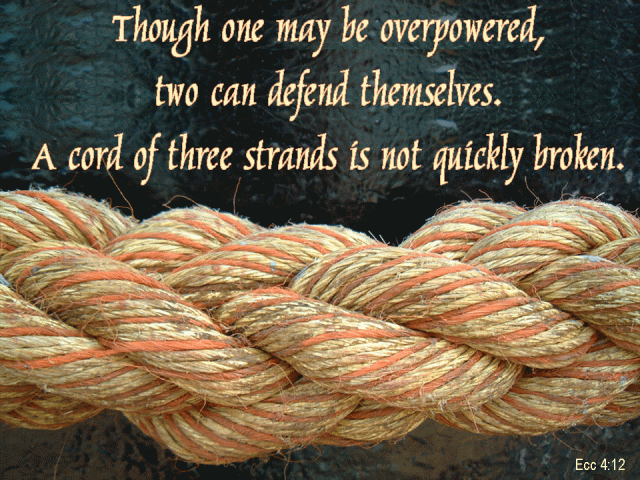
Two are better than one, because they have a good reward for their toil. 10 For if they fall, one will lift up the other; but woe to one who is alone and falls and does not have another to help. 11 Again, if two lie together, they keep warm; but how can one keep warm alone? 12 And though one might prevail against another, two will withstand one. A threefold cord is not quickly broken.


The first part of this passage reminds me of Ebenezer Scrooge in A Christmas Carol. He had given himself to work and money, but after an eventful Christmas realizes that he needs more in his life. He needs other people. Qohelet is condemning singleness here. He is writing about people who chose work over relationships.  He is writing about people whose children are orphans because their parents choose not to be with them. He is writing about people whose “eyes are never satisfied with riches.”

Qohelet has just said that work is one of the things we can do that gives our lives some purpose, but here he is providing a corrective. Work may add meaning to our lives, but the crucial word here is “add.” In the end work cannot be the end-all-and-be-all of our lives. If we try to make it more than it is, well, it is mere breath.

At this point Qohelet does talk about the value of relationships. “Two are better than one,” he says, and gives a host of practical examples why. (Coming from Alaska, my favorite is the one where two people keep each other warm!)

I usually read the last section at weddings I perform. Qohelet talks about the value of having someone to share your life with. He is echoing a long tradition of people who teach that the best life is one centered around relationships. Aristotle taught that friendship was the highest ethical virtue, and that a friend was a part of your true self. Athanasius of Alexandra wrote that the Triune God is, by definition, a series of relationships (Father to Son, Son to Spirit, Spirit to Father) and that without these series of relationships, the Christian God could not exist.

In the end Qohelet says that a three-ply cord cannot be easily broken. From my limited time doing braid-work, I know that you cannot braid two strands. The two need a third to give them stability. I use this in the wedding sermon, and tell people they actually need more in their marriage than just each other. Being a preacher type I am naturally going to point them to God, and tell them that Christ is that third strand. I’m sure Qohelet, living at least 400 years before Jesus, did not mean that, but why does he talk about a three-ply strand after just extolling the virtues of two helping each other? What did he think that third strand was?


Thoughts and Questions

  1. While Christianity has been about loving other people, there is also a tradition of people who choose the solitary life—monks, hermits, and others. Do you think one can live a fulfilling life if they have chosen to live in isolation from others?
  2. Many people do not chose to live alone; it is thrust upon them. What would Qohelet say (or what would you say) to the person who wants to be in a relationship, but cannot find one?
  3. What do you think Qohelet was referring to when he talks about a “three-ply strand?”


Posted in Devotional, Ecclesiastes, Ecclesiastes for Everyone, Lent, Lenten Devotional, Relationships, Spiritual Growth, spirituality, Uncategorized | Tagged , , , , , , | Leave a comment

Ecclesiastes for Everyday: Day 14

dc42c45f147f1bf18e5ca967369b535f--bulletproof-vest-world-war


I also observed that people work hard and become good at what they do only out of mutual envy. This too is pointless, just mere breath.

Fools fold their hands and eat their own flesh.
    But better is resting with one handful
than working hard for two fistfuls and chasing after wind.


Why do we work hard? Whether it is in an office, on a construction site, or in keeping a home, why do we work hard at what we do? I remember doing piece work in a factory one summer. My co-workers and I got into a friendly competition to see who could make the most parts in an hour. For us it was a way to pass the time, but there was also a sense where none of us wanted to be shown up. We wanted the other people to think we were good at what we do.

Qohelet would have liked that. He says here that one of the reasons we work as hard as we do is so we can impress other people—our bosses, our fellow workers, even ourselves.

To what end? While we can take pride in a job well done, life is more than just work.

Qohelet points to a middle way between two extremes. The first is idleness. Idle hands may not be the devil’s workshop, but neither are they the way to success. If we are not willing to work, he says, that is like eating our own flesh, a very graphic way of saying that you cannot sustain yourself without some source of outside nourishment.

On the other hand, why give yourself completely over to your job? I once spent a weekend at a retreat where we were not allowed to talk about work. We were a group of strangers, and I quickly realized that if I could not talk about work I did not have a lot to talk about. That was a wakeup call for me. I needed to have more in my life. I mean, I love my job, but I am more than a job. I realize the day will come when I retire, and if I have invested all I have into my work, what will have when they give me my gold watch and send me on my way? If my whole life consists of work, I will find myself empty-handed on that day.

In Alexander Solzhenitsyn’s One Day in the Life of Ivan Denisovich, prisoners in a Russian labor camp are building a brick wall. Ivan and the other prisoners are getting into the rhythm of the work, and as Solzhenitsyn describes it, they are almost enjoying their activity. They are in a labor camp. They cannot choose whether or not they will work. All they have control of is how well they work. If they work too hard, they will wear themselves out, and not be fit to work the next day. On the other hand, if they slack off, the authorities will come in with severe punishments.

While we do not live in labor camps, Qohelet would say that is a good description of our lives and work. There is no need to go overboard. Life is more than work. On the other hand, not working carries with it its own punishments.


Thoughts and Questions

  1. Can you think of times when you have genuinely enjoyed your work? Why was work pleasurable to you? What made you enjoy it?
  2. What about people who are caught in dead-end jobs? Qohelet claims to be a king. (Nice work if you can get it!) What about the people who empty the garbage, or pick pears, or unclog sewer lines? Can they find any meaning their work?
  3. Do you think that Solzhenitsyn was really describing the human condition when he is talking about Ivan Denisovich laying bricks, or is our life so different from that the comparison is not a valid one? Have you ever felt trapped in work, or in your life?


Posted in Devotional, Ecclesiastes, Ecclesiastes for Everyone, Lent, Lenten Devotional, Spiritual Growth, spirituality, Uncategorized | Tagged , , , , , , | Leave a comment

Ecclesiastes for Everyday: Day 13

220px-Dayafter1

4 Again I saw all the oppressions that are practiced under the sun. Look, the tears of the oppressed—with no one to comfort them! On the side of their oppressors there was power—with no one to comfort them. And I thought the dead, who have already died, more fortunate than the living, who are still alive; but better than both is the one who has not yet been, and has not seen the evil deeds that are done under the sun.


Back in the early nineteen eighties there was a TV movie called The Day After, which portrayed how the world would look after a nuclear attack. It was graphic and grisly. I remember thinking, as I watched people trying to navigate the through the collapse of society that it would probably be better to die in the blast than to have to live through the aftermath.

The Day After was a hard movie to watch. Sometimes life can be hard to deal with. Qohelet looks at the world and sees what is there. Not all of it is good. In fact some of it is downright terrible. He sees oppression, and the tears of the oppressed. If he were alive today, he would point to Syrian refugees, and he might carry in his pocket a picture of the little boy who died on the beach. He would see kidnapped teen-aged girls in Nigeria. He would see countless and nameless people dying of hunger, homeless people sleeping on park benches, and indigenous people around the world whose land has been stolen from them.

These are hard things to see, but what do you after you have seen them? Qohelet says it would be better to have never been born. But that is not an option. Around 353,000 babies are born every day, and many are born into horrible circumstances. We might say, with Qohelet, that it would be better if many of those babies had not been born, but they were.

And the fact is, we cannot change the circumstances into which they were born. People are born into oppressive circumstances every day. Wishing they had not been does nothing to change that.

What can we do?

The fact that we cannot change the whole world does not mean that we are absolved from trying to do what we can, where we can.

Thoughts and Questions

  1. Jesus said, “You will always have the poor with you.” Do you think he meant that we should just accept that, or do you think he offered that as a challenge?
  2. It is hard not to see Qohelet observations as a very depressing state of affairs. And it is easy to see why he would wish that some people were never born, for their own good. How do you deal with some of the harder facts of life? How do you deal with things that you cannot change?
  3. When the Psalms talk about oppression, it is assumed that God will rescue the oppressed. In the Prophets there is usually an exhortation for the people to rescue the oppressed. Qohelet looks, neither to the God, nor the people to rescue the oppressed. Yet he is disturbed by the oppression he sees. Do you think he has any kind of solution for oppression?
Posted in Devotional, Ecclesiastes, Ecclesiastes for Everyone, Lent, Lenten Devotional, Spiritual Growth, spirituality, Uncategorized | Tagged , , , , , , | Leave a comment

Ecclesiastes for Everyday: Day 12

2000px-Villianc_transparent_background.svg_


16 I saw something else under the sun: in the place of justice, there was wickedness; and in the place of what was right, there was wickedness again!  17 I said in my heart, God will judge the righteous and the wicked, for he has appointed a time for every matter, and for every work.


18 I said in my heart with regard to human beings that God is testing them to show that they are but animals. 19 For the fate of humans and the fate of animals is the same; as one dies, so dies the other. They all have the same breath, and humans have no advantage over the animals; for all is mere breath.


20 All go to one place;

all are from the dust,

and all turn to dust again.


21 Who knows whether the human spirit goes upward and the spirit of animals goes downward to the earth? 22 So I saw that there is nothing better than that all should enjoy their work, for that is their lot; Who, really, is able to see what will happen after their passing?


I was watching a movie recently, and one of the main characters said to the villain, “You know, nasty little fellows such as yourself always get their comeuppance.”

“They do?” asked the villain?

“Always.”

Except we know that is not true. The good do not always come out ahead.  Sometimes the villain wins. Good does not always triumph over evil, at least not in ways that we can see. Sometimes nasty little fellows end up getting very rich.

Qohelet, in his unflinching view of life has seen that happen time and time again. We like to think that life is like the movies; the good guy always wins in the end, and gets to ride off in the sunset with the girl. The bad guy always suffers a humiliating defeat. But life is not a movie. It is much more complicated. (In fact, sometimes we cannot even tell the difference between the good guys and the bad guys!)

But for Qohelet this is not a reason to despair. He has just told us that everything happens in its time. Justice will happen, and God will see to it, but in God’s time, not our time! The problem is that we often want things to happen in our time, according to our schedules. We don’t like waiting. Things are resolved on TV in less than an hour (not counting commercials). It takes slightly longer in movies—two hours. But it is always resolved.

That is not the way things happen “under the sun.”

Then Qohelet raises an interesting question. He has just talked about wickedness and injustice, in short saying we live like animals sometimes. Justice does not always prevail in ways we can see. But he takes that even further. A man lives, a man dies. An animal lives, an animal dies. What is the difference between us?

For Qohelet there is one major difference—we can take pleasure in our work. An animal does what it has to do to survive. Humans have more leeway. We are not just creatures of need. For Qohelet, even though he is not sure about an afterlife[i], the fact that we can be cognizant of our own existence sets us apart from the animals.

He ends this section by asking, “Who really knows what happens in the future?” and is most likely referring to what happens after we die.

Thoughts and Questions

  1. How does it make you feel knowing that you will not always see justice and what is right and good prevail? Does it make want to fight for justice even more, or sit back and just let things happen? Do you think that we are ever instruments of God’s justice?
  2. In a few weeks we will celebrate Easter, and the resurrection of Jesus Christ, which, according to Paul, is prove of our resurrection. Qohelet lived in a time long before Christ. How different is it to live our lives in the light of the Resurrection? How might your life be different if you did not know of the Resurrection?


[i] At the time that Qohelet was writing this the idea of a personal afterlife was new to the Jewish tradition. Qohelet is not sure he agrees with these newfangled ideas.

Posted in Devotional, Ecclesiastes, Ecclesiastes for Everyone, Lent, Lenten Devotional, Spiritual Growth, spirituality, Uncategorized | Tagged , , , , , , | Leave a comment

Ecclesiastes for Everyday: Day Eleven

MystCover

What gain have the workers from their toil? 10 I have seen the business that God has given to everyone to be busy with. 11 He has made everything beautiful for its time; moreover he has put a sense of eternity into their minds, yet they cannot find out what God has done from the beginning to the end. 12 I know that there is nothing better for them than to be merry and partake of good things in this life; 13 moreover, it is God’s gift that all should eat and drink and take pleasure in all their toil. 14 I know that whatever God does endures forever; nothing can be added to it, nor anything taken from it; God has done this, so that all should stand in awe before him. 15 That which is, already has been; that which is to be, already is; and God seeks out what has gone by.


I’m not really big on computer games, but I found one I liked many years ago.  It was called Myst. The goal of the game was to explore a semi-deserted island, but in order to do so you had to solve a series. Each new move brought a new puzzle that had to be solved.

Of course, the more puzzles you can solve, the more interesting the game was. If you could not solve them you ended up wandered aimlessly around the island.

I had a very hard time with the game at first. The directions were not clear at all. The first puzzle you had to solve was to figure out that the game was a series of puzzles.  The puzzles were hard, I was very frustrated when I first started playing. I knew there was more to the game than just meandering around the island, but I could not figure out what it was.

Qohelet says our life is like that. We know that there is more to this game called life, but we have a hard time figuring out what it is. Do we have an ultimate purpose? What is the meaning to our life? We know that there is more to life than just meandering around. Qohelet says that God “has put a sense of eternity into their minds, yet they cannot find out what God has done from the beginning to the end.”

If it all stopped there, we would say that life was pretty miserable. It would be like God put in a Myst-like game, with puzzles to solve, but puzzles that had no answer. (It reminds me of the old joke, “How do you confuse a Presbyterian Minister? Put him in a round room and tell he there is potential new member in the corner.”)

But Qohelet says more. He says we can three things that help us deal with our troubled relationship to eternity. First, enjoy the moment, or as Qohelet says, “Make merry.” If we can live in the moment, then we have eternity at our grasp. In the present moment there is no past or future. Time is our enemy when we worry about the past, which we cannot change, or the future, which has not yet happened.

The second is to enjoy food, drink, and the work of our hands. This is related to the first, but here Qohelet encourages us to make the most of the life we have been given, and points us to two anchors of life—food and work. The majority of our lives are taken with these two endeavors. If we can embrace them, we can embrace life itself.

The third is the basis for understanding the first two—to understand that God is eternal, and stand in awe of God’s eternal nature. To contemplate the nature of God is to contemplate eternity itself. We are formed by what we give our minds to, and when we give our minds to God, in devotion and service as well as contemplation, we are changed, and the spark of eternity that lies within us grows.


Thoughts and Questions


  1. Qohelet says that not only has God put eternity in our minds, God has also given us a beautiful world to enjoy. In what ways can we enjoy the beauty of the world around us, and how do you think that draws us closer to God?
  2. Take a moment and recount all the good things in your life. When we focus on what is wrong, we tend to see more of what is wrong. When we focus on what is right and good, we tend to see more of that. This is a rhetorical question of course, but which would you rather have running through your mind—the things that are right and good, or all the things that need to fixed?
  3. What are some ways we can contemplate the nature of God? Can you do by looking at nature? In worship? In prayer? Try to spend at least five minutes a day, for the rest of Lent, thinking about the nature of God. (Hint: The Psalms can be a great help in this!)


Posted in Devotional, Ecclesiastes, Ecclesiastes for Everyone, Lent, Lenten Devotional, Spiritual Growth, spirituality | Tagged , , , , , , | Leave a comment

Ecclesiastes for Everyday: Day Ten

75b625ea707d3dfb156afc8d9f6aa2ad

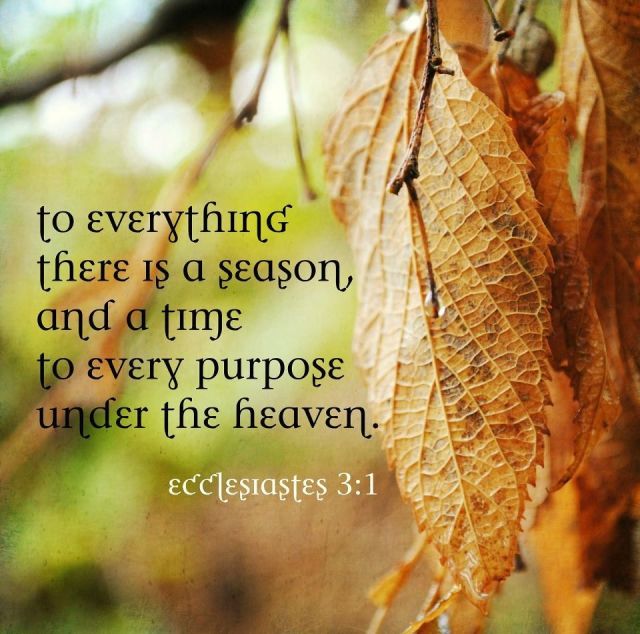
3 For everything there is a season, and a time for every matter under heaven:

a time to be born, and a time to die;
a time to plant, and a time to pluck up what is planted;
a time to kill, and a time to heal;
a time to break down, and a time to build up;
a time to weep, and a time to laugh;
a time to mourn, and a time to dance;
a time to throw away stones, and a time to gather stones together;
a time to embrace, and a time to refrain from embracing;
a time to seek, and a time to lose;
a time to keep, and a time to throw away;
a time to tear, and a time to sew;
a time to keep silence, and a time to speak;
a time to love, and a time to hate;
a time for war, and a time for peace.


This is the most well-known passage in Ecclesiastes. It was turned into a song by Pete Seeger, which was later recorded by the Byrds. (The lyrics from the song are taken directly from the King James version of this passage, which makes this the oldest number one Billboard song.) It is highly possible that you got suckered into doing this devotional series because you wanted to read the book that had this passage. You might not have realized that you had to work your way through one of the most cynical works of literature in the Bible.

This is one of the most profound pieces of literature in the world. Its simplicity is only exceeded by its depth.

Rabbi Rami Shapiro wrote, “There is no thing without its opposite, and to live clinging to the one without in time welcoming the other is a fool.”

This sounds like a nice sentiment, the kind you might write a song about, if you were a songwriter. Some of it is obvious. Anyone who has ever had a garden knows that there is a time to plant, and a time to pluck up what is planted. Nothing grows from last year’s tomato plants. We know there is a time to speak, and a time to keep quiet (and most of wish more people knew about the latter).

But we prefer to have a time of laughing without the requisite time for weeping. We prefer dancing over mourning. We prefer peace over war. And we certainly prefer birth over death.

When I worked as a chaplain in the hospital, I was called to attend a death at least once a week, often more. But I rarely was there after a birth. That was a happy occasion, and no one felt the need to call the chaplain. They could handle that on their own. But for a death, they needed all the help they could get. You can say that everything has a season, but we do all we can to avoid the season of death, the season of mourning, the season when we refrain from embracing, the season when we scatter stones, the season of war and of hate.

As we should. We are not called to embrace hate, or war, or death in this passage. But we are just told these are inevitabilities. We are not told that we are to give ourselves over to tearing apart, to losing things dear to us, or to scattering stones. But we are warned that such a time will come. We are not told that we must “go gentle into that good night” of death, and I believe it is acceptable to “rage, rage against the dying of the light.” But we should know that our raging may not change the inevitable.

“For everything there is a season, and a time for every matter under heaven.”

Thoughts and Questions

  1. Qohelet is writing poetry here, not philosophy as he is the rest of the book. This passage certainly works as a poem, but he leaves a lot out. How can we know which is the time for embracing, for example, and which is the time to refrain from embracing? How do we know when it is time to love and when it is time to hate? What guides you through these decisions?
  2. If you have heard the song, “Turn, Turn, Turn,” based on this text, you know it has a hopeful note to it, especially in the words Pete Seeger added at the end—“A time for peace, I swear it’s not too late.” As you read it, in the context of what you have read so far in Ecclesiastes, does it still strike you as a hopeful song? Why or why not?
  3. Are there any other events you might add to this list? For example, a time to eat, and a time to go hungry; A time to be entertained and a time to work. Write three of your own.
Posted in Devotional, Ecclesiastes, Ecclesiastes for Everyone, Lent, Lenten Devotional, Qohelet, Spiritual Growth, spirituality, Turn, Turn, Turn, Uncategorized | Tagged , , , , | Leave a comment

Ecclesiastes for Everyday: Day Nine

6a00d83451c0aa69e2022ad3556e80200c-500wi

 24 There is nothing better for mortals than to eat and drink, and find enjoyment in their toil. This also, I saw, is from the hand of God; 25 for apart from him who can eat or who can have enjoyment? 26 For to the one who pleases him God gives wisdom and knowledge and joy; but to the sinner he gives the work of gathering and heaping, only to give to one who pleases God. This also is mere breath and an attempt to try to herd the wind.


So far Qohelet seems to be a pretty gloomy guy. Is there anything in life that pleases him?

As it turns out, there is—eating, drinking and hard, satisfying work. If you can be satisfied with what you have to eat and drink, and with the labor you perform to earn your daily bread, you are indeed a happy person, he says.

There is a story of a Buddhist monk who was walking along a mountain path. Down the path came a hungry tiger, and when he saw the monk, he came running toward him. The monk slipped over the edge of the path, and started to climb down a vine that was hanging there. As he descended, he saw a bear at the bottom, waiting for him. Above him the tiger was looking down, and below him the bear was looking up. He looked over and saw that ants were beginning to chew on the vine. To his left he saw a strawberry, and reached over to pluck it. He ate it.

It was delicious.

This is an extreme example of what Qohelet teaches, but it underscores his point. We cannot control the many factors that make up our lives, but if we can be satisfied with the food and drink we have, as well as the way we have to earn it, then we are blessed.

Previously, Qohelet has said that making pleasure (including food and drink) one of our main goals in life is pointless (mere breath), but here he is affirming that we have to eat, drink, and work, so we might has well find some kind of satisfaction in that.

Qohelet has a warning here. For the first time he affirms that people who please God receive “wisdom and knowledge and joy,” but those who sin end up “gathering and heaping” only to have the righteous enjoy the fruits of their labor. This is one of the few times where Qohelet says that God rewards the just and punishes the unjust. In most other places he frets because it seems that too often the just and the unjust receive the same from God.

However he seems to be making a different point. If you attempt to hoard things, if you think you can find pleasure from gathering about you a wealth of material resources, one day you will die, and all that is valuable to you will parsed out to others. All your hard work is for nothing in the end. But if you are satisfied with what you have in this life, and do not attempt to hoard, you will die happy and satisfied, and if anybody gets what you did manage to accumulate, that will not bother you in the least, because your possessions did not own you.

Thoughts and Questions

  1. Qohelet ends this passage with his usual, “This also is mere breath and an attempt to try to herd the wind.” Perhaps he is saying that after all is said and done, and you are in your grave, it does not matter what you did in this life. Richard Pryor said, “You never saw a Brink’s truck following a hearse.” What good is our accumulated wealth?
  2. What do you feel is the measure of a Good Life? Looking back on your own life, what were your happiest days? What were the most frustrating days? How can you maximize the reminder of your days?
  3. Qohelet says that taking pleasure in eating and drinking comes “from the hand of God.” Perhaps that is why we should give thanks at every meal we eat. How well do you appreciate or enjoy the food you eat on a regular basis? The next meal you have, take time to enjoy it. Eat slowly. Thank God for every bite. Enjoy the drink you have. These are gifts from God.
Posted in Buddhist Story, Devotional, Ecclesiastes, Ecclesiastes for Everyone, Lent, Lenten Devotional, Musings, Qohelet, Spiritual Growth, spirituality | Tagged , , , , , , , | Leave a comment

Ecclesiastes for Everyday: Day Eight

Blank yellow sticky note block isolated on white background

18 I hated all my toil in which I had toiled under the sun, seeing that I must leave it to those who come after me 19 —and who knows whether they will be wise or foolish? Yet they will be master of all for which I toiled and grew wise under the sun. This also is mere breath. 20 So I turned and gave my heart up to despair concerning all the toil of my labors under the sun, 21 because sometimes one who has toiled with wisdom and knowledge and skill must leave all to be enjoyed by another who did not toil for it. This also is mere breath and a great evil. 22 What do mortals get from all the toil and strain with which they toil under the sun? 23 For all their days are full of pain, and their work is a worry; even at night their minds do not rest. This also is mere breath.


My uncle Pete made the best red cole slaw you ever ate in your life. I always looked forward to going to his house for dinners, because of his cole slaw. But he kept the recipe a strict secret. He would not tell anyone what his secret ingredients were, not even his wife, children and grandchildren.

He got lung cancer, and was in hospice. My step father was visiting him, and said one day, “Pete, why don’t you leave us that cole slaw recipe before you die? That can be your legacy to the world.”

Uncle Pete nodded, and asked for some paper and a pen. He scribbled down, “two heads of cabbage,” looked at the paper for a while, then crumpled it up and said, “Nah, you’d just mess it up.”

And those were his last words.

Like Qohelet, it galled him that someone would take his work, mess it up, and then take credit for it.

There is a saying that a good person is someone who plants a tree they will never enjoy the shade of themselves, who plant a long term crop they will never be able to harvest. This seems to go against the claim he just made however that all the good a person does will be forgotten. Perhaps this is a clue that Qohelet is overstating his case to make a point. And the point is this; don’t cling too tightly to what you have, or what you have done. It is not really yours.

In 1968 Dr. Spencer Silver, a scientist at 3M was trying to invent a super strong adhesive. Instead he ended up with a very low strength adhesive, whose only positive property was that you put it on several different surfaces without it losing its adhesive power. The invention floated around 3M for a while, until in 1974 Art Fry saw Silver’s invention, and turned it into the Post-it note we know today. One man invented it, but it took another man to see the practical use for it. That is often the way of life. Everything we do is incomplete. Had Silver clung to the notion that his invention was supposed to be a superstrong adhesive, we would not have Post-it notes today.

Qohelet does not want to let go of the fruit of his wisdom however, because he is afraid that people who don’t deserve it will get a hold of it, and use it for their purposes. But holding on to his wisdom only makes him miserable.


Thoughts and Questions

  1. What do you hold on to? Family? Friends? God? Work? Does holding on to it make it more precious to you, or more worrisome? What would it mean to let go of it?
  2. Qohelet asks, “What do mortals get from all the toil and strain with which they toil under the sun?” What is the natural reward of all our work? What do you want it to be? What is it really?
  3. Qohelet seems to be like a petulant child here. “I don’t want you to have this because it is mine!” he is saying. This does not look like the sentiments of a wise man, and yet these are common sentiments. He is showing us, perhaps, how foolish we look sometimes. Do you see other people in the picture of life he paints? Do you see yourself?


Posted in Devotional, Ecclesiastes, Ecclesiastes for Everyone, Lent, Lenten Devotional, Musings, Spiritual Growth, spirituality | Tagged , , , , , , | Leave a comment