Gratitude Attitude October 1

Today’s Gratitude Attitude; Our food bank opens at 2 pm, and at 10 am we had people standing in line to get here. We get tons of food every week, thanks in part to Trader Joe’s, but most of it is gone by the end of the day. I am thankful that I do not have food insecurity. I don’t have to worry about where my next meal is coming from, even when the budget is really tight.

I am also thankful for the good people who run our food bank every week. They are making it possible for people to bring home shopping carts full of food, and without this, many would go hungry.

And finally, I am thankful for Jack Jones, who loaned me the documentary, “A Place at the Table,” about how food insecurity affects MILLIONS of people in America. As reported by NPR, ” the U.S. Department of Agriculture estimates that about about 50 million Americans fall into this category of “food insecure” — meaning they don’t always have the resources to buy the food they need. This includes nearly 17 million children in the U.S.” If you ate your fill today, and yesterday, and plan to do so tomorrow, give thanks, for many do not!

Today's Gratitude Attitude; Our food bank opens at 2 pm, and at 10 am we had people standing in line to get here. We get tons of food every week, thanks in part to Trader Joe's, but most of it is gone by the end of the day. I am thankful that I do not have food insecurity. I don't have to worry about where my next meal is coming from, even when the budget is really tight. 

I am also thankful for the good people who run our food bank every week. They are making it possible for people to bring home shopping carts full of food, and without this, many would go hungry. 

And finally, I am thankful for Jack Jones, who loaned me the documentary, "A Place at the Table," about how food insecurity affects MILLIONS of people in America. As reported by NPR, " the U.S. Department of Agriculture estimates that about about 50 million Americans fall into this category of "food insecure" — meaning they don't always have the resources to buy the food they need. This includes nearly 17 million children in the U.S." If you ate your fill today, and yesterday, and plan to do so tomorrow, give thanks, for many do not!
Posted in Uncategorized | Tagged | Leave a comment

To Be Rather Than to Seem

manufacture-of-homemade-face-masks-for-acne_1

MATTHEW 21:23-32

23When he entered the temple, the chief priests and the elders of the people came to him as he was teaching, and said, “By what authority are you doing these things, and who gave you this authority?” 24Jesus said to them, “I will also ask you one question; if you tell me the answer, then I will also tell you by what authority I do these things. 25Did the baptism of John come from heaven, or was it of human origin?” And they argued with one another, “If we say, ‘From heaven,’ he will say to us, ‘Why then did you not believe him?’ 26But if we say, ‘Of human origin,’ we are afraid of the crowd; for all regard John as a prophet.” 27So they answered Jesus, “We do not know.” And he said to them, “Neither will I tell you by what authority I am doing these things.

28“What do you think? A man had two sons; he went to the first and said, ‘Son, go and work in the vineyard today.’ 29He answered, ‘I will not’; but later he changed his mind and went. 30The father went to the second and said the same; and he answered, ‘I go, sir’; but he did not go. 31Which of the two did the will of his father?” They said, “The first.” Jesus said to them, “Truly I tell you, the tax collectors and the prostitutes are going into the kingdom of God ahead of you. 32For John came to you in the way of righteousness and you did not believe him, but the tax collectors and the prostitutes believed him; and even after you saw it, you did not change your minds and believe him.”

I was teaching Sunday School to a class of Junior High boys many years ago, and I asked them what they would do if they had a million dollars. The first boy said he would give half the money to the church, and buy his parents a new house. The second boy said that he would give most of the money to the church and buy his brother a new bicycle. The third, not to be outdone, said he would give ALL the money to the church.

“Those are good answers,” I said, “but what would you REALLY do if you had a million dollars?”

“I would buy a new car,” said the first, and the second chimed in, “Me too! A really cool sports car!”

The first go round, I got the Sunday School answers. The second time around I got the REAL answers. And while the Sunday School answers seemed like the right answers, they made the kids look like they were holy and devout Christians, I don’t think that was what God wants from us. I think God prefers our honesty over our pretensions to looking good.

f2e63dab7ee67889e7171daf8aefbf12As many of you know, I originally hail from North Carolina. The motto of North Carolina is, Esse quam videri, which means, “To be rather than to seem.” I think that should be the motto for Christians who want to live a spiritual life. What we are is more important than what we look like.

Or as one pastor put it, “A secret to the spiritual life is desiring to be more spiritual than you appear to be. The secret to hypocrisy is desiring to appear more spiritual than you actually are.

The great Christian writer C.S. Lewis used to ask, what is the most important conversion you can have in a day? Often people would answer, “The conversation we have with God.”

And he would reply, “No. It’s the conversation you have with yourself BEFORE you speak to God, because in that conversation with yourself, you decide whether you are going to be honest and authentic with God, or whether you are going to meet God with a false face, a mask, an act, a pretense.”

Above all things, God desires our honesty.

Jesus made that point in today’s Gospel lesson. A man has two sons, and asks them, each in turn, to go work in his fields. The first says, “No way, old man!” but he thinks better of it, and he goes and works in the fields. The second son says, “Of course I will father,” and but he ends checking his Facebook page first, and there are some interesting things on there, and he gets caught in that, and does not go work in the fields.

Now this is one of those stories we need to put in its historical context to really understand the point that Jesus is making here. It seems pretty clear to us. If you say you are going to do something, than do it! As a parent I can relate to this story. “Will you take out the garbage?” “Of course I will!” and then twenty minutes later, the garbage is not taken out yet.

The people who actually heard Jesus tell this story experienced it a little differently from how you do though.

Listen to what Jesus asks at the end of the parable; “31Which of the two did the will of his father?” Now for us, the answer is easy, but that was probably NOT the question that people of Jesus’ day were expecting to hear. They were probably expecting to hear something more along the lines of, “Which son did the best job honoring his father,” to which the obvious answer is the FIRST son—yes, the one who said he would go, but didn’t.

You see in Jesus’ day it was important to show honor to certain people—your parents, your teachers, town officials, religious leaders. To say “No” to a request to their face is to dishonor them.

I would run into this when I lived in Alaska. In Inuit culture they had roughly the same kind of values. You disrespected someone if you publicly turned them down.  So, for example, say I was with a group of people, and said, “Dan, can you take me to the airport tomorrow. I need to catch a plane at 1:00.” Dan is pretty obligated at that point to say yes, even if he knows that he is not even going to be in town.

Now what you are supposed to do in this situation is to say something like, “I’m going to need a ride to the airport tomorrow. Around 1:00.” Eventually someone will speak up and say, “I can get you there.” And you have your ride.

If you ask someone directly, you are putting them on the spot, and if you don’t get a ride to the airport, well, that is your fault for asking the wrong way.

Now we may look at this parable and say, “That sounds crazy! We would never do anything like that!”

Are there things we honor with our mouths, but not with our actions?

I heard a story of a pastor that when to visit a woman, someone who had not been to church in a long while, and she was saying that while she was not a faithful church attender, she was a faithful person, and turned to her son and said, “Bring Mommy that book that we all love to read from so much,” and the boy returned, not with the Bible, but with a TV Guide.

Now Jesus is not interested in saving face. He does not put honor above actions. He is more interested in saving lives and saving souls than in saving face. God wants us to BE rather than to SEEM, even if being is not quite what we want to look like before God.

Now here is the great irony of Church. On the one hand, this is the place where we should be most able to be ourselves. On the other hand, often this is the last place where we feel like we can really be ourselves.

But when Jesus said, I came that you might have life, and life abundant,” he did not mean that we are supposed to have somebody else’s life! He wants us to have our life, the life he gave to us, he wants us to be who he created us to be.

Now Jesus says something really interesting after he tells the parable; “Truly I tell you, the tax collectors and the prostitutes are going into the kingdom of God ahead of you.” Now for the average person in Jesus’ day, those were the LAST two people you would expect to see in the Kingdom of God. Yet Jesus says that they have a better chance than the Pharisees. Why?

Because they were not hiding behind a mask. God was able to see them for who they really are. They were who they were, even if the reality of who they were was not all that pretty.

Let me explain what I mean. We all have what psychologist call a social persona. That is the person we are in public. And that is often very necessary. We don’t just let it all hang out in public. You meet a casual acquaintance and ask them how they are doing, we all know that you are really not asking them to share the deep secrets of their hearts. There’s nothing wrong with this.

But then we have a private self. That is who we are when we are amongst friends, close friends, and loved ones. That is when you take the public mask off, and you can relax and just be yourself. Your spouse, and your close friends probably see a side of you that the general public does not see. One year my mother in law was visiting me during the NCAA basketball championship, and Duke was in the championship game.

We watched the final game together, and after the game she said, “You know, that’s a side of you I have never seen before.” Now it’s not like she saw me cuss and throw things in anger. But she saw more excitement in me that what I generally show. I did shout a bit, and I fretted when the score was close, and I might have even danced around the room a bit when Duke won.

Now here is the difference; she didn’t see a DIFFERENT me, she just saw MORE of me.

There is a difference between holding things back in public, and being a completely different person in public.  That is called hypocrisy. A hypocrite is literally an actor who wears a mask. Who they are and who they pretend to be are two very different people. There is little or no connection between the two. How many of you remember Leave It to Beaver? Remember Eddy Haskell? He was the kid who was always so polite when he was around parents, and a total brat when he was with his friends. That’s hypocrisy. He wore a mask of politeness when he was talking to the Cleavers, but in private he was a totally different person.

God accepts us for who we are. We don’t have to pretend to be different.

Now here is the big problem with wearing a mask. No one knows who you really are. I have a friend who builds sets in Hollywood. During one the strikes there, he had a hard time getting work, and I said, “You’re a carpenter. You shouldn’t have any problem finding work. You could do construction or fix things.” And he said, “You don’t get it. I build sets. I don’t build houses. I build things that look like houses. What I build, you cannot live in. You can just pretend to live in it.”

We meet someone, we put up a façade; that is normal. But as we get to know the person, we drop the façade, so they get to know who we REALLY are. If we don’t drop the façade, then they never really get to know us. And if they don’t know us, then deep down, if they like us, we know that all they really like is the façade. I have counselled husbands and wives who both held up facades for years, and eventually they realized they were not loved for who they were, they were loved for who they were pretending to be. And who we pretend to be is NOT who we are.

So here’s one piece of Good News. Before God, you can be who you really are—no matter who you really are. God accepts us for who we are. Before God we can take all the masks off, and be real. I love the part in the movie Bruce Almighty, where Bruce has a face to face encounter with God, and God encourages him to pray. Bruce says something like, Dear God, give us world peace and feed all the hungry people in the world. And God reaction? “That’s a good prayer…if you want to be Miss America.” And then Bruce prays a real prayer, he prays what is one his heart, and when he prays THAT prayer, it changes his life.

Sometimes we have to put on a false front for others; we never have to do that with God. God loves and accepts us for who we are. Jesus said that Tax Collectors were closer to the Kingdom of God than the Pharisees.

On the other hand, we can improve who we are. We call that growth. I am not who I was when I was fifteen. Or twenty-five. Or thirty-five. I am not who I was when I was forty-five. I hope I have gotten better over the years. I hope I have grown. I hope that, in spite of my age, I am still able to mature. Whether you are five, fifty-five, seventy-five, or a hundred and five, there is always room for growth. I know of no perfect people. I have been a Christian minister for upward on twenty years, and I still have plenty of room for spiritual growth. As I get older I see parts of myself that I could not see when I was younger.

Some of you know I play a little golf—and I play very badly. I used to get really frustrated when messed up shots, which was most of the time. Still is. But now I have learned to laugh, and I enjoy the game more.

I said that God accepts us where we are, but God does not leave us there. Yes, God accepts tax collectors and prostitutes, but God does not leave them where God finds them. They do not have to continue to rip off friends, or sell themselves to the highest bidder.

God does not want our lip service. God does not want us to put a great performance for his pleasure. God does not want us to put up a false front. God does not want our sentimental notions of what it means to be a good Christian. We don’t need to act spiritual before God. It doesn’t work.

If we act like something we are not, before God, God can never really get to work on molding us into the people God created us to be. God gave us our personality, with all the foibles and flaws we carry, and God can use THAT for the Glory of God, for the Kingdom of God.

God wants our hearts. God wants our love, meagre as it is. God wants us to be, not to seem.

Posted in ministry, spirituality | Tagged , , , , , , | Leave a comment

The Gratitude Attitude

We try to teach our kids manners, and we never quite know how that is going to work out.

I knew some parents who did what most parents do. Whenever someone gave their child something, a gift, or something to eat, the Mom would say to her son, ‘Now, what do you say?” to which the boy would say, “Thank you.”

One day the Mom thought that the boy should have that down, so when someone gave him something, she waited to see what he would do. There was a silence and finally the boy turned to his mom, and said, Mommy, when someone gives me something, you are supposed to say, “What do you say?”!

We can teach our kids to say please and thank you, but teaching them real gratitude is a whole different ball of yarn. It often takes time for the attitudes to catch up with the words, and sometimes they never do.

We can teach someone to say “Thank you,” but it takes more to teach them to be gracious.

We have two stories this morning about gratitude—specifically people who have a hard time being gracious.

We start with Jonah.

You may just think of Jonah as the guy who got eaten by a big fish. But there is much more to the story than that.

He was sent on a mission—to go to Nineveh and tell them that God was very angry with them, and was about to destroy them. Of course Jonah did not want to go, so he got on a boat headed to Tarshish instead, which is the opposite direction. There was a storm, and Jonah realized it was a God-storm and not just an act of nature, so he was thrown off the boat, and swallowed by the fish.

Apparently three days inside a big fish gives a man time to think about his priorities, and Jonah decided that going to Nineveh was now one of his priorities. So he goes there, and starts preaching to the people that God is going to destroy them.

Well to his surprise and it turns out, his great consternation, the people received the message with open hearts. They repented. They changed their ways. And God decided that he did not need to destroy them anymore.

And THAT made Jonah extremely angry. You see, Nineveh was his enemy. He didn’t flee from his task because he was afraid of going to Nineveh. He fled from his task because he was afraid that if the told the Ninevites that God was going to destroy them, they might repent, and then God might NOT destroy them. He says, “That is why I fled to Tarshish at the beginning; for I knew that you are a gracious God and merciful, slow to anger, and abounding in steadfast love, and ready to relent from punishing.”

Which is exactly what happened. God relented. God showed divine graciousness, divine mercy, and divine love.

And Jonah’s response to God’s graciousness? “O Lord, please take my life from me, for it is better for me to die than to live.”

Jonah would rather die than live to see God’s love turned toward the Ninevites.

If you remember last week, I mentioned anger, and how good anger can feel at times. Well, Jonah is someone who loves his anger. He loves nothing better than being angry—angry at the Ninevites and angry with God.

After God decides to spare the Ninevites, Jonah goes up on a hillside, overlooking the city, hoping that maybe God will change the Divine mind, and he will get a front row seat to a great show of Divine wrath. But it is not to be. While he is sitting there, a plant grows up to give him shade from the hot sun. But then a bug comes along and eats the plant, causing it to die, causing Jonah to have to endure the hot sun. His response?

“It is better for me to die than to live.” Oh, woe is me. Life is terrible! I’m hot and Nineveh is still standing! Better that I die than have to endure this!

I can understand his anger at the Ninevites. Nineveh was the capital of Assyria, and Assyria was a perpetual threat to Israel. In the end, they did invade and essentially destroyed Israel, so the fear was well founded. But why was he angry with God?

Jonah did not like it when things did not go his way. He wanted to control God, he wanted things to go his way, and if they didn’t, he assumed the world was out of whack, and needed a good dose of his complaining. (Like that ever makes anything any better.)

Jonah cannot be gracious for what he has, because all he can see is what he does not have. He cannot appreciate the joy of living, because he is too consumed with the work of complaining.

Did the Ninevites deserve God’s compassion? Probably not. But did Jonah? No. He is a walking complaint center.

Jonah was angry because his shade plant died. That’s the way life is, full of ups and downs. One moment we are basking in the shade, the next the sun is beating down on us. One moment everything seems to be going swimmingly well, the next it seems to have all fallen apart.

How do we live in such a world?

Gratitude.

We learn to appreciate life when things are good, and that can help us get through those times when things are rotten. The good does not always outweigh the bad, but it can help us develop and attitude of gratitude, and THAT can help us.

The second story is the parable of the vineyard. A man needs day labor for his vineyard, and so he goes to out and hires some workers. Later in the morning he realizes he needs some more, so he goes out and hires more workers. He still needs more, so later he hires more, and so on throughout the day. Finally, just a few hours before quitting time, he hires the last batch.

They line up for their pay at the end of the day, and to everyone’s surprise, the people who came in at the very end of the day get a full day’s wages. Word gets out, and the folks who came in first in the morning are thinking they are really going to pull down a good day’s wages, but when it is their turn, they get the same thing as the people who just worked a few hours. And they sweated out in the hot sun all day long!

So of course they let the vineyard owner know their displeasure, and the owners shows his displeasure with them. This is wrong! This is un-American! This is unjust! This is unfair!

Now think about this for a moment, from the owner’s point of view. He could have just paid an hour’s wages for the people who worked an hour. That is what we are used to. We get what we earn. You work an hour, you get paid for an hour. You work a day, you get paid for a day.

But this owner is different. He is thinking of things differently. Tell me, does milk cost less, if you were only able to get an hour’s wage? Is grain cheaper for the people who only an hour? Does anyone ever get an “I-could-only-find-a-few-hours-of-work-today” discount?

Of course not. It costs just as much to feed your family on an hour’s wages as it does on a day’s wages. When asked why they were not working, the last people hired said they were waiting all day, but were not chosen.

The owner of the vineyard is being compassionate. He found some people who have been waiting all day for work, and could not find any, and he wants them to be able to feed their families just the like the people he hired earlier in the day. He’s not thinking of fairness—he is thinking compassion.

The people who worked early in the day, they want fairness…of course they want fairness because it works to their advantage. If he works one hour and gets ten dollars, and I work eight hours, then I should get eighty dollars. That is what is fair.

Now here is what is interesting—they are angry, not because the owner cheated them, but because the owner was compassionate. They want equality. They want fairness. But the owner wants to show compassion.

How often do we get caught up in looking at what other people get, as opposed to what we get? It’s an easy thing to do. It’s a game that is played a lot. Christmas rolls around, and you start eyeing the presents your siblings got, to see if they got more than you did. I know as a parent, I spend a lot of time trying to make sure that everyone gets an equal amount of Christmas booty. When we get a Christmas present from a friend, we want to make sure that what we give them is about as good.

Now that kind of attitude does two things. First, it limits compassion. If we have to make sure they everyone gets equal amounts, or gets only what is fair in terms of what other people get, then we are limiting how much we can show love to others. We are not giving according to need, but according to a strict standard of fairness. And sometimes fairness isn’t…well, fair.

I read somewhere, equality is where everyone has shoes. Equity is where everyone has shoes that fit.

243888_v0_600x

We are not always called to be fair; we are called to be compassionate. We are called to reach out to people in need. We are called, not to make sure everyone has an equal share, or to make sure that people get what they deserve. We are called to give freely, without regard to strict standards, that limit our giving. We are called to give out of our abundance to people who stand in need.

Now here is the other thing that happens when we over emphasize fairness—we limit our gratitude. If the standard for my gratitude is that I get roughly what you get, then it is going to be hard for me to maintain my gratitude, especially if you happen to get more. When I compare my blessings to the people around me, I lose sight of our important my blessings are for me.

I might have been happy with my Christmas present until I saw that you happened to get a bigger present than I did. Maybe there is a reason. I remember one year my brother got a bike for Christmas, and I didn’t. I got nice gifts, but not a bike. Of course, my brother, who was younger, did not have a bike at that time, and I did, but still, he got a bigger present than me! I could have been happy with my G.I. Joes, or whatever it was I did that year, but I was too busy looking at what someone else got, and I lost my sense of gratitude.

If we are focused on what we don’t have, we lose sight of those things we do have. And it is hard to be grateful people when all we see is what is NOT there. In my first church, it was a small congregation, about 80 people, and there were times when a lot of people might be gone the same Sunday. One Sunday, we had about ten people there. And I was upset. I was angry. I was angry at the people who weren’t there that Sunday.

But during the service, and it was when the ushers were bringing the offering up, it was like a voice was speaking to me, saying, Murray, stop focusing on who is NOT here today, and focus on who is! Look at the faithful people who ARE here worshiping God, not at the people who are missing. And you know, after that, I stopped fretting over the people who were not there, and started serving the people who were.

Is a preoccupation with fairness, with what other people have, keeping you from being grateful for those things you do have? Are you grateful for where you live, or do you keep seeing how other people live, and wish you had that? Are you grateful for your job, or do you see what other people are doing, and feel envious?  Are you happy with the accomplishments of your children, or do you look at what other children have done, and wish yours had done more?

The best way to make yourself happy is to learn to be grateful for what you do have, instead of focusing on what you don’t have. Sometimes our blessings are abundant—sometimes not so much. Sometimes we really should be content with what we have, other times it is ok to want more. But no matter what, if we lose sight of the blessings we do have, and lose a sense of gratitude for those blessings, we are in training to be miserable people.

There was once a man who was walking down a mountain road. On one side of the mountain road was mountain, on the other side was a sheer cliff. He saw a lion coming down the path, and the lion looked hungry. There was a vine leading off the cliff, so the man climbed on the vine, and started to shimmy down. He looked down and saw a bear at the bottom, saying grace, waiting for him to come down. He looked over to the left side of the vine, and an army of ants were on the vine, chewing through it.

He looked to the right, and saw a ripe strawberry. He plucked and ate it.

It was delicious.

That is living in the moment of gratitude. Our gratitude will probably not be that advanced, but we can practice it.

For the next thirty days, I am taking the gratitude challenge, and I invite you to join me. Each day I will post on my FaceBook page three things that I am thankful for. In doing so I hope to build up my Gratitude Attitude. I want to challenge you to improve your Gratitude Attitude by also naming three things for which you are thankful, and telling someone what they are. You can post it on Facebook, or just tell a loved one or friend.

Let us be the gracious people of God.

JONAH 3:10 – 4:11


10When God saw what they did, how they turned from their evil ways, God changed his mind about the calamity that he had said he would bring upon them; and he did not do it.

4But this was very displeasing to Jonah, and he became angry. 2He prayed to the Lord and said, “O Lord! Is not this what I said while I was still in my own country? That is why I fled to Tarshish at the beginning; for I knew that you are a gracious God and merciful, slow to anger, and abounding in steadfast love, and ready to relent from punishing. 3And now, O Lord, please take my life from me, for it is better for me to die than to live.” 4And the Lord said, “Is it right for you to be angry?”

5Then Jonah went out of the city and sat down east of the city, and made a booth for himself there. He sat under it in the shade, waiting to see what would become of the city. 6The Lord God appointed a bush, and made it come up over Jonah, to give shade over his head, to save him from his discomfort; so Jonah was very happy about the bush. 7But when dawn came up the next day, God appointed a worm that attacked the bush, so that it withered. 8When the sun rose, God prepared a sultry east wind, and the sun beat down on the head of Jonah so that he was faint and asked that he might die. He said, “It is better for me to die than to live.” 9But God said to Jonah, “Is it right for you to be angry about the bush?” And he said, “Yes, angry enough to die.” 10Then the Lord said, “You are concerned about the bush, for which you did not labor and which you did not grow; it came into being in a night and perished in a night.11And should I not be concerned about Nineveh, that great city, in which there are more than a hundred and twenty thousand persons who do not know their right hand from their left, and also many animals?”

GOSPEL MATTHEW 20:1-16


1“For the kingdom of heaven is like a landowner who went out early in the morning to hire laborers for his vineyard. 2After agreeing with the laborers for the usual daily wage, he sent them into his vineyard. 3When he went out about nine o’clock, he saw others standing idle in the marketplace; 4and he said to them, ‘You also go into the vineyard, and I will pay you whatever is right.’ So they went. 5When he went out again about noon and about three o’clock, he did the same. 6And about five o’clock he went out and found others standing around; and he said to them, ‘Why are you standing here idle all day?’ 7They said to him, ‘Because no one has hired us.’ He said to them, ‘You also go into the vineyard.’ 8When evening came, the owner of the vineyard said to his manager, ‘Call the laborers and give them their pay, beginning with the last and then going to the first.’ 9When those hired about five o’clock came, each of them received the usual daily wage. 10Now when the first came, they thought they would receive more; but each of them also received the usual daily wage. 11And when they received it, they grumbled against the landowner, 12saying, ‘These last worked only one hour, and you have made them equal to us who have borne the burden of the day and the scorching heat.’ 13But he replied to one of them, ‘Friend, I am doing you no wrong; did you not agree with me for the usual daily wage? 14Take what belongs to you and go; I choose to give to this last the same as I give to you. 15Am I not allowed to do what I choose with what belongs to me? Or are you envious because I am generous?’ 16So the last will be first, and the first will be last.”

Posted in Uncategorized | Leave a comment

The Arithmetic of God

(The sermon is based on two texts, Matthew 18:21-35 and Romans 14:1-12. The texts can be found at the end of the sermon.)

The first real case of pastoral counseling I had was actually with a neighbor, not a parishioner. I am going to call her Ashley, although that is not her real name.
Ashley moved in about two years after we did. She had the neighborhood dog, who spent as much time at our house as hers. She was in real estate, and doing quite well.
One night she came over to invite us to dinner, then told us that her girlfriend was going to be there, and she hoped we did not have a problem with that. We didn’t and we had a lovely dinner that night.
Two months later, just after Christmas, I was taking the trash out and saw Ashley packing up her car. She hadn’t said anything about going on vacation, and we usually looked after each other’s houses if the other was gone.
Ashley came over and told me that her father had just died. Apparently he fell asleep while smoking, on Christmas Eve, and burned down the family house, which had been in their family for generations. Ashley was driving up to Delaware to be with her family. She also had learned she had been made executor of the estate, so it was going to be a pretty long trip. To make matters worse, she had a very conflicted relationship with her father. He was abusive, and she had run away from home just to get away from him.
We said goodbye, and I just held her in my prayers until she returned home a few weeks later. I was out, taking out the garbage again as she pulled into her driveway. I walked over and said hello, and she asked if she could come over after she had unpacked.
We chatted about her trip for a while, and then told me the real reason she wanted to talk. While she was up in Delaware, her girl friend called, and demanded that Ashley invite her up there, so she could be with her. She explained that it was a very stressful time, and that a lot of her family did not know she was gay, and now was not the time to shock with a suddenly appearing girlfriend. The girlfriend gave her an ultimatum. “If you really love me,” she said, “you will invite me up. If you don’t invite me, I will not be here when you get back.”
And in fact she had taken all her stuff out of Ashley’s house, and left a note saying it was over.
“I can usually forgive people pretty easily,” Ashley said. “I can just let go of things, and act like they never happened. But this is different. I can’t forgive her. She hurt me.”
“You have never HAD to forgive anyone else before,” I said. “All the other times you could just shake it off. This the first time you have actually had someone really hurt you, and the first time you have had to forgive.”
I think a lot of us labor under the same misconception that Ashley had—that forgiveness was the ability to just shrug things off as if they had never happened.
The Gospel lesson this morning is all about forgiveness. First Peter wants a statute of limitations on forgiveness. How often do I have to forgive someone? Suppose they do something that hurts me. And I forgive them. Then they do it again. And I forgive them again. And then, they do it AGAIN, so I forgive them AGAIN…how many times do I have to do that? At what point can I say, “Enough is enough is enough and be done with it? Is seven times enough?”
Peter understands how hard forgiveness can be, and that it can be even harder when the person we need to forgive is not exactly receptive to the idea that they are doing things that need forgiving.
Have you ever been in a situation like that? Someone does something that hurts us one time, well, we can forgive that. They do it again, ok, we can forgive this one too. But you get five times, six times, seven times, and about that time you should be off the hook. No one should have to forgive someone that many times!
Jesus does not give him any wiggle room.
“Seventy TIMES seven,” he says, which is a way of saying, “There is no end to forgiveness.”
Then Jesus tells a story. Once a man owed about a bijillion dollars.
He couldn’t pay the debt and was threatened with prison. But he begged and pleaded, and the debt was forgiven. He ran into a man who owed a few bucks, and demanded his money. The man could not pay, and he had him thrown into debtor’s prison, until he could come up with the money.
In other words, forgiveness is VERY important.
What is so important about forgiveness? Oh, sure we should be able to get past the little piddly things. We can’t go holding grudges for everything! But when we get to the serious stuff, why should we have to forgive that?
It costs to forgive. It cost you something to get past the hurts that have been inflicted on you over time. It is not easy. It is much easier to stay angry, to stay bitter, to nurse the grudges, and sometimes even go looking for them.
Frederick Buechner wrote, “Of the Seven Deadly Sins, anger is possibly the most fun. To lick your wounds, to smack your lips over grievances long past, to roll over your tongue the prospect of bitter confrontations still to come, to savor to the last toothsome morsel both the pain you are given and the pain you are giving back–in many ways it is a feast fit for a king.”
Let’s be honest. If you have ever really nursed a grudge, you know how good that can feel. But Buechner goes on to say, “The chief drawback is that what you are wolfing down is yourself. The skeleton at the feast is you.”
The first reason we forgive is because it is good for us. Hanging on to anger, or to hurts may be easier than forgiving, but it is clearly more dangerous. The problem is, it is not like we have these little boxes inside of us, where we can store hurt or anger in relative isolation. It is not like, “Well, I have this thing that someone did to me, so I will put in this box here, and keep it separate from everything else in my life.” Its not like you can store your hurt or anger or bitterness in emotional Tupperware, which keeps it separate from everything else in your life.
No, hanging on to anger is like keeping fish in your refrigerator too long. After a while it starts to stink. And what’s worse, it starts to make everything else in your refrigerator stink. Anger, bitterness, past hurts fester in our lives, and they bleed over into all the other areas of our lives. Usually in small ways, but sometimes in huge ways.
When people nurture a grudge, they start treating other hurts like that grudge. Have you ever known someone who was perpetually angry? If you scratch the surface of that person, you will find past hurts that they were not able to deal with in a healthy way. They start off angry at some person who legitimately hurt them, but then end up angry because their paper is late, the President did something they disagree with, or there is a social injustice halfway across the world.
I got called down the ER one day when I was a chaplain to minister to a man whose wife had just committed suicide. What was so sad about that was that he had tried to get her committed to the psych ward three times. The first time she refused to leave her car, and come into the hospital and he did not want security to have to bring her in. Twice it was full, and the only thing we could do was to ship her down to Anchorage, which was a complicated, expensive and drawn out process. So on Sunday night we discharged her, and on Monday morning she sent her kids off to school, went to the upstairs bathroom, and shot herself in the head.
I was angry and hurt. We were supposed to help people like that, and we failed her. Two weeks after that I was sitting in a meeting where the facilitator was pretty caustic, and before I knew what I was doing, I stood up, and told the facilitator that I didn’t need his…well, particular style of leading a meeting, and stormed out.
I was not half as angry with that facilitator as I was with the Hospital and our inability to help this person.

So how do we deal with forgiveness?
1) First, we need to acknowledge that there are often things we need to forgive. We need to acknowledge that what other people do sometimes hurts us, and that we need to do the hard work of forgiveness rather than just brush it off.
In Alaska and North Carolina I did some work with troubled churches, and more than once I saw a church that was conflicted, and stuck, and as we got to the know the history of that church, often there was a pastor in the past who had somehow hurt the congregation. Maybe they had an affair or some other violation of trust and had to resign. Maybe they left quickly, and the congregation felt like they were left in a lurch. Maybe they were an abusive sort of personality, and without doing anything technically wrong, they abused their power as pastor. Anyway, what often happens in this kind of church is that the congregation takes it out on the next pastor, or the next few pastors. I worked with a church in Fairbanks that, in my time there, went through a pastor about every two years.
Or, having been hurt, and not willing to admit it, they misplaced their anger. Sometimes the session was the focus, sometimes it was a program of the church, sometimes they just all turned on each other. But they were not willing to admit that they had been hurt! So they never dealt with it directly. And they never got over the hurt.

2) Keep your accounts current. Last week Jesus said that if someone hurts you, deal with it. And deal with it, with that person. And if you need to, get help from others. Don’t let things fester, because some things just get bigger over time. A paper cut can turn into a festering wound if it get infected. If you are carrying a wide variety of hurts, they will bleed into one another, and start bleeding into other areas of your life.
If you have to work backwards, then do it that way. But don’t let hurts accumulate. Little things can pile up, and a whole lot of little things soon become big things.
Some of you remember S&H Green stamps. You buy something from a store, and you get a strip of green stamps, which you put in a little booklet, designed to hold the green stamps. When you book is full, you can redeem it at an S&H center, where you could trade your stamps for toasters, or blenders, or other things for your house.
Well, we do that with relationships. Someone does something to us that we don’t like. We don’t blow up, but we don’t forget it. We turn that into anger stamps, or just irritation stamps, and we post them in our little relationship book. Something else happens, and we put that in the book. Again, we feel some sleight from someone, or some small hurt, and we just post it in the book. Then, something else happens…our spouse is late picking us up, say, and we go to put our anger stamps in the book, but lo and behold—the book is full.
So we redeem it. The whole book. All over that one small event. We blow up, and let our spouse have the full brunt of all the past hurts and irritations.
Instead of saving them up, we need to deal with them as they come, so they are not hanging around. It is easy to forgive someone for one or two simple things they have done to hurt us. It is much harder when that one or two has turned into a multitude of offenses.

3) If you can, let go of it. The Buddha said holding on to anger is like holding on to a hot rock. It only burns you. Yes, maybe someone hurt you, but is holding onto that hurt helping anything? What would your life be like if you could let go of it? You don’t have to hold onto these things.
Too often we carry baggage that we just don’t need to carry. We don’t need to carry other people’s baggage. Other people get hurt, and while we can commiserate with them, we don’t have to take their hurts as our hurts. We can help other people without getting sucked into their hurts as if they were our hurts. We can support other people without taking on their anger as our anger.
And we don’t need all the baggage that we carry with us.
In the summer of 1986 my first wife and I moved to Bonn, Germany for a year of theological study at the University there. We were going to be there for a year, and so we packed enough stuff for the year. I literally had to sit on my suitcases, and wrap a belt around them to keep them closed. In spite of the fact that it was August, I wore a heavy winter coat, and a sweater, and had my pockets stuffed with socks and underwear. I had a backpack and a carry one, both also stuffed full. She was as weighted down as I was.
When I checked in at Newark airport, the agent said, “You are seventy pounds overweight!”
“What does that mean?” I asked.
“I am supposed to charge you five dollars a pound,” she said.
We barely had enough money to get us to Bonn, and could not afford the charges for the extra weight. But I remembered I was in Newark.
“How much is it if I pay you?” I asked.
“Twenty dollars,” said the agent, and after a furtive payment was made, we were on our way.
We had hitchhiked on a plane to Europe. I bought tickets from a company called Airhitch, which bought and sold empty seats on a variety of planes to Europe. The ticket (really a voucher) was not specific in terms of destination or date. We just knew that sometime in August we would be on a plane to Europe. We had no idea which country.
As it turned out, we got a flight to London. We would have enjoyed it, except that we had to drag all our baggage around with us, first from the airport to the city, then to our B&B. I still had to arrange transportation from London to Bonn.
After two days in London, we bought train tickets to Bonn. We dragged our luggage to the station. By this time the metal luggage carriers we brought with us had all been destroyed by the weight and volume of our baggage, so we were each carrying my two suitcases, two carry-ons, and a variety of loose, extraneous things that did not fit in our luggage.
The train left around 10 at night, and would arrive in Bonn around 1 the next afternoon. Most compartments were full, but we found one that was almost empty. We threw our mountain of stuff in, and sat down. When the conductor came to check our tickets, he frowned, made to say something, then obviously thought better of it, and moved on.
Later I found out we were in a First Class compartment—and we didn’t have a First Class ticket. I guess the conductor figured out it would be more trouble to move us than to let us stay where we were!
So we are on the train, and able to rest for a while. Except that I am no dummy. I know that England is on an island, and that trains do not travel well on water. So I also knew that we would probably have to get all our stuff off the train, and then onto a ferry, off the ferry and back onto another train. Which is exactly what we had to do. We hit the docks at around 1 am, lugged our stuff off the train, which was not hard, but then had to stand in line, move our mountain of luggage with us, and then move the mountain up two flights of stairs onto the ferry.
After a fitful rest on the ferry (afraid that someone might steal our luggage) we docked around 4:30 am, dragged our stuff down three flights of stairs, and then scrambled to find a place on the next train. It was packed but we did manage to find a place for us and our luggage. As we got closer to Bonn, I started getting our stuff ready, only to learn that the train did not actually to Bonn—it went to Bonn Beul, which was across the river from Bonn. In order to get to Bonn we had to change trains in Cologne.
That was a minor disaster. While I was handing luggage to my wife, who had boarded the train to Bonn, it left the station. I had half the luggage, both tickets, no sleep, and was about ready to just leave the bags where they were. But another train came by soon, I met up with my wife at the station in Bonn, and we were there—almost. We had to get our stuff from the station to the dorm where we were staying, which took three trips in the small car of the Hausfrau who managed the dorm.
Later I was relating this to one of my German friends and he said, “Why didn’t you just check your bags in London?”
We could do that? You mean, we could have checked our bags, let someone else worry about them? You mean we could have given our bags to someone at the station London, and had a much more leisurely, enjoyable trip, than the hellish journey we had to endure? You mean we carried all those bags all that way—FOR NOTHING?
How often do we do with other things in life? How often do we carry things around with us that only weigh us down, that are not needed, that are heavy burdens we don’t need to carry?
How often do we carry past hurts, grudges, slights and anger when all they do is weigh us down? How much emotional baggage do we carry that we have no business dragging around?
Drop it, if you can. Let go of those things you do not need. Let go of the things that just weigh you down. Let go of your burdens, especially those that keep you from forgiving and moving on. It’s not worth the effort.
But sometimes we cannot just let it go. Sometimes it is like glue, sticking to us. We can’t just let go.
4) Let someone carry the load with you. Sometimes the hurts are too big for us to deal with on our own. That is when we need help. We need other people to help us carry the baggage. We are not alone. Sometimes whatever we are dealing with is large enough that we need to walk with other people. We need them to help us go through our baggage, and help us decide what to keep.

Sometimes we just need to hear someone say, “Do you really need to carry this?” I have a hard time getting rid of clothes…or at least I did until I met Angelee. More than once she has helped me go through my clothes, by holding a pair of pants, or a shirt I haven’t worn in years and asking, do you really need this? Sometimes we just need another person to ask us, do you really need to hold on this?

Sometimes we need people to take our stuff from us. Sometimes we need people to carry things we have no business carrying. Sometimes we just need a friend who can help us carry the things that are too heavy for us.

And finally, we need to remember that we are forgiven…always by God, hopefully by the people in our church community. No matter what we have done, God will forgive us. God does not cling to our past sins, even if we do. God does not pin those sins to us, even if we won’t let go of them. God does not hold our past against us, even if we still do.
The reason for forgiveness is so we can be healthy people. Remember my friend Ashley? She and I had a long talk about how she had been wronged. I explained that her girlfriend had emotionally blackmailed her, and how that was not a characteristic of a healthy relationship. Ashley learned to forgive, so she would not be carrying around the pain all her life. She learned to forgive, so that the rest of her relationships would not be defined by that harmful one.
By learning what was wrong with that relationship, she could focus on what a healthy relationship looked like.
And a few months after our conversations, she showed up at my door one day. “Guess what!” she said. “I’m in love.” I smiled at her. “And,” she was quick to add, “it’s a healthy relationship!”

ROMANS 14:1-12
1Welcome those who are weak in faith, but not for the purpose of quarreling over opinions. 2Some believe in eating anything, while the weak eat only vegetables. 3Those who eat must not despise those who abstain, and those who abstain must not pass judgment on those who eat; for God has welcomed them. 4Who are you to pass judgment on servants of another? It is before their own lord that they stand or fall. And they will be upheld, for the Lord is able to make them stand.
5Some judge one day to be better than another, while others judge all days to be alike. Let all be fully convinced in their own minds. 6Those who observe the day, observe it in honor of the Lord. Also those who eat, eat in honor of the Lord, since they give thanks to God; while those who abstain, abstain in honor of the Lord and give thanks to God.
7We do not live to ourselves, and we do not die to ourselves. 8If we live, we live to the Lord, and if we die, we die to the Lord; so then, whether we live or whether we die, we are the Lord’s. 9For to this end Christ died and lived again, so that he might be Lord of both the dead and the living.
10Why do you pass judgment on your brother or sister? Or you, why do you despise your brother or sister? For we will all stand before the judgment seat of God. 11For it is written,
“As I live, says the Lord, every knee shall bow to me,
and every tongue shall give praise to God.”
12So then, each of us will be accountable to God.
GOSPEL MATTHEW 18:21-35
21Then Peter came and said to him, “Lord, if another member of the church sins against me, how often should I forgive? As many as seven times?” 22Jesus said to him, “Not seven times, but, I tell you, seventy-seven times.
23“For this reason the kingdom of heaven may be compared to a king who wished to settle accounts with his slaves. 24When he began the reckoning, one who owed him ten thousand talents was brought to him. 25and, as he could not pay, his lord ordered him to be sold, together with his wife and children and all his possessions, and payment to be made. 26So the slave fell on his knees before him, saying, ‘Have patience with me, and I will pay you everything.’ 27And out of pity for him, the lord of that slave released him and forgave him the debt. 28But that same slave, as he went out, came upon one of his fellow slaves who owed him a hundred denarii; and seizing him by the throat, he said, ‘Pay what you owe.’ 29Then his fellow slave fell down and pleaded with him, ‘Have patience with me, and I will pay you.’ 30But he refused; then he went and threw him into prison until he would pay the debt. 31When his fellow slaves saw what had happened, they were greatly distressed, and they went and reported to their lord all that had taken place. 32Then his lord summoned him and said to him, ‘You wicked slave! I forgave you all that debt because you pleaded with me. 33Should you not have had mercy on your fellow slave, as I had mercy on you?’ 34And in anger his lord handed him over to be tortured until he would pay his entire debt. 35So my heavenly Father will also do to every one of you, if you do not forgive your brother or sister from your heart.”

Posted in Uncategorized | Leave a comment

The Trinity Not Quite Explained


Shamrock_leaf

I was sitting with a group of people once, all from different countries, and we were comparing languages. We decided that Spanish started out easy, and never really got too complicated. French, on the other hand, started out very had, but if stayed with it, it got easy after a while. German started off difficult, and stayed difficult, and Russian started off hard, and just got harder.
English, we all agreed, started off very easy. A German friend of mine said he got by for three months using just a few nouns and verbs and the word “get.’ He could get a hotel room, get some food, get to the next city, get some sleep, and get away. But eventually English got impossible.

For example, look at the following words.

Bomb–does not rhyme with
Tomb, which does not rhyme with
Comb, but…
Pomb rhymes with comb, but is spelled…
Poem, which is not how you spell
Hoem, although they DO rhyme, but it is spelled,
Home, does not rhyme with
Some, which is not how you spell
Nome, which is spelled
Numb.
Laughter does not rhyme with
Daughter, and
Heard does not with with
beard.

Today I want to talk to about something else that starts off sounding easy, but gets impossible to understand pretty quickly and that is the Christian Doctrine of the Trinity.

On the one hand, the Trinity is simply the idea that God appears as Father, Son and Holy Ghost. We get that, obviously from the Bible, where we read about God the Father, God’s Son, Jesus, and the Holy Spirit. The Trinity is all over the Bible, even in Genesis, which we heard today.

When I was an undergraduate, a Muslim once asked me to explain the Trinity to him, and after our conversation it was hard to tell who was more confused—me or him. The more I tried to explain it, the less I understood.

He had some good questions, but I didn’t have any good answers. Does this mean there are three Gods? No. There is only one God, but one God in three persons.

Throughout the history of the early church, as they tried to explain the Trinity, they ran into more and more problems, many of which we still run into today.

The Trinity is like water; you have ice, you have water and you have steam. That works a little bit, except that we have a hard time thinking of water as a solid, a liquid, and a gas all at the same time.

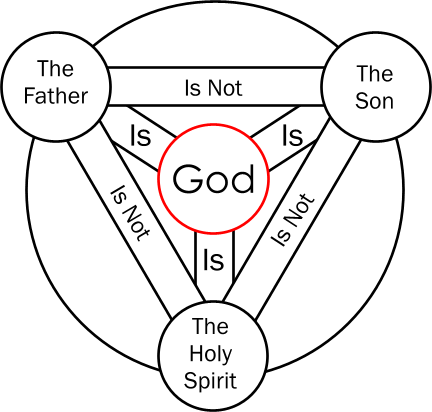
You can think of a shamrock, which is often the symbol of the Trinity, however all the leaves are the same, and theologians were insistent there was a difference between the Father and the Son and the Holy Spirit.

In the end, all the theologians could really say was this. The Bible speaks of the Father, The Son and the Holy Spirit. They are different persons, yet one God.
If you look at this slide, you see what I mean.

Trinity Graphic


Theologian waxed long and eloquently about the Trinity, and it is, I believe, one of the most sublime doctrines of the history of Christianity, perhaps in the History of religion. One distinction theologians made in their musings was the difference between theoretical and practical doctrines of the Trinity, and this morning I am going to steer clear of the theoretical and focus on the practical doctrines of the Trinity.
Are there practical implications to the doctrine of the Trinity? I think there are, and wouldn’t you know it, I came up with three practical implications.

And this is my first point. It would be nice to worship a God we could completely understand, but the fact is, I don’t completely understand my wife or my children, the people I am closest to in the world, so why would I think I should be able to completely understand the nature of God? The Trinity is a reminder that God is infinitely more complicated than we can imagine.

Too often we think we have a handle on God, and that is far from the reality of the situation. In fact as Christians we do not claim to have a handle of God—quite the contrary. Instead we recognize that God has a handle on us.
A person who thinks they have figured God out is a dangerous person. In fact, if there is any truth to the Trinity, they are deluding themselves. What they have a handle on is THEIR IDEAS about who and what God should be. That is often a very different thing from who God really is. Instead of worshipping God, I am worshiping something that I made up, a pigment of my own fascination. And the fact is, I can make a pigment of my own fascination be anything I want it to be.
I can make God back up and all of my own opinions. I can make my god a left-wing democrat, or a right-wing republican. I can make my god a tree-hugging, Birkenstock wearing, Prius driving, bleeding heart liberal socialist.

Or I can make my god a gun-toting, gay-bashing, Obama hating, pro-life, tax cutting, free market libertarian.
But in fact God is not like either of those caricatures, and if you ever see the triune God identified with any political party or philosophy, any economic system or philosophy, any nationality or racial group, or for that matter any one denomination or Christian subset, then you know someone is trying to use God for their own purposes, and they are not worshiping the Triune God. We don’t get a handle on the Triune God. The Triune God gets a handle on us.

But the true God, the Triune God of Christianity is much, much more complicated than that. The Trinity reminds us that if we think we have God down, we are sadly mistaken.
Second, The Trinity is about variety. God is not Just One Thing. While there is a deep unity within the Trinity, there is also a variety, a diversity. Within God’s own nature, God does not look the same. The Father is NOT the Son and the Son is NOT the Spirit.
One note; Three notes.
If there can be diversity within the very nature of God, can we not then accept diversity within our churches?

And thirdly, the essence of God is personality and relationships. God is not a force, not a vague power, not a ground of being. When the early Church fathers were discussing the doctrine of the Trinity, they very carefully used the word “person” when referring to the three different parts. When we speak of the Triune God, we are speaking of a relationship between the divine beings. They only exist as they exist in relationship.
We get this from the very beginning of the Bible, as we heard this morning: Genesis 1:26 Then God said, “Let us make humankind in our image, according to our likeness; and when we were created, 27So God created humankind in the image of God, in the image of God they were created; male and female God created them.
One of the overriding convictions of the early theologians of the Trinity was that in order to be a person, you have to be in relationship. To quote John Donne, no man is an island.
Now that is exactly how the movie About a Boy starts. The main character, Will, says that he is an island, he does not need anyone else in his life. He is independently wealthy, so he does not have to work, he is young and good looking, so he has a series of romantic relationships, none of the serious or long lasting, and he has no real family to speak of.
He is an island. But occasionally he wants other people on his island. Through a series of funny and strange circumstances, a young boy, Marcus comes into his life. Marcus is the school outcast, the kid everybody makes fun of, and he ends up coming over to Will’s apartment after school everyday to watch TV with Will.
At first they are just watching TV together, but then Marcus starts to grow on Will. He buys him some cool shoes, and Marcus invites Will to have Christmas with he and his mom. Will goes, and has a surprisingly fun time.
Soon after that, Will meets a woman, Rachel at a New Year’s Eve party, and is very interested in her. When he first meets her, he tries to strike up a conversation, and she asks what he does for a living. Will says he does nothing. She asks what he did before he did nothing, and Will says, “the interesting thing about me is that I don’t do anything.” Well Rachel turns away to talk to someone else, clearly not interested, and says something about rap music to the other person. Will is desparate for her attention, and says, “I know a twelve year old who would disagree with you on that.” Rachel says, “I have a 12 year old too. What is the name of yours?” and Will says, “Marcus.” Now Will has to pass off Marcus as his son. It works for a while, but finally Will confesses to Rachel that Marcus is not really his son, and that they are not even related.
Rachel says, “When I first met you, I thought you were a blank. But when we were talking about our children, you became a person to me. But now I see you were lying to me.”

And Will says, “That’s all I am. A blank.” He recognized that he was an island, but he was not really a person.
Soon after that Marcus runs into problems, and Will realizes that he lost Rachel, who he loved, but that he also cares for Marcus, and he makes some great sacrifices for Marcus. He comes off his island. He becomes a person.
God only exists in relationship. The Trinity is a relationship between the Father, the Son and the Holy Spirit. Some theologians have said that the Spirits arises from the relationships between the Father and the Son. I don’t know about that, but I know that the essence of God is a series of relationships.
For us that means two things. First, that God desires a relationship with us.
Think of all the things you might think God wants from you.—obedience, service, to be a good person, to do good to others, to go to church regularly, to worship, to read the Bible. The list can on and on. But what God really requires of you is a relationship. God wants to know you. And God wants you to know God, as much as you are able.
The second thing is that we are created in the image of God, and we are created for relationships. We are created to be with others, to love others, to care for others, and to be cared for by others. We were made to be in relationship.

Posted in Church, Jesus, Trinity | 1 Comment

New Country People

ROMANS 6:1B-11Businessman trying to button suit that is too small for him
1bShould we continue in sin in order that grace may abound?2By no means! How can we who died to sin go on living in it?3Do you not know that all of us who have been baptized into Christ Jesus were baptized into his death?4Therefore we have been buried with him by baptism into death, so that, just as Christ was raised from the dead by the glory of the Father, so we too might walk in newness of life.
5For if we have been united with him in a death like his, we will certainly be united with him in a resurrection like his.6We know that our old self was crucified with him so that the body of sin might be destroyed, and we might no longer be enslaved to sin.7For whoever has died is freed from sin.8But if we have died with Christ, we believe that we will also live with him.9We know that Christ, being raised from the dead, will never die again; death no longer has dominion over him.10The death he died, he died to sin, once for all; but the life he lives, he lives to God.11So you also must consider yourselves dead to sin and alive to God in Christ Jesus.

This may come as a surprise to you, but when I was a kid, I was not the easiest kid to have in a Sunday School class. I was the kid who asked all the hard questions. Sometimes I asked them to embarrass the teacher, like asking, “What is circumcism,” and sometimes I asked questions that I knew the teachers could not answer, like “So God made us. Who made God?”
And sometimes I asked question like I was looking for a loophole. For example, when the teacher was explaining sin and grace. We do bad things, but God loves us, and shows his love by forgiving us.
“So,’ I said, “if God shows his love by forgiving our sins, shouldn’t we do a lot of sinning, so that God can show even more love? The more we sin, the more we experience God’s love.”
I thought it was a pretty good question, and it did stump some of my teachers. It was not as original as I thought it was. I have been asked this question plenty of times when I worked with Junior Highs, and in fact, as I read the Bible, I found that Paul himself raised that very same question, albeit he poses the question, he does it in a rhetorical manner, because he already has the answer.
I turns out though to be a much more profound question than I first thought. At first blush it is a smart alecky question, but in fact it cuts much deeper than I could imagine as a seventh grader.
Now let me review a little on what Paul has written in his letter to Romans so far. In Chapter one, he is telling us that this is a sinful world, and it is a sinful world because, in his words, because people, “traded the true God for a fake god, and worshiped the god they made instead of the God who made them.”
Now I want you to bookmark that for a moment. Just keep in mind that for Paul, sin means we live as if there was no god.
In chapter two of Romans, Paul drives home the point that sin is not just a disease that other people have—we all are affected by it. It is easy to point fingers at a group of people OVER THERE and say, “Look at those miserable sinners,” but Paul makes the point that we are all sinners.
Now in chapter five, Paul says something that is kind of hard to take. He says we all sinners, and that sin came into the world through Adam. You know, the story of Adam and Eve. They eat the apple, commit the first sin, and before you know it, the whole human race is affected by it.
In other words, sin is not completely our fault. Now what Paul says is very true. And you really do not need to take the story of Adam and Eve literally to see the truth in it. We are all, in some way, affected by the past sins of others, whether the other person is Adam, or one of our parents, or grandparents. We are affected by the past sins of others.
When I worked with the hospitality house, I did groups for Adolescents. Now many of these kids were in our program because of something bad they had done in the past—usually something really bad. One kid stole a car. One kid broke into the house of another kid, beat him up, and stole some of his stuff. Some of the kids has sexually abused other children. These were, by most people’s definition, BAD KIDS.
And on the one hand, they had to take responsibility for their actions. They did what they did. They made some really bad choices.
On the other hand, it was also true of them that someone else had a hand in their sins. When I did groups, I always opened with a check in question—how are doing this week. In one group one of the kids said, “Really bad, because Obama won the election yesterday.”
Well, I did not want to pick a political fight with the kid—they are allowed their own opinions, but I did say, “So you don’t like Obama’s politics.” What he said was, “I don’t like black people.” Now, given the fact that we had African-American kids in our program, as well as Alaska Native kids, I figured I could not let that stand, so I asked, “Why don’t you like Black people?”
“That’s what my daddy taught me,” he said.

And he went into all the bad things his daddy had taught him about black people. I think racism is a sin, and he was committing that sin, but he got it from someone else. Another kid got busted for smoking pot, which he got from his mom. Another kid watched his mom go through a series of boyfriends, all really bad characters themselves, and had the most screwed up ideas about relationships I have ever seen.
Call it Adam, call it original sin, call it the sins of our parents, whatever you call it, the disease we call share called sin is something we caught from someone else.
So Paul is saying that we are essentially powerless over sin. However the reason Paul brings up Adam, is that he wants to contrast Adam and Christ. “Adam,” however you define Adam, brought sin into the world. He was a carrier. We all got a little bit, or a lot infected by this idea that God was not such a big deal, and in the end we could just do what we wanted to do.
And that separates us from God. And the problem is, we lose who God really is.
I don’t know how many of you heard of or remember Jim and Tammy Bakker and the old PTL Club. It was located in one of the cities where I lived in North Carolina. I used to watch it occasionally, one day they had these people on who were preaching the health and wealth gospel. If you have enough faith, you will be healthy and wealthy. Well, this day, Jim Bakker was not the host; I don’t remember who was, but while the woman was going off on how Jesus wanted us to be to be healthy and wealthy, and if we weren’t it was because we didn’t have enough faith, and the host asked, “What about the sufferings of Jesus? He died a painful death, and he never had a lot of money.” And the woman drew herself up and said, “My Jesus never suffered! MY Jesus was never poor,” which I should say contradicts everything we know about Jesus. The problem was, she worshiped a Jesus of her own making; she did not really worship a real Jesus.
Now the problem is, we ALL do that, to some extent. And what Paul says in Romans five is that Jesus sets us free, and gives us real life: Romans 5:19 …just as all people were made sinners as the result of the disobedience of one man, in the same way they will all be put right with God as the result of the obedience of the one man.
What we cannot do, which is worship the true God in the right way, Jesus does for us. Only Jesus can do that, because Jesus is God. And Jesus does it because of the love of God.
So this is where the Junior High question comes in. Well if God makes it all right, because of the Love of God, then why should we bother? Why should we worry about whether or not the God we worship is the One Real God, or fake copy of God that we have invented for our own purposes? If God really loves us, then it does not matter.
And here is Paul’s answer—outside of Christ, we are left to our own devices. You want to worship money—by all means, make the acquisition of wealth your god. You want to worship power? Then by all means, make power your goal.
Except here is what really happens for most people. If you worship wealth, you rarely end up wealthy; but you do end up bowing down to those who are. If you worship power, you will rarely gain real power, but you will end up bowing down to those who have it. That is why many poor people consistently defend the very rich people who are often the reason they are poor. They worship wealth, which means in the end, they worship the wealthy.
Now if we think of sin as merely doing something wrong, then all Paul is saying is that Jesus brings forgiveness. Our sins are not going to cause God to judge us. We are, in the eyes of God, officially Not Guilty. But remember I asked you to bookmark something about sin? Sin is when we worship the wrong God, and that gets us all twisted around. We exchange the truth of God for a lie and we worship that lie. And that messes us up.
There was man who wanted to buy a suit, and he happened to run into the worlds best suit salesman. The man was trying on the suit, and said, “Looks like one leg is shorter than the other.”
“Oh, you are just standing funny,” said the salesman. “Here hitch your hip up, now it looks fine.”
“But one of the arms is longer than the other.”
It’s not the suit, you are still standing funny. Hitch your shoulder up, like this.”
So the man does, he buys the suit. As he is walking down the road, his body all crumpled up from trying to conform to the suit. two women see him. “Look a the poor cripple man,” says one of the woman. “Yes, but doesn’t that suit fit him nicely,” says the other.
If all sin is, is just forgiveness for actions we do, then all forgiveness really is, is God saying, “You know, I think you look fine in that suit. I say that you are well dressed for this party we call heaven, so come on in.”
But in fact, what Paul is saying is that God says, “Take that misfit suit off! You were not made to live like that! Get rid of that suit. Burn it. It does not fit you. But I have one that does. And you are going to look great in the suit I have for you.”
The old suit—now that is a mess–evil, grabbing and grasping, vicious backstabbing, envy, wanton killing, bickering, and cheating, mean-spirited, venomous, fork-tongued God-bashers. Bullies, swaggerers, insufferable windbags… Stupid, slimy, cruel, cold-blooded. That is how Paul describes in In Romans one.
In Romans six, he talks about a new way of living, a new country we live in. He uses the metaphor that in Baptism, the old self died, the old suit is taken off.
Eugene Peterson in his translation the message, says, If we’ve left the country where sin is sovereign, how can we still live in our old house there? Or didn’t you realize we packed up and left there for good? That is what happened in baptism. When we went under the water, we left the old country of sin behind; when we came up out of the water, we entered into the new country of grace—a new life in a new land!
When Angelee and I first moved down here, it was November. And for the first month or so, every time we opened the door, we braced ourselves for the cold. But it was not cold down here. This is not Alaska any more. This is Medford, Oregon—SOUTHERN Oregon. We were thinking of the old country. Now we live in a new country.

In the old country, you had to look out for yourself. In the new country of grace, we look out for one another. In the old country, winning was everything. In the new country, working together with your brothers and sisters is everything. In the Old Country it was important to be right; in the new country it is important to live in right relationships. In the old country, the currency of the realm is wealth, power, and fame. In the New Country, the currency is sacrificial giving, service, and a humility that engenders loving relationships.
In the old country we have no higher values than our own passions and desires. In the new country, we worship a God who loves us, who cares for us, and who takes the divine spark that lies within us, and nurtures it until it grows into a glowing fire of grace and love.
So why would we continue to live in the old country? Why would we continue to wear that suit that makes us conform to its deformities rather than the new clothes that God offers to us?
As Paul writes in Colossians 3:12-14 So, chosen by God for this new life of love, dress in the wardrobe God picked out for you: compassion, kindness, humility, quiet strength, discipline. Be even-tempered, content with second place, quick to forgive an offense. Forgive as quickly and completely as the Master forgave you. And regardless of what else you put on, wear love. It’s your basic, all-purpose garment. Never be without it.
Going back to the original question; why don’t we keep on living a life a sin, so that we might experience more of God’s love? Because a life of sin is a deformed life. It is a stunted life. We can live for the unholy trinity—me, myself and I—or we can live a life given to God’s love and grace.
Remember the kid I told you about who got racist ideas from his daddy? He had been in our program for a while, and I was noticing some real changes in him. He did not seem as angry. When he first came, in groups he would pull his hoodie over his head and ignore everyone in the group. After about six months, he started talking. I ran into one of his teachers, and the teacher told me that that this kid was getting it; he started doing his school work, and he had a goal to graduate.
So one day we were cleaning out an old barn on our property, and I asked him how he was doing. “When I first came here,” he said, “all I could think about was myself. I hurt a lot of people. Here I learned what it means to care about others. And I am a lot happier.” The anger of the old country was disappearing. The self-centeredness of the Old Country was disappearing. He was starting to be happy.
Why continuing living in the Old Country, when Jesus offers us a new land, a land of grace and peace and love?

Posted in Church, Jesus, ministry, Presbyterian | 1 Comment

Could We Be One (So the world would know…)

unity 


SECOND READING 1 PETER 4:12-14, 5:6-11

4:12Beloved, do not be surprised at the fiery ordeal that is taking place among you to test you, as though something strange were happening to you. 13But rejoice insofar as you are sharing Christ’s sufferings, so that you may also be glad and shout for joy when his glory is revealed. 14If you are reviled for the name of Christ, you are blessed, because the spirit of glory, which is the Spirit of God, is resting on you.

5:6Humble yourselves therefore under the mighty hand of God, so that he may exalt you in due time. 7Cast all your anxiety on him, because he cares for you. 8Discipline yourselves, keep alert. Like a roaring lion your adversary the devil prowls around, looking for someone to devour. 9Resist him, steadfast in your faith, for you know that your brothers and sisters in all the world are undergoing the same kinds of suffering. 10And after you have suffered for a little while, the God of all grace, who has called you to his eternal glory in Christ, will himself restore, support, strengthen, and establish you.11To him be the power forever and ever. Amen.

GOSPEL JOHN 17:1-11

1After Jesus had spoken these words, he looked up to heaven and said, “Father, the hour has come; glorify your Son so that the Son may glorify you, 2since you have given him authority over all people, to give eternal life to all whom you have given him. 3And this is eternal life, that they may know you, the only true God, and Jesus Christ whom you have sent. 4I glorified you on earth by finishing the work that you gave me to do. 5So now, Father, glorify me in your own presence with the glory that I had in your presence before the world existed.

6“I have made your name known to those whom you gave me from the world. They were yours, and you gave them to me, and they have kept your word. 7Now they know that everything you have given me is from you; 8for the words that you gave to me I have given to them, and they have received them and know in truth that I came from you; and they have believed that you sent me. 9I am asking on their behalf; I am not asking on behalf of the world, but on behalf of those whom you gave me, because they are yours. 10All mine are yours, and yours are mine; and I have been glorified in them.11And now I am no longer in the world, but they are in the world, and I am coming to you. Holy Father, protect them in your name that you have given me, so that they may be one, as we are one.”


Could We Be One?


When I was in Germany I took a tour of an art museum. The tour guide was a devout Catholic, and did not hesitant to share, not only what she knew about art, but also her opinions about religion. We stopped before one statue of a Mary, and the woman explained out this was from the school of Cologne, which you could tell because of the S shaped curve in Mary’s body, but also that that Mary bore the body of Christ, and that in America they had torn the body of Christ apart because of all the different denominations there, and how could not be whole because of the way we had split up the church.


Had I been a less gracious guest, I might have pointed out that the denominational thing started with Martin Luther, who was a German. I further could have pointed out the first real big split in the church was in 1054 when the Roman Catholic Church split off from the larger Eastern Orthodox Church over the role of the pope and the addition of three words in the Nicene Creed.


It seems that we don’t need many excuses to split apart as Christians. You notice in my benedictions I hold up three fingers. That is not because I used to a boy scout. I picked this up from the Russian Orthodox Church. The three fingers stand for the Father, Son and Holy Spirit, and the Spirit finger is bent toward you to indicate that the Spirit of God has come to us.

However the way one makes a the sign of the cross was a reason for a major split in the Russian Orthodox Church, along with the way one processed around the sanctuary during the service—clockwise or counter clockwise.

The Presbyterian Church is not at all immune to any of this. Here is a chart of the Family Tree of the Presbyterian Church USA, not be confused with the Orthodox Presbyterian Church, the Evangelical Presbyterian Church, the Associated Reformed Presbyterian Church (not be confused with the Reformed Presbyterian Church-Evangelical Synod) the Cumberland Presbyterian Church or any religious body that goes by the name Presbyterian. It is a veritable split pea soup of dissent.

americanpresbyterianfamily001


And in the face of all this, Jesus prays that we, his followers, should be one. The passage I just read tells us what Jesus prayed on this last night with the disciples.

He prayed a lot of things, but the one I want to look at this morning is the last sentence of the reading, where Jesus prays, “Holy Father, protect them in your name that you have given me, so that they may be one, as we are one.”

This was an important part of Jesus’ prayer, because he repeats it a few sentences later. 20 “I ask not only on behalf of these, but also on behalf of those who will believe in me through their word, 21 that they may all be one. As you, Father, are in me and I am in you, may they also be in us, so that the world may believe that you have sent me.

Jesus prays that the disciples, and not only them, but all who follow them, which is us, would be one, just like Jesus and the Father are one.

So what does it mean to be “one”?

The Greek word used here mean unity. There is another word, Monos, which means single. If Jesus had wanted us to all look alike, he would have used the word monos—from which we get the word “monotony.”

In Madeleine L’Engle’s book A Wrinkle in Time, she describes a society that is One in the sense of the term Monos, and it is very oppressive place. All the little boys go out at the same time every day and bounce the same kind of ball against the same kind of wall, and then they all go back inside at exactly the same time. Everyone has the same things for dinner every night. There is no complexity, no difference—no real thought, no real life.

That is not what Jesus means. He does not mean that we all have to look alike and sound alike. When I first started taking Jesus seriously, in high school, I noticed that a lot of Christian leaders wore a certain type of clothes—so I got those kind of clothes so I could “look like a real Christian.” It did not take me too long to figure out how silly that was! I fell in with a certain kind of church, that was pretty different from the Presbyterian Church, and I figured that the way that church believed was how I was supposed to believe, and worse than that, that was how EVERY CHRISTIAN should believe. So for a while I began to think that if you not follow the theological teachings of this church, then you really weren’t a Christian, at least not a REAL Christian.

restoration_movement_chart

One thing I learned along the way, and one thing I really do appreciate about the Presbyterian Church is that historically, it is not up to us to say who is or who is not a Christian. That belongs to God and God alone.

So when Jesus was praying that we be one, even as he and the Father are one, what did he mean by that?

If we look at the New Testament, a pretty specific picture emerges. At Pentecost, which we will celebrate next week, people from a wide variety of language groups come together, and are brought into the fold of the new Jesus Movement. In the book of Acts, all sorts of people are brought into this new thing which will called the church—Widows and orphans, upstanding religious people, outcasts such as Samaritans and Eunuchs, people from many different nations, Gentiles of all stripes. In fact, as you look at the Church of Jesus Christ, throughout all of history, one thing that stands out is how diverse it has always been. It is not tied to a language, for the Gospel is preached in almost every language that is spoken on earth. It is not tied to geographic area, for there are churches all over this world. It is not tied to any one culture. The church existed in Rome, Greece, Asia Minor, the Middle East, and now exists all over the world.  There are churches in Russia where their liturgy comes from the seventh century and the choral music is elegant and as complicated as any classical music piece, and there are churches in Africa where they use banana chips for communion, and dance wildly as part of the service. I was telling Ginni last week that in some African-American churches the organist provides a soundtrack for the preacher, punctuating the sermon with flourishes and rolls. There is a church in Korea that has 800,000 members, and where the great majority of the service is spent in fervent prayer.

There are holy rollers and High church liturgists, Bible thumpers and Bible Doubters, High Church, Low Church Wide Church, Narrow Church, and Barely There Church. There is the Churches of All Things Done Decently and In Order, and there is the Free For All, Shout for Joy Church.  The kingdom of God ranges from the First Presbyterians, Baptists, Methodists and Lutheran, to the First Bible is True and Right Holy and Sanctified Apostolic Fellowship of True Believers. There are people who do things that make you proud to be a Christian, and people who things that make you wish Jesus had remained a carpenter.

And in that diversity, we are one world-wide church. The beauty of the Christian Church is that it can have many, many different expressions.

What holds all these various expressions of the faith together is our common insistence that, however we define it, Jesus is Lord and savior. We are held together, not by a common culture, or a common language or even a common theology. We are held together by the person of Jesus Christ, by the power of the Holy Spirit, and by the hand of a loving Father.


That is what makes us the Church. We are not the Church because we have the word “Church” on a sign out front. We are not the Church because we call ourselves one. We are not the Church because we are, officially on paper as a 501(c) 3 Religious organization. We are the church because we are children of God who gather to worship.

When Jesus prayed, he said to God, The glory that you have given me I have given them, so that they may be one, as we are one, I in them and you in me, that they may become completely one, so that the world may know that you have sent me and have loved them even as you have loved me.


There are a lot of people worried these days because churches are losing members, because more and more people are saying that they are “spiritual” but not “religious” and the fact is, we have no one to blame but ourselves. Jesus said that the world would know that he was sent from God, that what he said was what God would have us do, IF the Church was one. We have given the world plenty of reasons to not believe that Jesus is the Way to anything.

Now, we will have our fights. The church has always fought about issues, and it will continue to fight about issues, from which way to process in the sanctuary to whether a Christian can own slaves to whether we should ordain women. And it is ok for  us to have fights. Currently the Church is fighting about how we perceive our notions of salvation, whether Jesus is the absolutely only way to God and whether we should ordain and marry gays and lesbians. Those are important issues, and I am not saying that we should just avoid in the name of a shaky peace.

But we have to understand, and this is the long term sin of the church, that when we disagree we are disagreeing with other children of God, and that we are not defined by our agreements or disagreements. We are not defined by how perfect our theology is, but how we respond to the love of God. And if one of our responses is to shut other people out who disagree with us, or who practice differently from us, then we are responding poorly to the love of God.

If, on the other hand, we can look our brother or sister in the eye, and say, “I think you are dead wrong, but I love you as a brother or sister in Christ,” then we are responding rightly to the love of our Heavenly Father.

In one sense, the woman who led me on that art tour in Germany was dead wrong. We cannot split the Body of Christ. We may THINK we can do that, but in reality we cannot. Churches who split from other churches, who leave their denominations, who go off to start new things are only doing something on paper. It has no effect in the Kingdom of God. We cannot split the church any more than we can create the Church.

It is God’s church. We might say to other brothers and sisters in the faith, “I don’t think you are a part of the family,” but that is like when I was a kid, and would tell my brother that he really wasn’t a part of the family, that we found him somewhere. Saying it, even putting it on paper, does not make it true.

So the really sad part is that often we ACT like we are separated. We act like we have been split up. We act like we are separate groups, running around doing the work of God all on our lonesome.

This table reminds us of our oneness in Christ. We call the meal “Communion” which means we all share a common relationship. We are not invited to the this table because we are such great people, but because we are the people of God. That means we have no right judging who else is at the table. We are not judged by what we bring—our beliefs our practices, what we have done in our lives, nor can we judge others by what they bring.

We are invited to this table because God loves us.

The night he was arrested, Jesus prayed. One thing he prayed was this: 22 The glory that you have given me I have given them, so that they may be one, as we are one, 23 I in them and you in me, that they may become completely one, so that the world may know that you have sent me and have loved them even as you have loved me.


Posted in Church, Emergent Church, Jesus, ministry, Presbyterian, spirituality, Worship | Tagged , , , , | Leave a comment

The True Meaning of Easter

10276450_10154095093395192_533344874_n

First Presbyterian Church, Easter morning

046_resurrection

Resurrection Icon

Every December we hear the question, “What is the meaning of Christmas?” But I don’t remember every hearing an Easter equivalent of that. In December we get a mix of Jesus and Santa and angels and reindeer, and It’s a Wonderful Life, and White Christmas, all to remind us of the true meaning of Christmas. There is no Easter equivalent. I do remember, as a kid, the Wizard of Oz was shown every Easter Sunday night, but I don’t think that movie tells us the true meaning of Easter.


What is the true meaning of Easter?

First let’s take the name. You know, most of the world does not use the word Easter when talking about this holy day. They use a form of the Greek and Latin word for Easter, Pascha, which means Passover.

In fact, the word Easter is derived from the name for the Anglo-Saxon goddess of the Dawn, or the spring, scholars are not sure. Apparently there was a Pre-Christian, Anglo-Saxon festival in the spring, dedicated to the goddess Ēostre. When the Christians showed up, instead of introducing them to their Spring festival, Paschal, they just coopted the festival that was already going on, kept the name, but changed the God and the meaning.

That made a lot sense because the goddess symbolized the dawn, which is the time of the rising sun, and Jesus is the risen Son of God. The dawn is about new light, and Jesus is about new life.


So part of the meaning of Easter is New life, but there has to be more than that.


Now when IS Easter? It is not like Christmas, which comes the same day every year. It is a revolving holiday. So here is how the time of Easter is calculated. Easter comes after the first full moon after the Spring Equinox. How did we get there?


Well, originally Easter was tied to the Jewish Passover. But unlike today, where Passover is a set holiday, in the early centuries after Jesus, Passover was a floating holiday. It was tied to the Jewish calendar, and always occurred in the month of Nisan. But the Jewish calendar is a lunar calendar. It is based on the phases of the moon, not the rotation of the earth around the sun. And so every couple of decades, they would have to add a month, otherwise the “month of harvest” would be happening in dead of winter. And in the first couple of centuries, they had no system for adding that month.


That put Christians in the tricky position of having to wait for a council of Jewish rabbis to set the date for their most important holy day of the year. So eventually, in 325 AD they decided to come up with their own system.


Easter always falls on the first Sunday after the first full moon after the spring equinox. That first full moon is called the Passover moon, because it signals the start of the Jewish month of Nisan, which is when Passover is celebrated. In other words, when the early church was trying to determine a set date for Easter, they tied it, as best they could, to the Jewish Passover holiday.


So Easter has something to do with Passover. That tells something about Easter, but it does not really get what the meaning of Easter is.


So let’s turn to the story as the Bible  tells it.


In the Acts passage we heard this morning, Peter talks about the ministry of Jesus. He basically says that God threw his best at us, in Jesus, and we went and killed him. But that instead of taking that as our final answer, God raised Jesus from the dead. This, for Peter and other people in the Bible, proves to us that Jesus WAS who he said he was. Not only was he a good person, walking around doing and saying good things, he was in fact the Only Begotten Son of God, just like he said he was. When Jesus told us to love our neighbors as ourselves and to love our enemies, when Jesus told us not to spend too much time worrying about the future, because God would care for us, when Jesus told us that to accept the outcasts, and to help the poor, He really meant it, because when Jesus told us he was the Son of God, God showed us he meant that, by raising him from the dead.


The Bible also tells us that Easter is about eternal life. Jesus is risen from the dead, and so shall we rise from the dead one day. What is interesting about that, is that Paul says a lot about how we will one day be risen with Jesus and that our future is tied to the resurrection of Jesus, but…none of the Resurrection accounts in the Gospels say anything about how we get eternal life because Jesus did. Now Paul says that, and he says that pretty clearly. But in their telling of Jesus’ resurrection, none of them mention it directly. When Jesus comes out of the grave, he does not say, “I have risen, and one day, after you die, you will rise from the dead as well.”


If the major point of of Easter is proof that we have eternal life, you would think that AT LEAST ONE of the gospel writers would have told us. If that was the major message of Easter, I am pretty sure that Matthew, Mark, Luke or John would have mentioned it. At least one of them. But in fact, none of them do. As it turns out, eternal life for us is a byproduct of Easter, but it is not the full meaning for the day. There is something else going on.


So in order for us to get a really good handle on it, we need to look at how the gospel of John STARTS.


John 1:1, In the beginning was the word. John starts his story by reminding us of the original story, the story of creation. In the creation story, God creates, and on the seventh day, God takes a rest. Now traditionally what follows the day of God’s rest is the Eighth Day—the rest of the story. God sets it all in motion, takes a rest, and on the Eighth Day, creation takes off and becomes what we think of as our world. On the eighth day we get Adam and Eve, and Abraham and Sarah, and Moses, and King David, Deborah and Isaiah and Ruth and Jeremiah, and Esther, Obadiah, and Ehud, the left handed Midianite.


We get Jesus. And the Disciples. And Mary and Joseph. And all the people we have heard about the last few weeks. Nicodemus. The woman at the well. The man born Blind. Mary and Martha and Lazarus.


We get the story we heard last week—the last supper, the arrest, trial and crucifixion of Jesus.


And as John tells the story, on the sixth day of the week, the day before the Sabbath, Jesus died on the cross, and they put him in a tomb. And on the seventh day, what we call Holy Saturday, Jesus rested in the tomb. In the Old Testament creation story, God rested on the seventh day. In the Gospel of John, Jesus rests on the seventh day.


And is risen on the Eighth day. That is the day of a New Creation, a new Eighth day. The whole world is reformed, it has been recreated. In Lent, after the confession, we heard the same assurance of pardon; who is in a position to condemn? Only Christ, and Christ Everyone who is in Christ is a NEW Creation, the Old is gone. That first day of the week after the crucifixion almost two thousand years ago, was not just the first day of the week; it was the first day of whole new creation.


What is the meaning of Easter? It is about a New Creation that God is doing.


What does that new creation look like? Well it looks remarkably like the old one. It is not like on that Easter morning, two thousand years ago the world woke up and saw that everything was different. It was not like the new creation is all fields of butterflies, But then, when Jesus came out of the tomb, he did not look all that different.


All of the Gospels portray a Jesus who looks quite ordinary when he is risen. He is not all lit up, with butterflies and angels flying around his head. He is quite ordinary. If you put the resurrected Jesus in a line up, and asked someone to pick which person just rose from the dead, they would not be able to. Mary mistakes Jesus for the gardener. In Luke, Jesus is walking down the road with some people, some of his followers, and they don’t recognize. He eats fish with his disciples, and Thomas is allowed to touch him, if he wants. If the risen Christ were a visitor at our church this morning, we would not know it.


But it is a different world. In all of the Gospels, the disciples are sent out to proclaim that this is a different world.


So how IS it different? Well, Easter is tied to Passover, as we have seen, and Passover is about the Liberation of people. Easter is about our liberation from an old life, a life where we can get drug down by our pasts, a life where we have to continually carry around our past mistakes, a life where we are defined by the things that confine us. In the Passover story, with the help of God, Moses brought the Hebrew children out of slavery. In the New Passover story, Easter, we help each other out. If the slavery is hunger, we help feed one another. If the slavery is poverty, we help lift each other up. If the slavery is something done in the past to hurt another person, we offer forgiveness. If the slavery is anger or hate, we offer love. If the slavery is that we don’t feel good enough, good enough for God, good enough for others, we offer unconditional love. We are all the New Moses, and we all help one another into the new Promised Land.


This new creation is a new world of radical INCLUSION. No one is excluded. Jesus sends the early disciples out, first to their home—Jerusalem and Judea, then to their avowed enemy—Samaria. Yes, whatever God is doing in Easter, God is doing with the Samaritans. And finally, to the ends of the earth. Whatever God is doing in Easter, God is doing with all humanity. The first few converts are people who were traditionally outcasts in that society.


In the old comic strip Calvin and Hobbes, they form a club, and the sole purpose of the club is to keep the neighborhood girl, Suzie, out of the club. In the new creation, no one is excluded.


Samaritans. Eunuchs, who were considered unclean by all the good people of Jesus’ day. And Gentiles. People like you and I. Where the first Passover was directed toward a specific people of God, the new Passover, the Passover of the New Creation is directed to ALL humanity.


And the New Creation is defined by transformation. Although we may look like the people we were yesterday, the new Resurrection life is a life where we are continually transformed, and where society is continually being transformed. Like the resurrected Jesus, it can look strangely like the old creation, but occasionally the New breaks through in surprising ways.


In the post-resurrection stories, a normal looking Jesus shows up, and does some extraordinary things. We will be looking at some of those things in the next few weeks, but suffice it to say that life is never the same for the disciples. They are different people because of Jesus’ resurrection. Peter is forgiven for denying Jesus, and becomes the foundation for this new church. Thomas finds his faith, Paul goes from being a persecutor of the church to being its strongest supporter. Two ordinary people walking to Emmaus encounter Christ, and find his words burn within them. The world is turned upside down.


When I was in high school a man came to speak to our youth group. I don’t remember his name, but I remember his story. He grew up in inner city New York, and had become part of gang early in his life. He had many run-ins with the law, until he stumbled in a church one day, and found this new life I have been talking about. He left the gang, he left his old life, he left his old ways. He went to school, got a job, got married, and had kids. He became a youth pastor in the same neighborhood where he was once a gang member.


One day, walking home from work, he was mugged. He went to the police station, where he now had many friends, and was shown mug shots of possible muggers. He thumbed through them, and in the end said he did not see anyone he recognized. “Are you sure?” asked the cop who was with him. “Yes, I am positive. I did not recognize anyone in these mug shots.”

“No one?” asked the cop again. “No one,” he said.


“How about this guy?” asked the cop?

The guy stared at the picture and said, “He does look a little familiar.”


“Well, he should,” said the cop. “That is a picture of you, ten years ago, when we arrested you.”


Sometimes we are changed so radically, we cannot even recognize our old selves.


Easter is a new world! The true meaning of Easter is that we live in and in fact we are co-creators with God of a new creation, a new way of relating. We are given the awesome responsibility of creating this new world with God. Our tools are love, and grace, and faith and hope. We chip away at the anger, despair, distrust, exclusion, pride, self-interest, greed, and misplaced devotions that are the flotsam and jetsam of the old world. We reach out in love to all who are in need, and when we are in need, we take the hands of those who reach out to us. No one is excluded, no one is left out, no one falls short. In this new world, we are one in the Risen Christ.


Christ is Risen!

Posted in Easter, ministry, spirituality, Worship | Leave a comment

The Down Side of Getting Better

Image

So you start that diet, only to find you are now tempted by foods you previously had no interest in eating. Or you want the quick fix for your problems. Or want to test someone’s love. Or you just feel like being bad. This is how Jesus dealt with it. Kind of helpful for everyday life, not just churchy things. 

GENESIS 2:15-17, 3:1-7

2:15The LORD God took the man and put him in the garden of Eden to till it and keep it.16And the LORD God commanded the man, “You may freely eat of every tree of the garden;17but of the tree of the knowledge of good and evil you shall not eat, for in the day that you eat of it you shall die.”

3:1Now the serpent was more crafty than any other wild animal that the LORD God had made. He said to the woman, “Did God say, ‘You shall not eat from any tree in the garden’?” 2The woman said to the serpent, “We may eat of the fruit of the trees in the garden; 3but God said, ‘You shall not eat of the fruit of the tree that is in the middle of the garden, nor shall you touch it, or you shall die.’” 4But the serpent said to the woman, “You will not die; 5for God knows that when you eat of it your eyes will be opened, and you will be like God, knowing good and evil.” 6So when the woman saw that the tree was good for food, and that it was a delight to the eyes, and that the tree was to be desired to make one wise, she took of its fruit and ate; and she also gave some to her husband, who was with her, and he ate.7Then the eyes of both were opened, and they knew that they were naked; and they sewed fig leaves together and made loincloths for themselves.

GOSPEL MATTHEW 4:1-11

1Then Jesus was led up by the Spirit into the wilderness to be tempted by the devil.2He fasted forty days and forty nights, and afterwards he was famished.3The tempter came and said to him, “If you are the Son of God, command these stones to become loaves of bread.”4But he answered, “It is written,

‘One does not live by bread alone,

but by every word that comes from the mouth of God.’”

5Then the devil took him to the holy city and placed him on the pinnacle of the temple, 6saying to him, “If you are the Son of God, throw yourself down; for it is written,

‘He will command his angels concerning you,’

and ‘On their hands they will bear you up,

so that you will not dash your foot against a stone.’”

7Jesus said to him, “Again it is written, ‘Do not put the Lord your God to the test.’”

8Again, the devil took him to a very high mountain and showed him all the kingdoms of the world and their splendor; 9and he said to him, “All these I will give you, if you will fall down and worship me.” 10Jesus said to him, “Away with you, Satan! for it is written, ‘Worship the Lord your God, and serve only him.’” 11Then the devil left him, and suddenly angels came and waited on him.

Image

 The Down Side of Getting Better

So this is Lent, which is a time when people choose to give up something, as a sacrifice to God. A lot of people give up sweets or alcohol. Sometimes people start doing new things for lent, for example, daily Bible readings, or acts of service.

The problem with things like fasting, or making a commitment to say, work with Wednesday night Live, is that once you try to start, you are tempted to stop. Say I decided to give up pecan pie for lent. Now in reality I have pecan pie once or twice a year, and to be honest, while I really like it, its not like I go everyday wishing I had a piece.

But if I tried to give it up, I bet I would start thinking about it—a lot. I would wake up in the morning thinking, I wish I could have some pecan pie. It’s kind of like, you don’t miss food…until you go on a diet.

Temptation is something that only occurs when we are trying to get better—if we are trying to lose weight, we are tempted to eat, if we are trying to quit smoking, we are tempted to have a cigarette, if we are trying to get up early to read the Bible, we are tempted to stay in bed, if we are trying to grow spiritually, we are tempted to stay where we are.

Temptation is really a good thing. It shows that we are trying to be better people. If you are never tempted by anything, than you either have the make up of a saint (but to be honest, most saints can write prolifically of their temptations) are you are too content staying where you are.

Jesus, for whatever reason, felt the need to go out in the desert and spend forty days in prayer and fasting. Jesus felt the need to work on his spiritual life. And of course, while he was out there, Jesus was tempted.

The first temptation involves fasting. Jesus goes out in the desert for a forty day fast. Now the desert is filled with rocks and when I saw the place where this all supposedly happened, I was struck by how much the rock looked like little loaves of bread. Jesus has not eaten for a while, and Satan says, “Hungry? You know you can do something about that. Just turn one of these stones in to bread.”

In order to understand why this is a temptation, we need to understand why fasting is important.

You see, we grow spiritually one of two ways—by doing something, or by not doing something. We are more familiar with spiritual growth that involves doing something—going to church, reading the Bible, helping others. But there is another type of spiritual growth, where we grow by NOT doing things. In the monastic tradition they spoke of Ora et Labora—work and prayer. Prayer, in this context, means much more than just talking to God; it means being totally quiet, and listening to God.

We fast, we give up food, so we can grow closer to God.

But the thing is, spiritual growth is a process—a long term process. There are few short cuts. And the things we do have a cumulative affect. They build up over time, and the more we do them, the more we tend to grow. Going to church once will affect your spiritual life about as much as skipping one meal will affect your weight. The best spiritual growth happens over the long haul. And you cannot speed up the process, just like you cannot speed up a diet. As a matter of fact, studies show that the quicker you lose weight, the more weight you put back on after you stop the diet.

Now fasting is kind of like the opposite of dieting. In dieting you go without food to shrink your body. In fasting you go without food, or sweets, or something, to grow your spiritual life.

It works like this. I used to put a lot of sugar in my coffee. I like my coffee hot and sweet. But a few years ago I gave up sugar for lend, including sugar in my coffee. To this day, when I drink a cup of hot, unsweetened coffee, I am reminded of my relationship with God. When I fast, and I get hungry, or I start to desire the thing that I have given up, I am again reminded of my relationships with God. The other night I went with some folks to a movie. After the movie they wanted to go for ice cream, and I was all over that, but my wife reminded me that I am giving up sweets for Lent. So reluctantly I turned down the invitation, and we went home, where I had soda water.

So what is it about fasting that helps us grow spiritually? When you grow during times of prosperity, you tend to grow fat. But when you grow during times of deprivation and hardship, you tend to grow strong. Fasting is a time of deprivation, and helps you grow spiritually strong.

So Jesus is out in desert on a forty day fast. And Satan comes up and tries to get him to take a short cut.

“Jesus, you are out here to discover more of who God is, and who you are by fasting. I have an idea. Why don’t see how much power you really have, and just do a little miracle here. Just turn one of these stones into a loaf of bread. That will show you how powerful you are. Come on Jesus, take a short cut!”

Image

How often are you tempted to take short cuts in the important things in your life? Almost always, they tend not to work. There are not reliable “Get Rich Quick” schemes. There are no quick weight loss methods. You cannot read a few books and subscribe to a Golf Magazine, and become a scratch golfer. You cannot put a book under your pillow and pass the test the next day. You cannot fix a broken marriage with a weekend seminar.

And there are no short cuts for spiritual growth. And that is what Satan is offering Jesus. Take a short cut! You have the power! Use it!

But the point of the fast was to grow, and taking a short cut would have cut short the spiritual growth Jesus needed to fast for forty days. I don’t why, but he did.

And the way Jesus fought this particular temptation was to remind himself why he was fasting. We do not live by bread alone, but by the Word of God. Bread is good, and feeds our bodies, but we need to feed our souls, and that was the point of his fast.

The second temptation had to do with Jesus relationship with God. Satan takes him to the pinnacle of the temple, the highest place in the city, and says, “Jump! If  you are really the Son of God, your Father will save you. He will make sure you do not get hurt.”

So what is so bad about this? Why is this a temptation? What would be wrong if Jesus did this? Look at Jesus response. “‘Do not put the Lord your God to the test.”

Imagine, if you will, a newlywed couple. They are settling into their new house, and they all lovely dovey, like newlywed couples tend to be, and one of them says to the other, “If you love me, you will take out the garbage.” If you love me, you will make me mashed potatoes for dinner. If you love me, you will do the dishes.”

The proper response to that would be, “What you mean, ‘If I love you…? I married you! Of course I love you! Why the test?”

Now imagine that this spouse does not even say, “If you love me, you will do the dishes after dinner,” they just leave the dishes undone. And they are thinking, “If you love me, you will notice, and you will do the dishes.”

Let me tell, that is NOT a loving relationship.

When I was in Fairbanks I had a person who wanted to join my church. She came from another church, and when I asked why she was making the change, she said, “I wasn’t sure the other church really cared about me. So I stopped coming, and sure enough, no one contacted me. Never. So I decided to come here.”

Now, to be fair, if someone starts to miss a lot of Sundays, they should be contacted. But the fact is, she did not love the church she was attending. If you love someone, you don’t test their love for you. You don’t pull that, “If you love me, you will…” stuff. Now I know we do it sometimes. We do it without thinking about it. When I do marriage counseling, one of the things I look for is whether the couple has a litmus test for love, whether they are playing the “If you love me…” game. Because that is a dangerous game, especially if you are not informing the other person about the rules.

Jesus, KNEW God loved him. He did not need to test God. He did not need to play the “If you love me you will make sure I don’t hurt myself when I do something stupid like jumping off this building.” And in a loving relationship, we don’t play that game either. Not with God, and not with each other. What we do is to day, “I love you, but I need this from you.” We don’t play games, and we don’t test love.

When we test people or God like that, we are focusing on how they might fail us, and not on how the postive aspects of the relationship. If Jesus had tested God like Satan suggested, he would be showing a lack of faith in God at the beginning of his ministry. And that is not how a good relationship starts.

Finally Satan says to Jesus, “If you worship me, I will make you Lord of the earth.”

Now this is really curious. If Jesus did not fall for the more subtle temptations, what makes Satan think he will fall for this one? If Jesus would not turn a stone in to bread, or jump off a tower to see how much his father loved him, why in the world would he then turn, and start to worship Satan?

But I think the tempter knows something here, something we should all know—we don’t have to be tricked to fall into temptation. We don’t have to be lured. Some times we can withstand all the subtle temptations, then fall for the most blatant of vices. If Satan thought he had a chance with this one, it is because it had worked before.

I had a man come into my office to confess to me that he had been having an affair for the last two years. Now this was not the kind of man I would expect to do this. He was an outstanding father, a respected member of the community, and as far as I could tell, a faithful husband. And what he said really scared me.

“I knew it was wrong from the get go.” He was tricked, he was not lured, he was seduced. It was not one of those relationships that started off innocent and then slowly crossed boundaries. “She came to work for me,” he said, “and from the moment I first saw her, I wanted to sleep with her. And I did.”

In the book, The Screwtape Letters, C.S. Lewis writes letters from a senior tempter in Hell, which he portrays as a bureaucracy, to a junior tempter on how to lead a new Christian astray. The senior tempter has a bag of tricks, that consists of very devious ways to destroy the faith and practice of Christians, but in this last temptation there are no devious tricks. Often when we fall to to temptation we are able to deceive ourselves, to tell ourselves that his is really ok, or to justify our actions, but if Jesus had worshiped Satan there would no deception, no self-justification, no sense of doing something wrong for the sake of a greater good. Jesus would just be doing what was wrong willfully.

And in this temptation we learn that is always a possibility. I have known former addicts, who stayed clean for years, and then one night just went out and got high. I have known alcoholics who stayed sober for for years, and then willfully went out one night and started drinking again. And they knew what they were doing. And they knew it was wrong. And they did it anyway.

When we chose to do something wrong, we do not always need a reason, nor do we need an excuse. Sometimes we just do it.

In dealing with the first temptation, Jesus quoted a verse that reminded why he was doing what he was doing. When we are tempted to take a short cut, whether it is a spiritual or material short cut, we can always remind ourselves why we on the road in the first place. If it is a spiritual short cut, we can remind ourselves why we want to grow spiritual, why we come to church, why we work for others, why we are serving our God. The answers to that are many, but can basically be boiled down to, God loves us, and we want to get to know God better.

If we are tempted to test those we love, from God on down to the members of our church, of our family or our friends, we can remind ourselves of why we don’t test them. A good relationship is based on how we treat them, not about how they live up to our expectations about them. When I go into a restaurant, I want a person to meet my standards of service but in a relationship I want to show them that I care about them, and not test them to see how much they care about me.

And when we are faced with those head on temptations,when we are about to venture into territory where we know we should not travel, we can remind ourselves who and what we want to serve. I do not want to serve alcohol or drugs, or pornography or money, or even my own baser instincts because those are cruel masters. When we bow down and serve the wrong things, we put ourselves under the power of something that can destroy us.

But when we serve God, when we serve love, when we serve the demands of our faith, when we serve the hope that we have within us, we serve a master who enlarges our lives, who enriches our lives, who fills us with the Good.

That said, I want to end with this. A long time in the garden Adam and Eve fell to temptation, a temptation that changed their lives for the worse. God intended that they live lives of love and openness, but the first thing that happened after they ate of the fruit was that they were ashamed of themselves, and they hid themselves—from God and from each other. They could no longer walk around naked. Adam looked at Eve, and then at his own nakedness, and wondered if Eve saw how he had gained a few inches around the middle, and who he might not measure up to what he thought Eve wanted in a mate. So he hid himself from her. Eve looked at Adam, and for the first time started wondering if that fig leave made her look fat, if Adam was still attracted to her, if she measured up to his standards. And she hid herself from Adam. And both hid themselves from God.

But what was God’s response?

We didn’t get it in this morning’s reading, but do you remember what God did? They sewed themselves clothes made of leaves, but God sewed them clothes made of leather. God helped them in their weakness.

“My children, my fragile children,” God must have thought, as he played the divine seamstress, “how broken you are now. How needy you are now. How scared you are now, of each other, of yourselves and of me. Wear these in your weakness. I will cover you. It is not my place to condemn you, but help you live your lives together, and if you need these to do so, then wear these. It will make love harder, but being naked is now impossible. So wear these.

And as I see that picture in my head, with tears in God’s eyes, clothes were laid our for them, clothes made in sorrow, but made in love.

We will not always succeed in mastering our temptations, but we will never succeed in separating ourselves from God. We will not always succeed in our relationships, but we will never succeed in cutting ourselves off from God. We will not always succeed in persevering, but God will always persevere in loving us.

Posted in Jesus, Lent, Love, Marriage, spirituality, Temptation | Tagged , , , , , | 1 Comment

Grace means…

We live by grace and die by shame.

Posted in Uncategorized | Leave a comment